Shi Chenyang, Zorman Marlo, Zhao Xiao, Salmeron Miquel B, Pfaendtner Jim, Liu Xiang Yang, Zhang Shuai, De Yoreo James J
Physical Sciences Division, Pacific Northwest National Laboratory, Richland, WA 99352, USA.
Department of Materials Science and Engineering, University of Washington, Seattle, WA 98195, USA.
Sci Adv. 2024 Sep 20;10(38):eado4142. doi: 10.1126/sciadv.ado4142. Epub 2024 Sep 18.
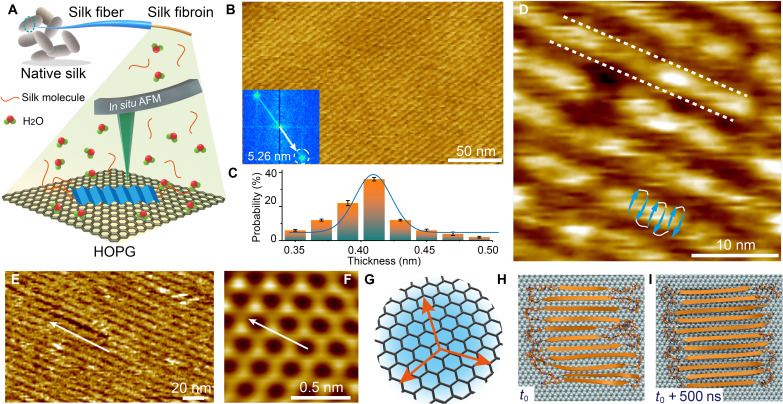
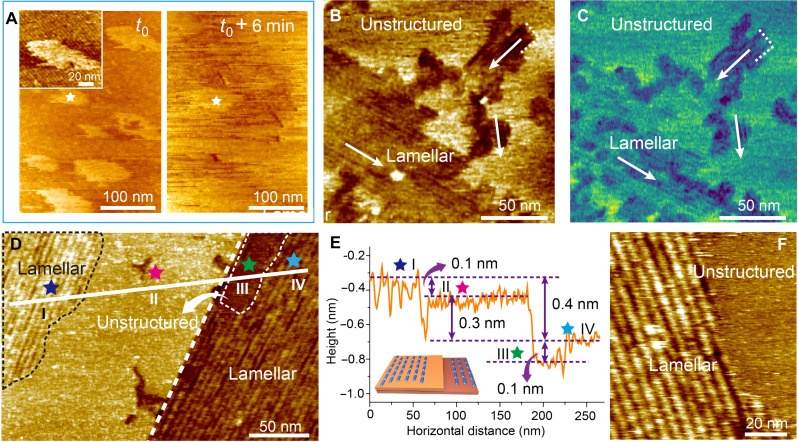
Despite the promise of silk-based devices, the inherent disorder of native silk limits performance. Here, we report highly ordered two-dimensional silk fibroin (SF) films grown epitaxially on van der Waals (vdW) substrates. Using atomic force microscopy, nano-Fourier transform infrared spectroscopy, and molecular dynamics, we show that the films consist of lamellae of SF molecules that exhibit the same secondary structure as the nanocrystallites of native silk. Increasing the SF concentration results in multilayers that grow either by direct assembly of SF molecules into the lamellae or, at high concentrations, along a two-step pathway beginning with a disordered monolayer that then crystallizes. Scanning Kelvin probe measurements show that these films substantially alter the surface potential; thus, they provide a platform for silk-based electronics on vdW solids.
尽管基于丝绸的器件前景广阔,但天然丝绸固有的无序性限制了其性能。在此,我们报道了在范德华(vdW)衬底上外延生长的高度有序的二维丝素蛋白(SF)薄膜。通过原子力显微镜、纳米傅里叶变换红外光谱和分子动力学,我们表明这些薄膜由SF分子薄片组成,这些薄片呈现出与天然丝绸纳米微晶相同的二级结构。增加SF浓度会导致多层结构的形成,多层结构的生长方式要么是SF分子直接组装到薄片中,要么在高浓度下沿着两步途径生长,首先是无序的单层,然后结晶。扫描开尔文探针测量表明,这些薄膜显著改变了表面电位;因此,它们为vdW固体上基于丝绸的电子学提供了一个平台。