Cancer Research UK National Biomarker Centre, University of Manchester, Manchester, UK; Division of Cancer Sciences, University of Manchester, Manchester, UK.
Cancer Research UK National Biomarker Centre, University of Manchester, Manchester, UK.
Cell Rep Med. 2024 Sep 17;5(9):101736. doi: 10.1016/j.xcrm.2024.101736.
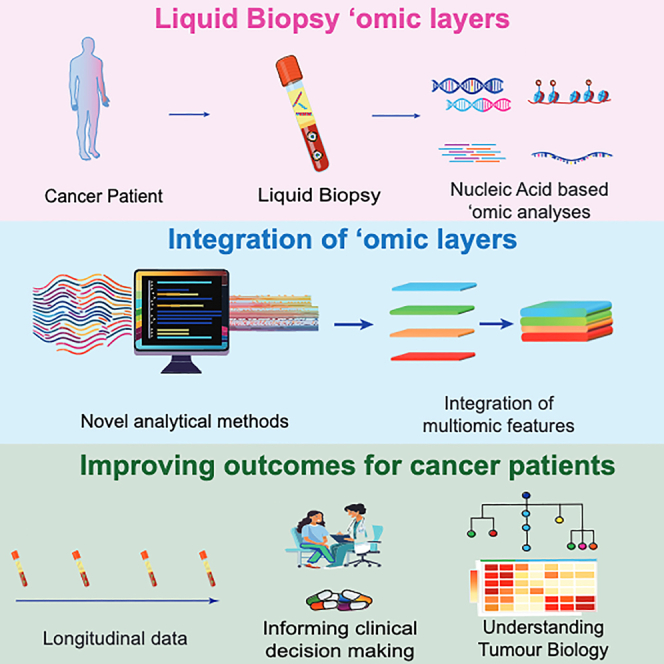
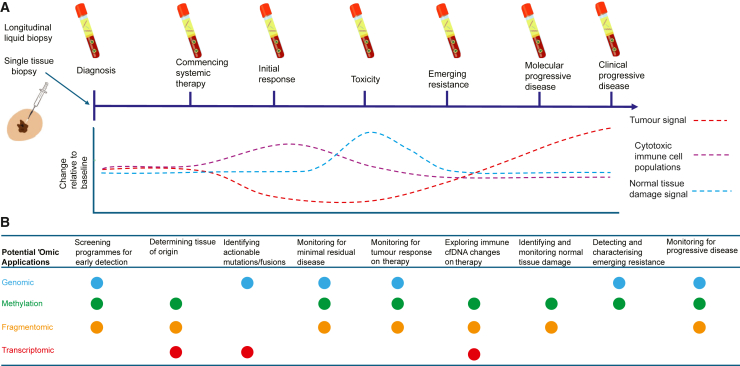
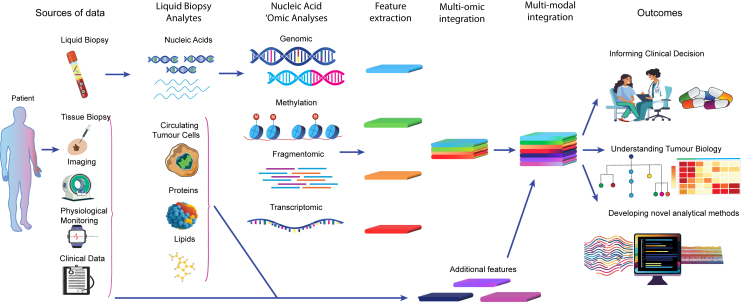
Treatments for cancer patients are becoming increasingly complex, and there is a growing desire from clinicians and patients for biomarkers that can account for this complexity to support informed decisions about clinical care. To achieve precision medicine, the new generation of biomarkers must reflect the spatial and temporal heterogeneity of cancer biology both between patients and within an individual patient. Mining the different layers of 'omics in a multi-modal way from a minimally invasive, easily repeatable, liquid biopsy has increasing potential in a range of clinical applications, and for improving our understanding of treatment response and resistance. Here, we detail the recent developments and methods allowing exploration of genomic, epigenomic, transcriptomic, and fragmentomic layers of 'omics from liquid biopsy, and their integration in a range of applications. We also consider the specific challenges that are posed by the clinical implementation of multi-omic liquid biopsies.
癌症患者的治疗方法变得越来越复杂,临床医生和患者都越来越希望有生物标志物能够解释这种复杂性,从而为临床护理做出明智的决策。为了实现精准医疗,新一代生物标志物必须反映癌症生物学在患者之间和个体患者内部的空间和时间异质性。从微创、易于重复的液体活检中以多模式方式挖掘“组学”的不同层次,在一系列临床应用中具有越来越大的潜力,并有助于提高我们对治疗反应和耐药性的认识。在这里,我们详细介绍了允许从液体活检中探索基因组、表观基因组、转录组和片段组学层的最新发展和方法,以及它们在一系列应用中的整合。我们还考虑了多组学液体活检临床实施所带来的具体挑战。