Department of Neurosurgery, Cleveland Clinic, Cleveland, OH, USA.
Department of Molecular Medicine, Cleveland Clinic, Cleveland, OH, USA.
Sci Rep. 2024 Sep 18;14(1):21771. doi: 10.1038/s41598-024-72249-7.
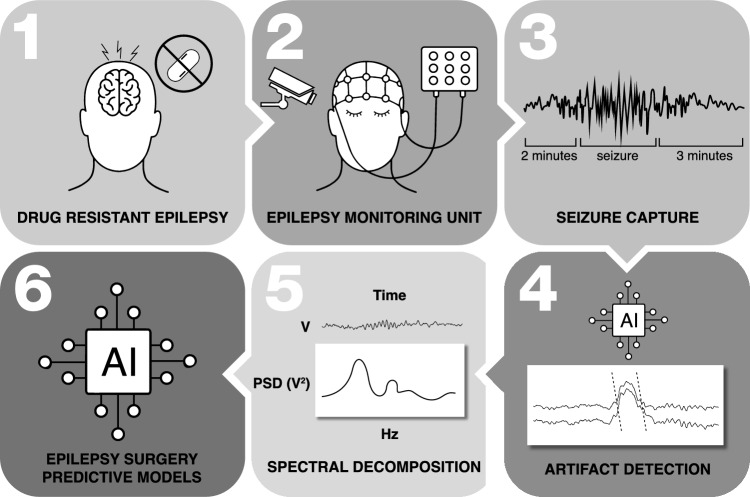
Brain resection is curative for a subset of patients with drug resistant epilepsy but up to half will fail to achieve sustained seizure freedom in the long term. There is a critical need for accurate prediction tools to identify patients likely to have recurrent postoperative seizures. Results from preclinical models and intracranial EEG in humans suggest that the window of time immediately before and after a seizure ("peri-ictal") represents a unique brain state with implications for clinical outcome prediction. Using a dataset of 294 patients who underwent temporal lobe resection for seizures, we show that machine learning classifiers can make accurate predictions of postoperative seizure outcome using 5 min of peri-ictal scalp EEG data that is part of universal presurgical evaluation (AUC 0.98, out-of-group testing accuracy > 90%). This is the first approach to seizure outcome prediction that employs a routine non-invasive preoperative study (scalp EEG) with accuracy range likely to translate into a clinical tool. Decision curve analysis (DCA) shows that compared to the prevalent clinical-variable based nomogram, use of the EEG-augmented approach could decrease the rate of unsuccessful brain resections by 20%.
脑切除术对一部分耐药性癫痫患者具有治愈作用,但多达一半的患者在长期内无法实现持续无癫痫发作。因此,非常需要准确的预测工具来识别可能出现术后复发癫痫的患者。临床前模型和人类颅内脑电图的结果表明,癫痫发作前后的时间窗口(“发作期”)代表了一种独特的大脑状态,对临床结果预测具有重要意义。使用 294 名接受颞叶切除术治疗癫痫的患者的数据集,我们表明,机器学习分类器可以使用作为常规术前评估的一部分的 5 分钟发作期头皮 EEG 数据(AUC 为 0.98,外组测试准确率>90%)对术后癫痫发作结果做出准确预测。这是首次采用具有一定临床转化可能性的常规非侵入性术前研究(头皮 EEG)进行癫痫发作结果预测的方法。决策曲线分析(DCA)表明,与普遍使用的基于临床变量的列线图相比,使用 EEG 增强方法可以将手术无效的比率降低 20%。