Department of Engineering Science, University of Oxford, Oxford, UK.
School of Engineering, University of Manchester, Manchester, UK.
Nature. 2024 Sep;633(8030):601-607. doi: 10.1038/s41586-024-07886-z. Epub 2024 Sep 18.
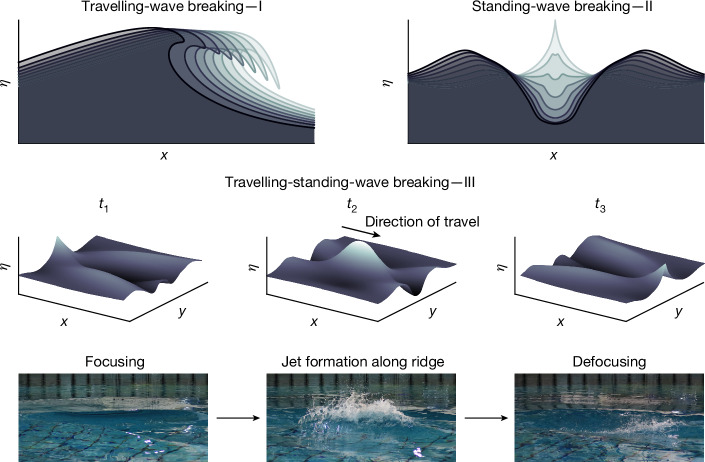
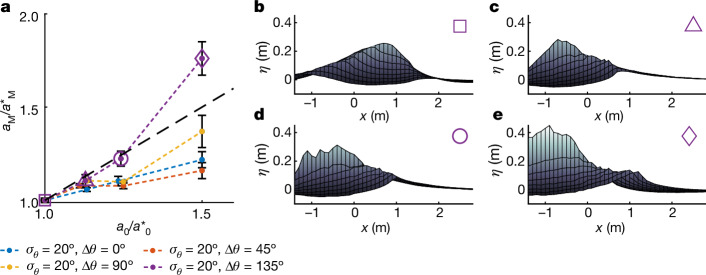
Although a ubiquitous natural phenomenon, the onset and subsequent process of surface wave breaking are not fully understood. Breaking affects how steep waves become and drives air-sea exchanges. Most seminal and state-of-the-art research on breaking is underpinned by the assumption of two-dimensionality, although ocean waves are three dimensional. We present experimental results that assess how three-dimensionality affects breaking, without putting limits on the direction of travel of the waves. We show that the breaking-onset steepness of the most directionally spread case is double that of its unidirectional counterpart. We identify three breaking regimes. As directional spreading increases, horizontally overturning 'travelling-wave breaking' (I), which forms the basis of two-dimensional breaking, is replaced by vertically jetting 'standing-wave breaking' (II). In between, 'travelling-standing-wave breaking' (III) is characterized by the formation of vertical jets along a fast-moving crest. The mechanisms in each regime determine how breaking limits steepness and affects subsequent air-sea exchanges. Unlike in two dimensions, three-dimensional wave-breaking onset does not limit how steep waves may become, and we produce directionally spread waves 80% steeper than at breaking onset and four times steeper than equivalent two-dimensional waves at their breaking onset. Our observations challenge the validity of state-of-the-art methods used to calculate energy dissipation and to design offshore structures in highly directionally spread seas.
尽管波浪破碎是一种普遍存在的自然现象,但人们对其起始和后续过程仍不完全了解。破碎会影响波浪的陡峭程度,并驱动气-液交换。大多数关于波浪破碎的开创性和最先进的研究都是基于二维假设的,尽管海洋波浪是三维的。我们提出了实验结果,评估了三维性如何影响破碎,而不限制波的传播方向。我们表明,最具各向异性的情况下的破碎起始陡峭度是其单向对应物的两倍。我们确定了三个破碎区域。随着方向传播的增加,水平翻转的“行进波破碎”(I)取代了垂直射流的“驻波破碎”(II),后者是二维破碎的基础。在两者之间,“行进-驻波破碎”(III)的特征是沿着快速移动的波峰形成垂直射流。每个区域的机制决定了破碎如何限制陡峭度并影响后续的气-液交换。与二维不同,三维波浪破碎起始并不限制波浪可能变得多么陡峭,我们产生的各向异性传播的波浪比起始破碎时陡峭 80%,比同等二维波浪在起始破碎时陡峭 4 倍。我们的观察结果挑战了用于计算能量耗散和在高度各向异性传播海域中设计海上结构的最先进方法的有效性。