Bring Arvid, Thorslund Josefin, Rosén Lars, Tonderski Karin, Åberg Charlotte, Envall Ida, Laudon Hjalmar
The Swedish Research Council for Environment, Agricultural Sciences and Spatial Planning (Formas), P.O. Box 1206, 111 82, Stockholm, Sweden.
Department of Physical Geography, Stockholm University, 106 91, Stockholm, Sweden.
Environ Evid. 2022 Dec 8;11(1):38. doi: 10.1186/s13750-022-00289-5.
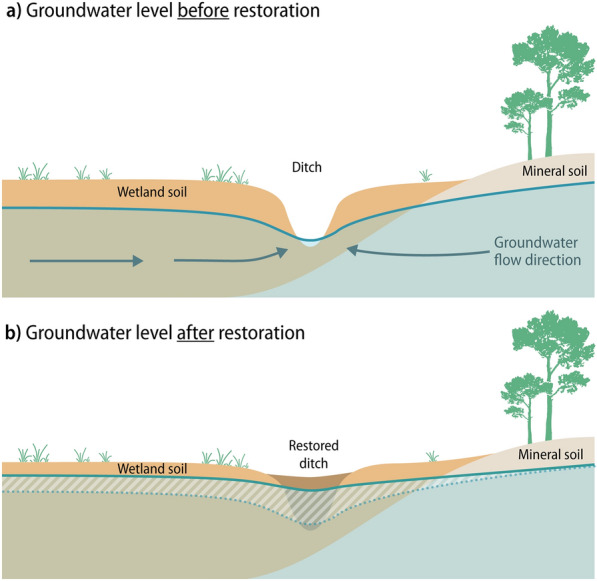
Drainage activities have caused widespread wetland loss, groundwater drawdown and impairment of ecosystem services. There are now several national programs for wetland restoration, primarily focused on reintroducing ecosystem services such as habitats and nutrient retention. In Sweden, recent dry summers have also reinforced interest in hydrological functions such as the potential for enhanced groundwater storage, both in and around the wetland. However, there are several knowledge gaps regarding groundwater storage effects of restoration, including if they extend beyond the wetland and how they vary with local conditions. Therefore, we have systematically reviewed groundwater storage effects from the interventions of restoring, constructing or draining boreo-temperate wetlands. Drainage was included primarily to evaluate to what degree restoration can reverse drainage effects.
We searched 8 databases for scientific journal publications in English, Swedish, Norwegian, Danish, French, German and Polish. Gray literature was searched in English and Swedish. Articles were included based on their relevance for Swedish conditions, i.e., in previously glaciated areas with boreal or temperate climate. Extracted outcome data were groundwater level changes, along with other variables including type of wetland and intervention and, when reported, distance between sampling point and intervention. Meta-analyses were conducted separately for studies that reported groundwater levels at different distances and studies that reported overall effects. Included studies were subject to critical appraisal to evaluate their susceptibility to bias, primarily selection bias, performance bias, and detection bias. Critical appraisal results were used in sensitivity analysis.
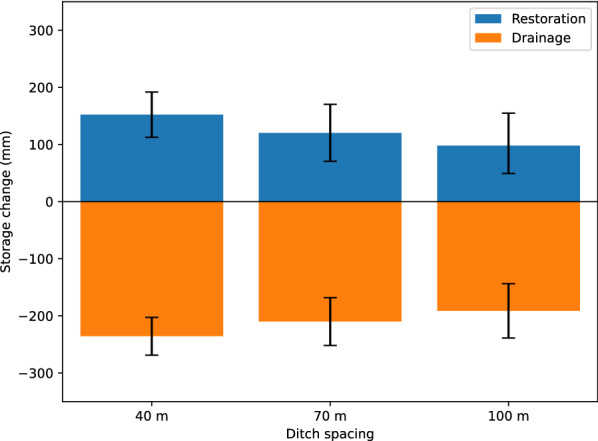
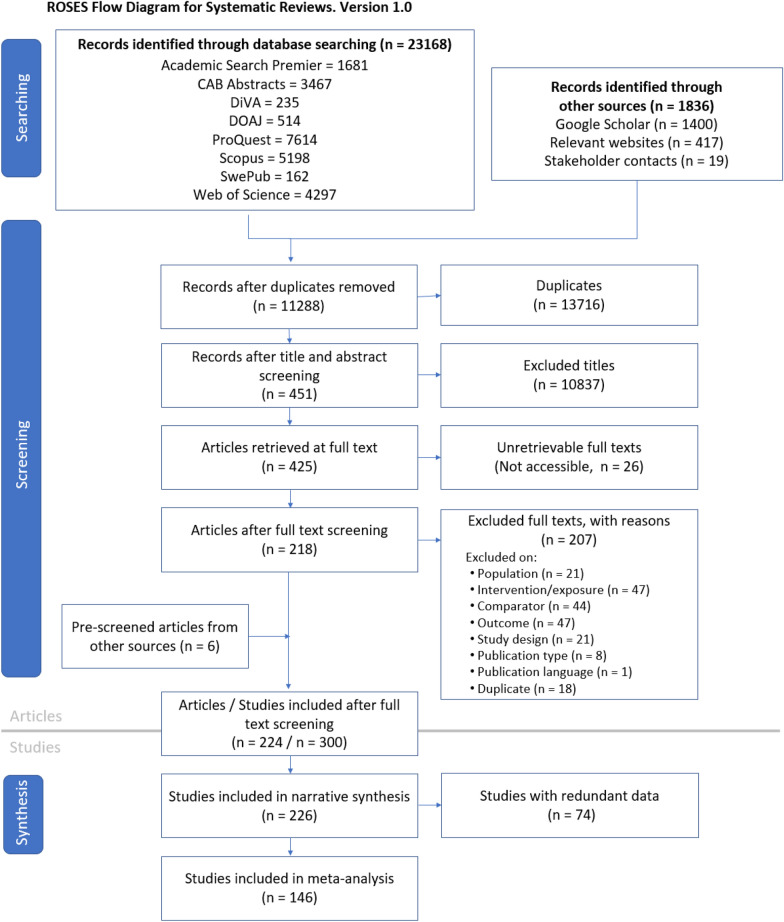
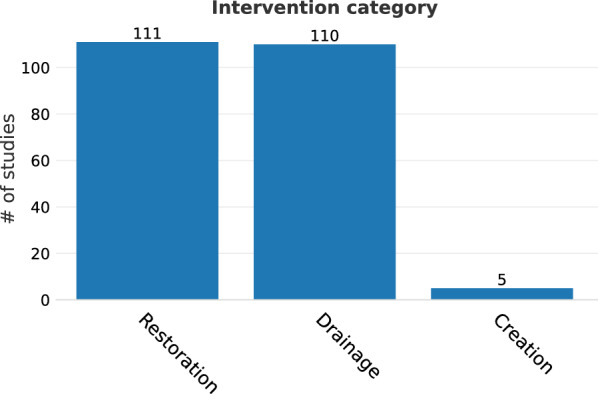
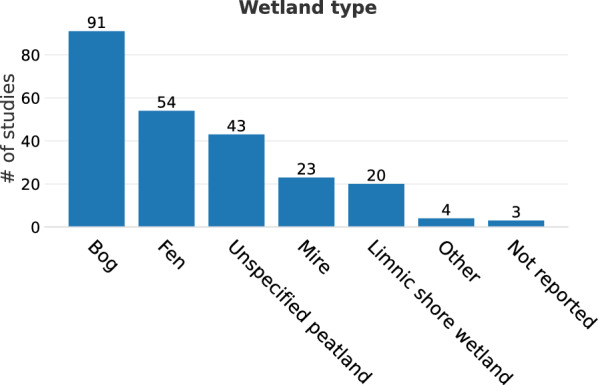
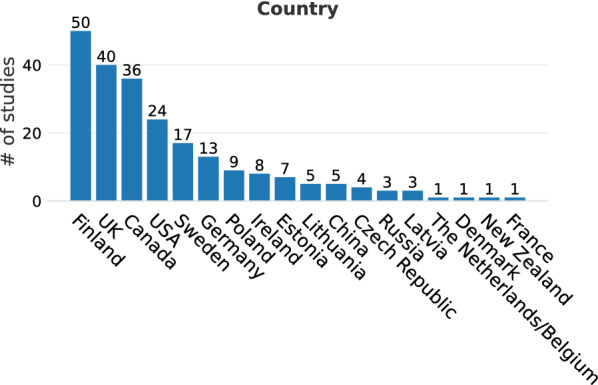
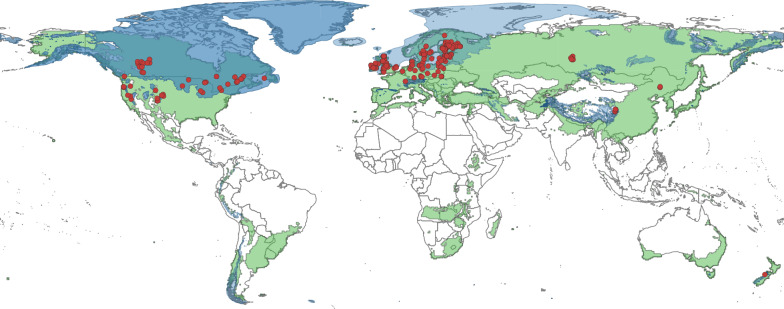
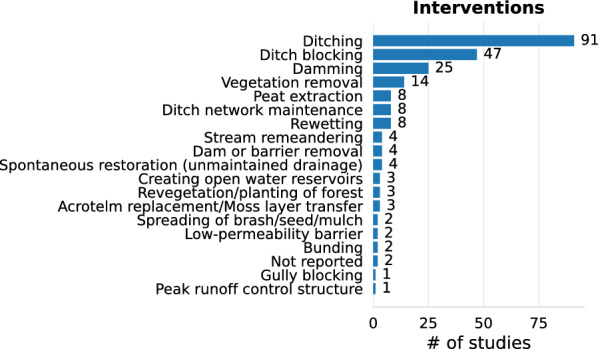
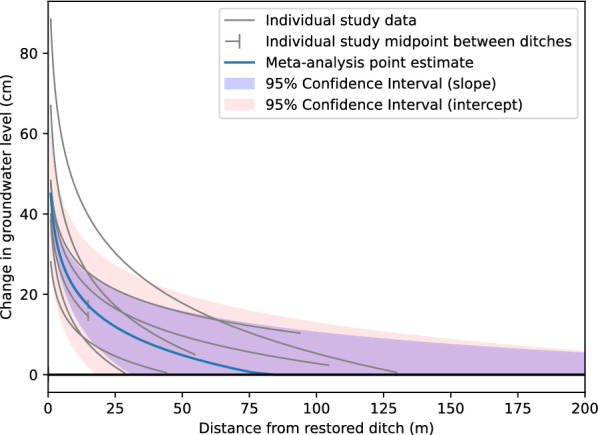
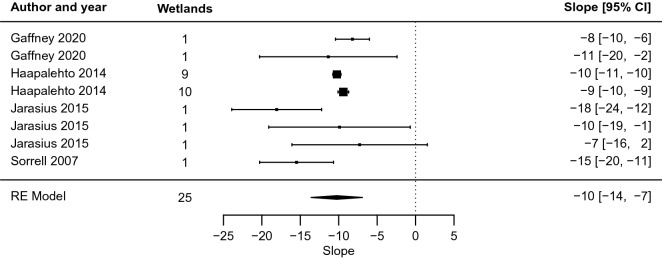
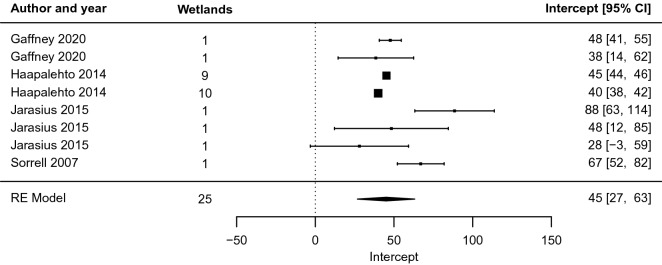
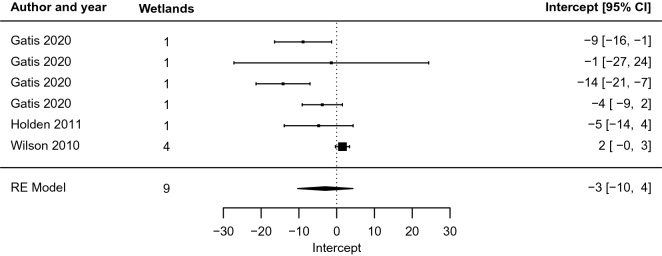
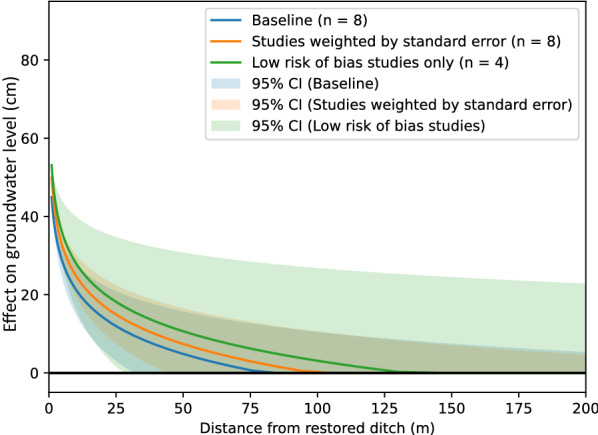
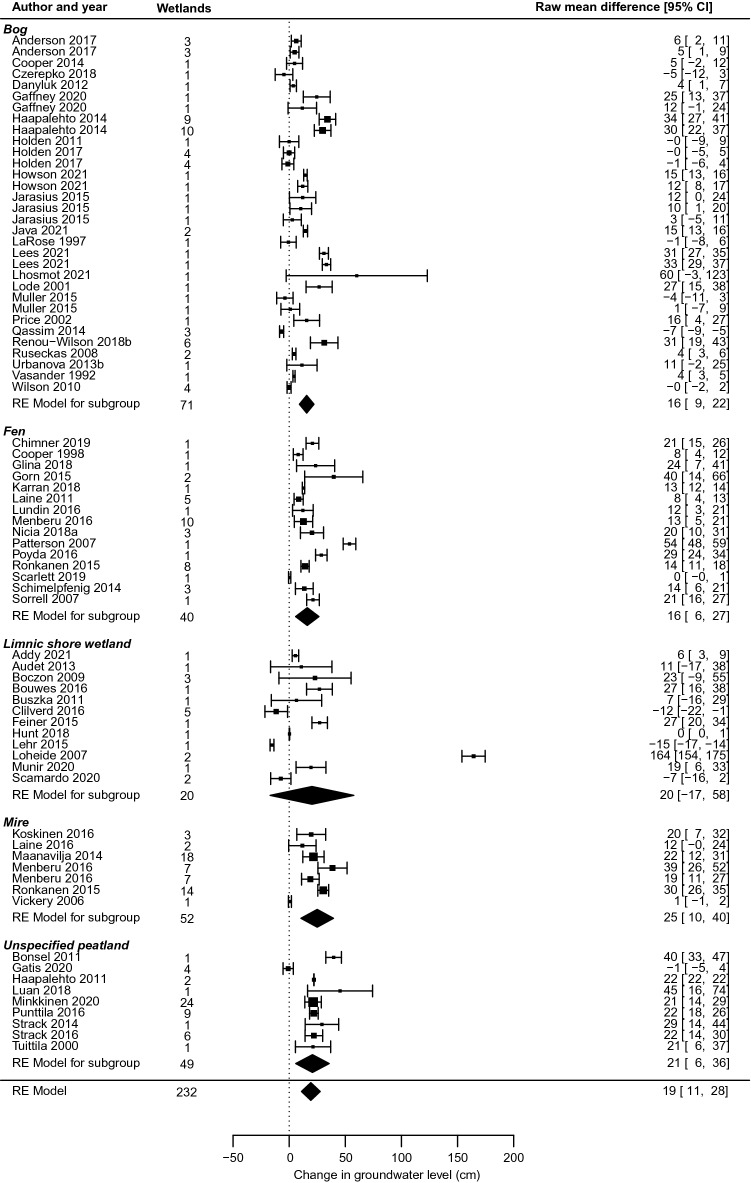
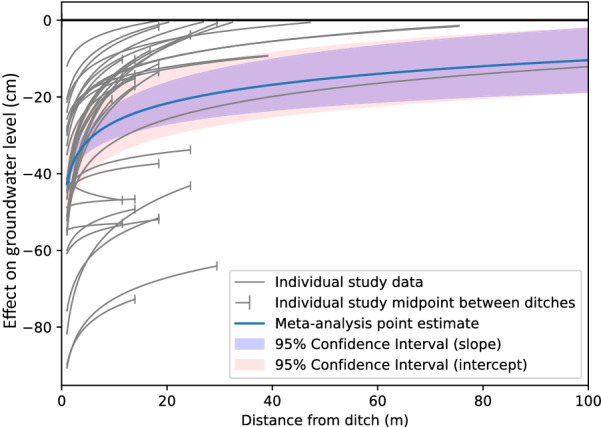
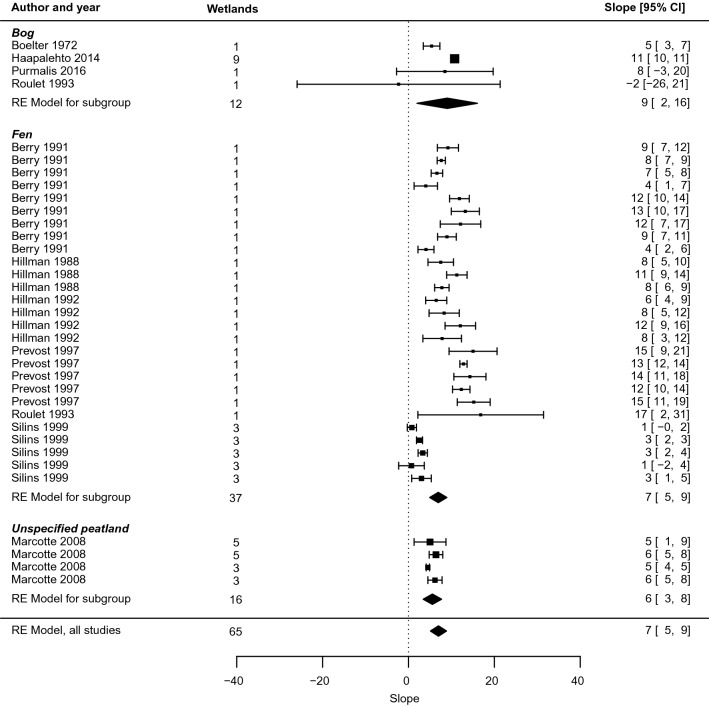
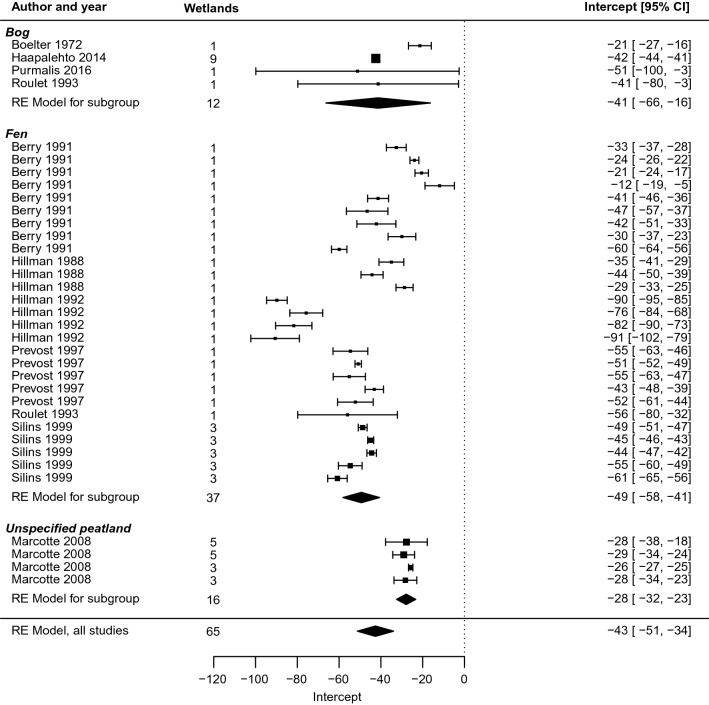
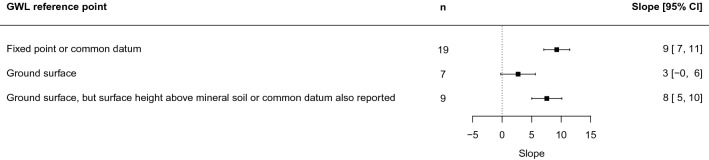
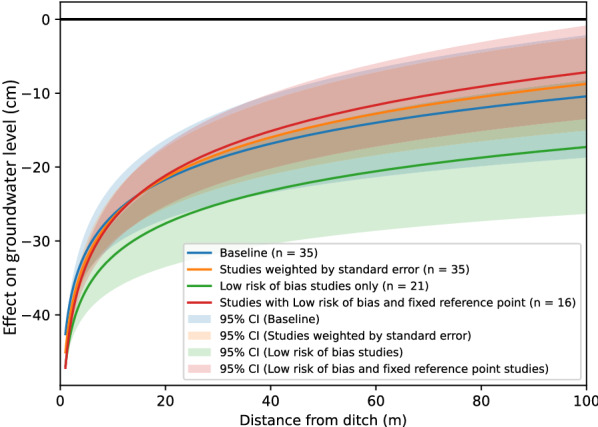
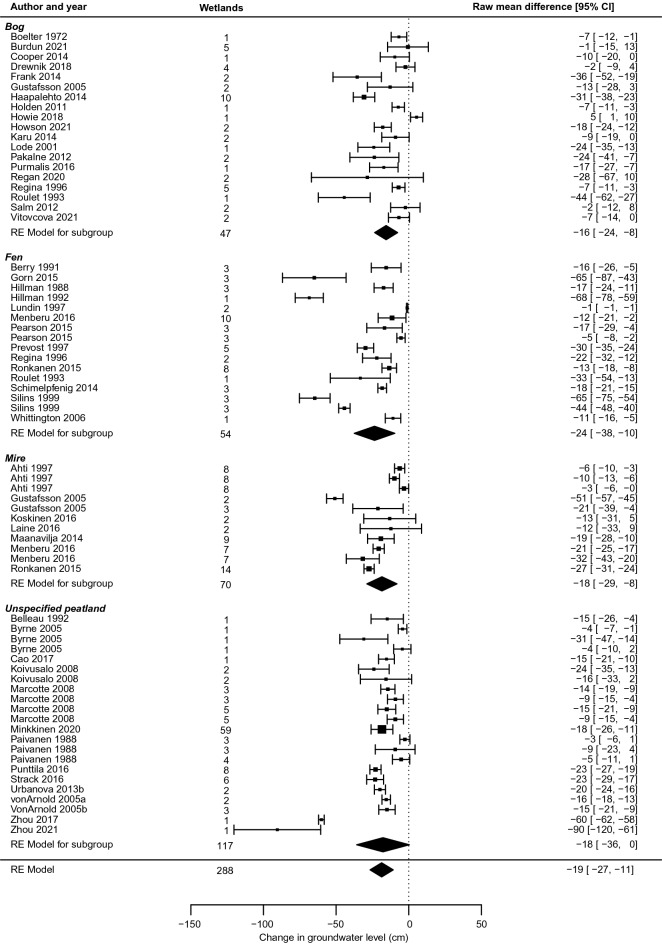
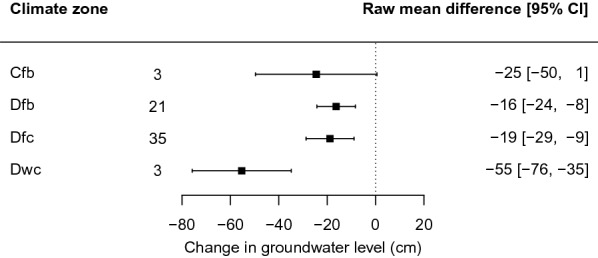
Out of 11,288 screened records, 224 articles fulfilled the criteria, and from these, 146 studies were included in meta-analysis. Most studies (89%) investigated peatlands, primarily from Finland, the UK and Canada. Restoration and drainage studies were equally common. Only nine studies reported measurements beyond the wetland area. Our synthesis is therefore primarily focused on effects within wetlands. In peatland restoration, the observed groundwater level rise decreased exponentially with distance from the restored ditch and was reduced to 50% after 9 [95% confidence interval: 5, 26] m. Drainage reached somewhat farther, with 50% of the groundwater drawdown remaining at 21 [11, 64] m. On average, restoration increased groundwater levels by 22 [16, 28] cm near the intervention, whereas drainage caused a drawdown of 19 [10, 27] cm. Assuming that sampling was unbiased, effects were similar for bogs, fens and mires. Restricting the meta-analysis to the 58% of studies that were of high validity did not alter conclusions.
Effects of peatland restoration and drainage were of similar magnitudes but opposite directions. This indicates that, on average, rewetting of drained peatlands can be expected to restore groundwater levels near the ditch. However, restoration may not reach all the area affected by drainage, and there was a strong dependence on local context. For managers of wetland projects, it is thus important to follow up and monitor restoration effects and reinforce the intervention if necessary. Our results also point to a need for better impact evaluation if increased storage beyond the restored wetland area is desired.
排水活动已导致湿地大面积丧失、地下水位下降以及生态系统服务功能受损。目前有多个国家湿地恢复项目,主要致力于重新引入诸如栖息地和养分保留等生态系统服务功能。在瑞典,近期夏季干旱也增强了人们对水文功能的关注,比如湿地及其周边地区增强地下水储存的潜力。然而,关于恢复对地下水储存的影响存在一些知识空白,包括这种影响是否会延伸至湿地之外以及如何随当地条件而变化。因此,我们系统回顾了恢复、建造或排水北方温带湿地的干预措施对地下水储存的影响。纳入排水主要是为了评估恢复能在多大程度上逆转排水影响。
我们在8个数据库中搜索了英文、瑞典文、挪威文、丹麦文、法文、德文和波兰文的科学期刊出版物。还搜索了英文和瑞典文的灰色文献。根据文章与瑞典情况的相关性纳入文章,即以前有冰川覆盖且具有寒带或温带气候的地区。提取的结果数据是地下水位变化,以及其他变量,包括湿地类型、干预措施,若有报告,还包括采样点与干预措施之间的距离。对报告不同距离处地下水位的研究和报告总体影响的研究分别进行荟萃分析。纳入的研究需经过严格评估,以评估其受偏差影响的可能性,主要是选择偏差、执行偏差和检测偏差。严格评估结果用于敏感性分析。
在筛选的11288条记录中,224篇文章符合标准,其中146项研究纳入荟萃分析。大多数研究(89%)调查的是泥炭地,主要来自芬兰、英国和加拿大。恢复和排水研究同样常见。只有9项研究报告了湿地范围之外的测量数据。因此,我们的综合分析主要聚焦于湿地内部的影响。在泥炭地恢复中,观测到的地下水位上升随与恢复沟渠距离的增加呈指数下降,在9 [95%置信区间:5, 26]米后降至50%。排水影响范围稍远,地下水位下降的50%在21 [11, 64]米处仍存在。平均而言,恢复使干预附近的地下水位上升22 [16, 28]厘米,而排水导致地下水位下降19 [10, 27]厘米。假设采样无偏差,对沼泽、沼泽地和泥潭的影响相似。将荟萃分析限制在有效性高的58%的研究中并未改变结论。
泥炭地恢复和排水的影响大小相似但方向相反。这表明,平均而言,排水泥炭地的再湿润有望恢复沟渠附近的地下水位。然而,恢复可能无法覆盖受排水影响的所有区域,且强烈依赖当地情况。因此,对于湿地项目管理者来说,跟进和监测恢复效果并在必要时加强干预很重要。我们的结果还表明,如果希望在恢复的湿地面积之外增加储存量,需要进行更好的影响评估。