Doncaster C Patrick, Spake Rebecca
Biological Sciences Institute for Life Sciences University of Southampton Southampton UK.
Geography and Environment University of Southampton Southampton UK.
Methods Ecol Evol. 2018 Mar;9(3):634-644. doi: 10.1111/2041-210X.12927. Epub 2017 Nov 21.
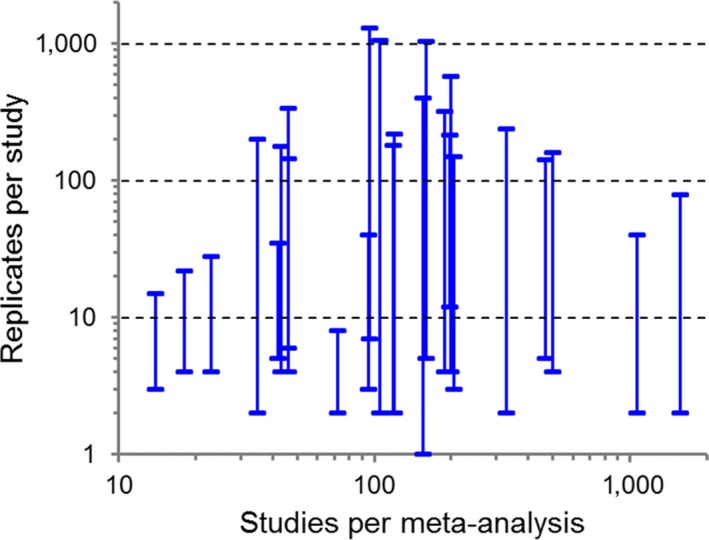
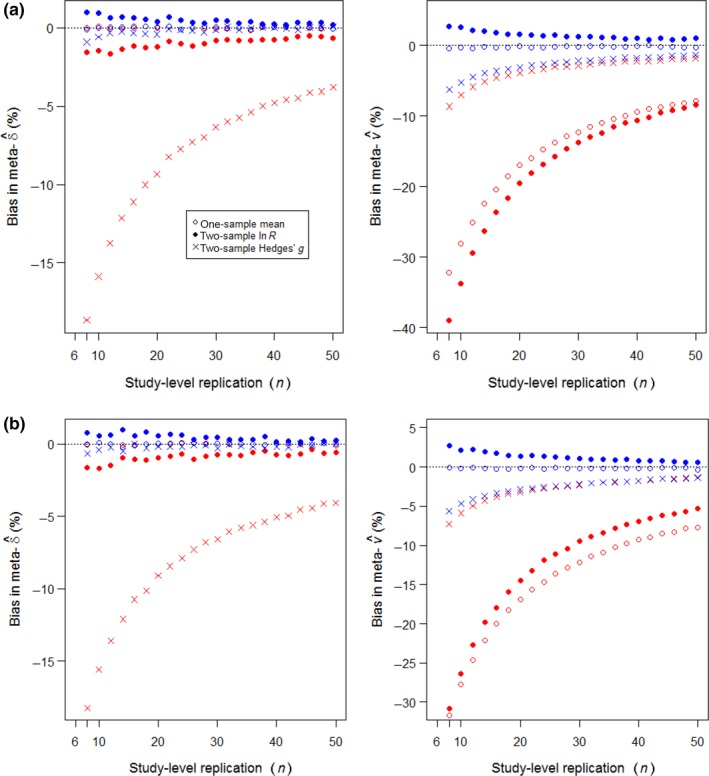
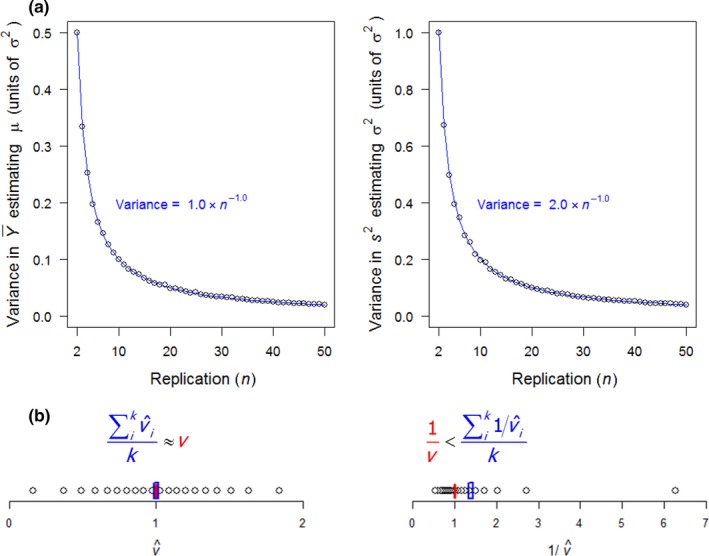
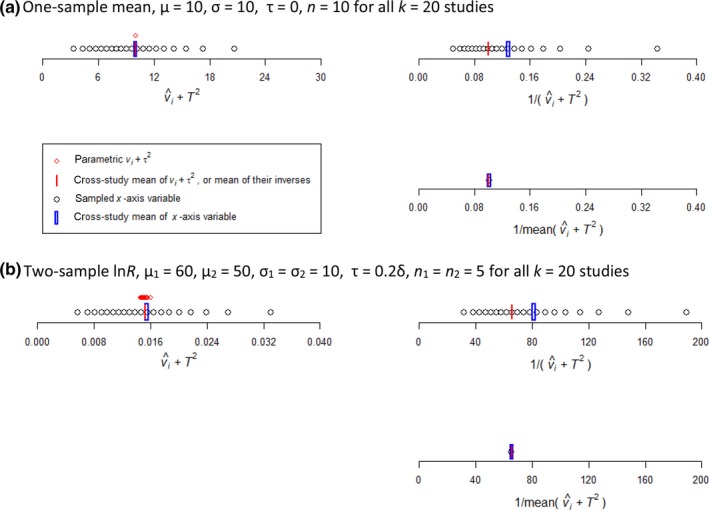
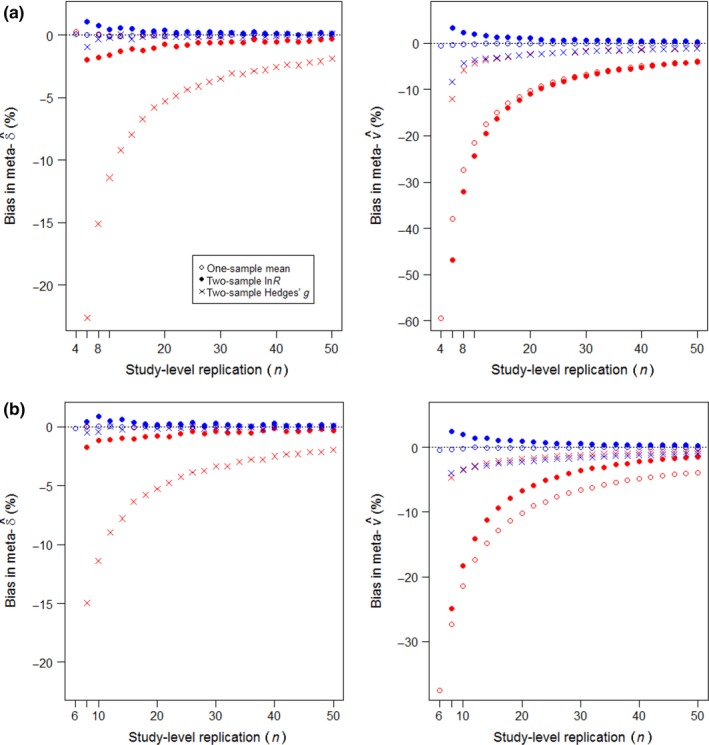
Meta-analyses conventionally weight study estimates on the inverse of their error variance, in order to maximize precision. Unbiased variability in the estimates of these study-level error variances increases with the inverse of study-level replication. Here, we demonstrate how this variability accumulates asymmetrically across studies in precision-weighted meta-analysis, to cause undervaluation of the meta-level effect size or its error variance (the meta-effect and meta-variance).Small samples, typical of the ecological literature, induce big sampling errors in variance estimation, which substantially bias precision-weighted meta-analysis. Simulations revealed that biases differed little between random- and fixed-effects tests. Meta-estimation of a one-sample mean from 20 studies, with sample sizes of 3-20 observations, undervalued the meta-variance by . 20%. Meta-analysis of two-sample designs from 20 studies, with sample sizes of 3-10 observations, undervalued the meta-variance by 15%-20% for the log response ratio (ln); it undervalued the meta-effect by . 10% for the standardized mean difference (SMD).For all estimators, biases were eliminated or reduced by a simple adjustment to the weighting on study precision. The study-specific component of error variance prone to sampling error and not parametrically attributable to study-specific replication was replaced by its cross-study mean, on the assumptions of random sampling from the same population variance for all studies, and sufficient studies for averaging. Weighting each study by the inverse of this mean-adjusted error variance universally improved accuracy in estimation of both the meta-effect and its significance, regardless of number of studies. For comparison, weighting only on sample size gave the same improvement in accuracy, but could not sensibly estimate significance.For the one-sample mean and two-sample ln, adjusted weighting also improved estimation of between-study variance by DerSimonian-Laird and REML methods. For random-effects meta-analysis of SMD from little-replicated studies, the most accurate meta-estimates obtained from adjusted weights following conventionally weighted estimation of between-study variance.We recommend adoption of weighting by inverse adjusted-variance for meta-analyses of well- and little-replicated studies, because it improves accuracy and significance of meta-estimates, and it can extend the scope of the meta-analysis to include some studies without variance estimates.
传统的Meta分析通过对研究估计值按其误差方差的倒数进行加权,以实现精度最大化。这些研究水平误差方差估计中的无偏变异性随着研究水平重复次数的倒数而增加。在此,我们展示了在精度加权Meta分析中,这种变异性如何在各研究间不对称地累积,从而导致对Meta水平效应大小或其误差方差(Meta效应和Meta方差)的低估。
生态文献中常见的小样本,在方差估计中会引发较大的抽样误差,这会严重影响精度加权Meta分析的结果。模拟结果显示,随机效应检验和固定效应检验之间的偏差差异不大。对20项样本量在3至20个观测值之间的单样本均值进行Meta估计时,Meta方差被低估了20%。对20项样本量在3至10个观测值之间的两样本设计进行Meta分析时,对数反应比(ln)的Meta方差被低估了15%至20%;标准化均值差(SMD)的Meta效应被低估了10%。
对于所有估计量,通过对研究精度加权进行简单调整,可以消除或减少偏差。在所有研究均从相同总体方差中随机抽样且有足够数量的研究用于平均的假设下,将易受抽样误差影响且无法参数化归因于研究特异性重复的误差方差的研究特异性成分,替换为其跨研究均值。无论研究数量多少,通过这种均值调整后的误差方差的倒数对每项研究进行加权,普遍提高了Meta效应及其显著性估计的准确性。相比之下,仅按样本量加权在准确性上有相同程度的提高,但无法合理估计显著性。
对于单样本均值和两样本ln,调整后的加权也通过DerSimonian-Laird方法和REML方法改进了研究间方差的估计。对于来自少量重复研究的SMD的随机效应Meta分析,在按常规方法加权估计研究间方差后,通过调整权重可获得最准确的Meta估计值。
我们建议,对于充分重复和少量重复的研究进行Meta分析时,采用调整后方差的倒数进行加权,因为这可以提高Meta估计的准确性和显著性,并能将Meta分析的范围扩展到包括一些没有方差估计的研究。