Hao Guang-Wei, Wu Jia-Qing, Yu Shen-Ji, Liu Kai, Xue Yan, Gong Qian, Xie Rong-Cheng, Ma Guo-Guang, Su Ying, Hou Jun-Yi, Zhang Yi-Jie, Liu Wen-Jun, Li Wei, Tu Guo-Wei, Luo Zhe
Department of Cardiac Intensive Care Center, Zhongshan Hospital, Fudan University, Shanghai, 200032, China.
Department of Nursing, Zhongshan Hospital, Fudan University, Shanghai, 200032, China.
J Intensive Care. 2024 Sep 18;12(1):35. doi: 10.1186/s40560-024-00750-2.
The optimal sedative regime for noninvasive ventilation (NIV) intolerance remains uncertain. The present study aimed to assess the efficacy and safety of remifentanil (REM) compared to dexmedetomidine (DEX) in cardiac surgery patients with moderate-to-severe intolerance to NIV.
In this multicenter, prospective, single-blind, randomized controlled study, adult cardiac surgery patients with moderate-to-severe intolerance to NIV were enrolled and randomly assigned to be treated with either REM or DEX for sedation. The status of NIV intolerance was evaluated using a four-point NIV intolerance score at different timepoints within a 72-h period. The primary outcome was the mitigation rate of NIV intolerance following sedation.
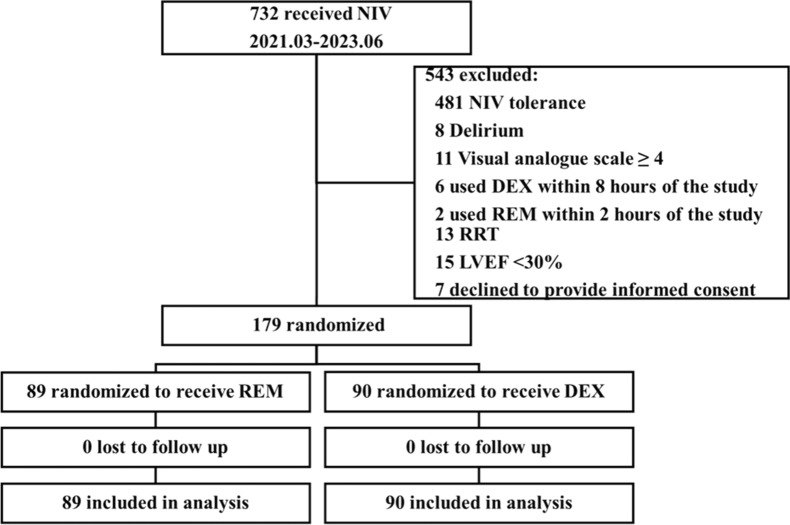
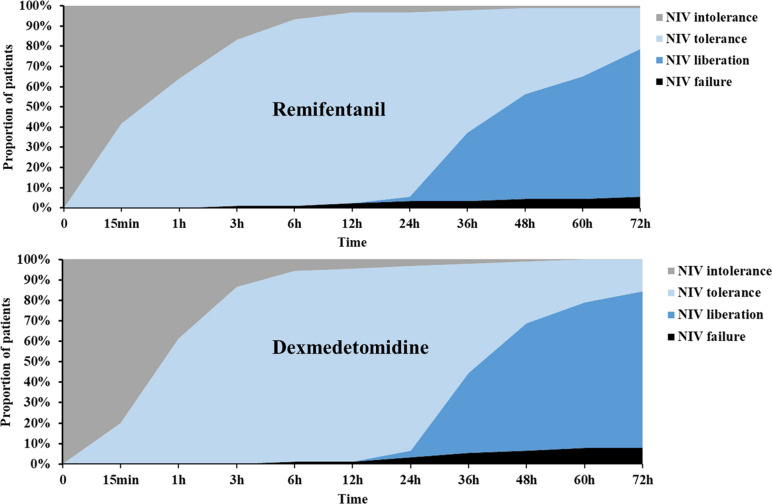
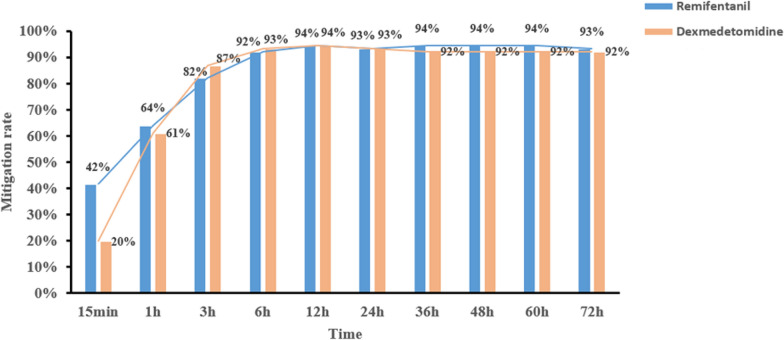
A total of 179 patients were enrolled, with 89 assigned to the REM group and 90 to the DEX group. Baseline characteristics were comparable between the two groups, including NIV intolerance score [3, interquartile range (IQR) 3-3 vs. 3, IQR 3-4, p = 0.180]. The chi-squared test showed that mitigation rate, defined as the proportion of patients who were relieved from their initial intolerance status, was not significant at most timepoints, except for the 15-min timepoint (42% vs. 20%, p = 0.002). However, after considering the time factor, generalized estimating equations showed that the difference was statistically significant, and REM outperformed DEX (odds ratio = 3.31, 95% confidence interval: 1.35-8.12, p = 0.009). Adverse effects, which were not reported in the REM group, were encountered by nine patients in the DEX group, with three instances of bradycardia and six cases of severe hypotension. Secondary outcomes, including NIV failure (5.6% vs. 7.8%, p = 0.564), tracheostomy (1.12% vs. 0%, p = 0.313), ICU LOS (7.7 days, IQR 5.8-12 days vs. 7.0 days, IQR 5-10.6 days, p = 0.219), and in-hospital mortality (1.12% vs. 2.22%, p = 0.567), demonstrated comparability between the two groups.
In summary, our study demonstrated no significant difference between REM and DEX in the percentage of patients who achieved mitigation among cardiac surgery patients with moderate-to-severe NIV intolerance. However, after considering the time factor, REM was significantly superior to DEX. Trial registration ClinicalTrials.gov (NCT04734418), registered on January 22, 2021. URL of the trial registry record: https://register.
gov/prs/app/action/SelectProtocol?sid=S000AM4S&selectaction=Edit&uid=U00038YX&ts=3&cx=eqn1z0 .
无创通气(NIV)不耐受的最佳镇静方案仍不确定。本研究旨在评估瑞芬太尼(REM)与右美托咪定(DEX)相比,在中度至重度NIV不耐受的心脏手术患者中的疗效和安全性。
在这项多中心、前瞻性、单盲、随机对照研究中,纳入了对NIV中度至重度不耐受的成年心脏手术患者,并随机分配接受REM或DEX镇静治疗。在72小时内的不同时间点,使用四点NIV不耐受评分评估NIV不耐受状态。主要结局是镇静后NIV不耐受的缓解率。
共纳入179例患者,89例分配至REM组,90例分配至DEX组。两组的基线特征具有可比性,包括NIV不耐受评分[3,四分位间距(IQR)3 - 3 vs. 3,IQR 3 - 4,p = 0.180]。卡方检验显示,缓解率(定义为从初始不耐受状态中缓解的患者比例)在大多数时间点无显著差异,但在15分钟时间点除外(42% vs. 20%,p = 0.002)。然而,在考虑时间因素后,广义估计方程显示差异具有统计学意义,REM优于DEX(优势比 = 3.31,95%置信区间:1.35 - 8.12,p = 0.009)。REM组未报告不良反应,DEX组有9例患者出现不良反应,包括3例心动过缓和6例严重低血压。次要结局,包括NIV失败(5.6% vs. 7.8%,p = 0.564)、气管切开(1.12% vs. 0%,p = 0.313)、ICU住院时间(7.7天,IQR 5.8 - 12天 vs. 7.0天,IQR 5 - 10.6天,p = 0.219)和院内死亡率(1.12% vs. 2.22%,p = 0.567),两组之间具有可比性。
总之,我们的研究表明,在中度至重度NIV不耐受的心脏手术患者中,REM和DEX在实现缓解的患者百分比方面无显著差异。然而,在考虑时间因素后,REM显著优于DEX。试验注册ClinicalTrials.gov(NCT04734418),于2021年1月22日注册。试验注册记录的网址:https://register.CLINICALTRIALS.gov/prs/app/action/SelectProtocol?sid=S000AM4S&selectaction=Edit&uid=U00038YX&ts=3&cx=eqn1z0 。