Tago Tatsuya, Yamada Yumi, Goto Yumi, Toyooka Kiminori, Ochi Yuka, Satoh Takunori, Satoh Akiko K
Program of Life and environmental Science, Graduate School of Integral Science for Life, Hiroshima University, Hiroshima, Japan.
Technology Platform Division, Mass Spectrometry and Microscopy Unit, RIKEN Center for Sustainable Resource Science, Yokohama, Japan.
Front Cell Dev Biol. 2024 Sep 4;12:1442198. doi: 10.3389/fcell.2024.1442198. eCollection 2024.
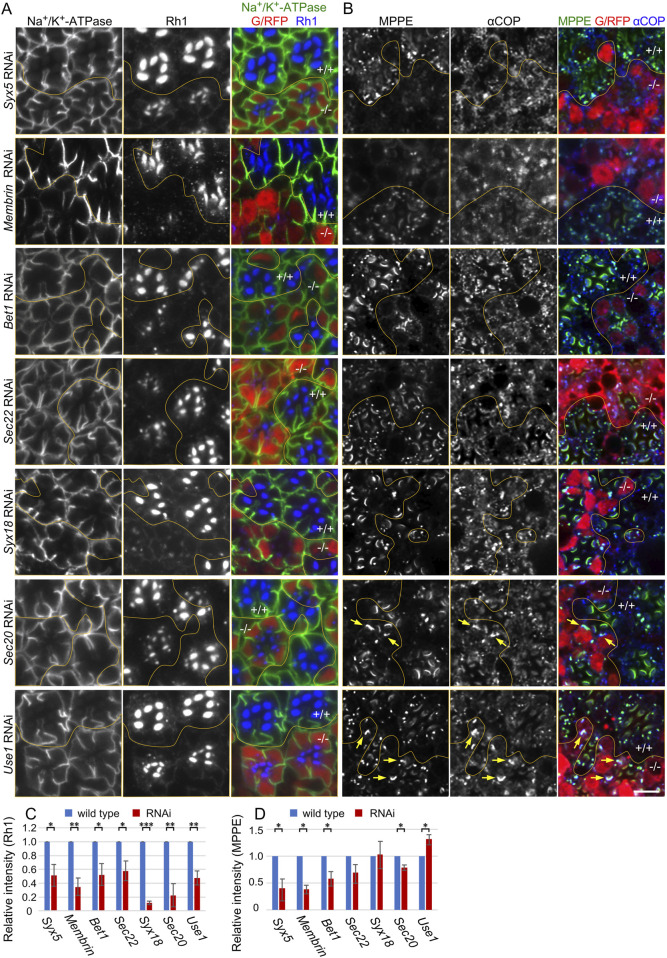
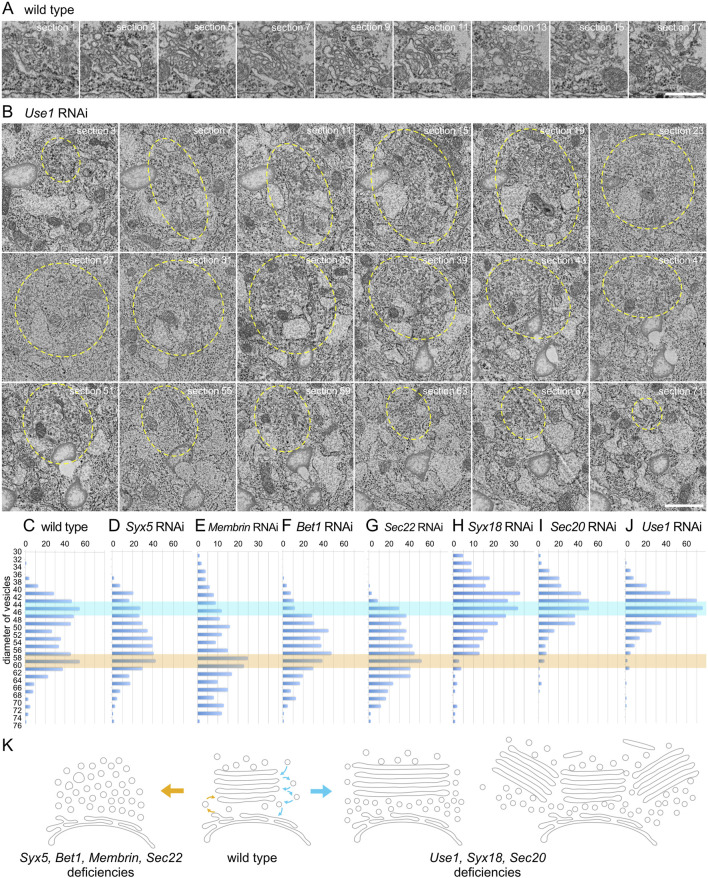
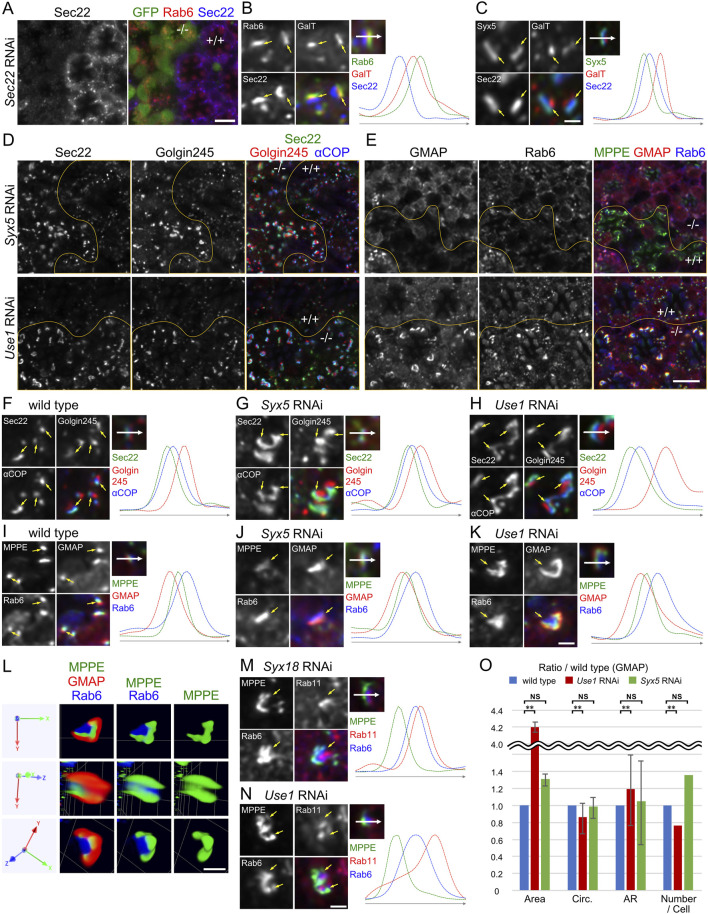
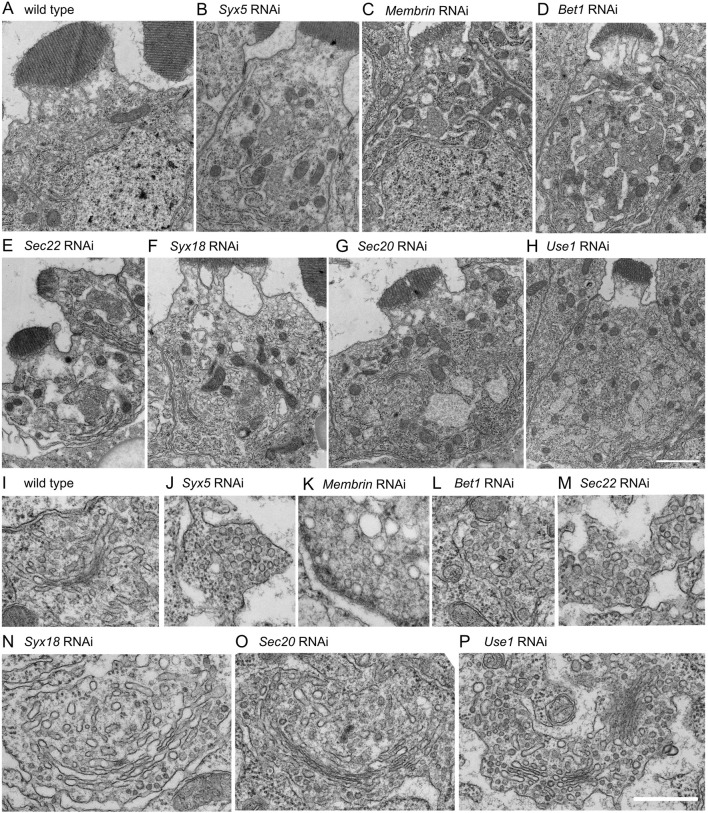
A comprehensive study of soluble -ethylmaleimide-sensitive factor attachment protein receptors (SNAREs) in the fly genome by RNAi in photoreceptors indicated that knockdown of any of the COPI-SNAREs, , , and , resulted in the same characteristic phenotypes: Golgi stacks gathering on their -side, laterally expanded Golgi cisternae, and a reduced number of discrete Golgi stacks. These Golgi stacks are reminiscent of mammalian Golgi ribbons and Brefeldin A (BFA)-bodies in S2 cells. As previously reported, BFA suppresses -Golgi network (TGN) fission and Golgi stack separation to form a BFA-body, which is a cluster of Golgi stacks cored by recycling endosomes. We found that the impairing each of COPI-SNAREs results in clustered Golgi stacks similar to BFA-bodies, indicating that COPI-SNAREs have a role to separate clustered Golgi stacks. These results further support the idea that the movement of Golgi stacks and the balance of fusion and fission of the TGN determine the level of clustering and ribbon formation of Golgi stacks within cells.
通过在光感受器中利用RNA干扰对果蝇基因组中的可溶性N - 乙基马来酰亚胺敏感因子附着蛋白受体(SNAREs)进行的一项全面研究表明,敲低任何一种COPI - SNAREs,即 、 、 和 ,都会导致相同的特征性表型:高尔基体堆叠在其 侧聚集、高尔基体潴泡横向扩张以及离散高尔基体堆叠数量减少。这些高尔基体堆叠让人联想到哺乳动物的高尔基体带以及S2细胞中的布雷菲德菌素A(BFA)小体。如先前报道,BFA抑制反式高尔基体网络(TGN)分裂和高尔基体堆叠分离以形成BFA小体,BFA小体是由循环内体作为核心的高尔基体堆叠簇。我们发现,对每种COPI - SNAREs的破坏都会导致类似于BFA小体的高尔基体堆叠聚集,这表明COPI - SNAREs在分离聚集的高尔基体堆叠中发挥作用。这些结果进一步支持了这样一种观点,即高尔基体堆叠的移动以及TGN融合与分裂的平衡决定了细胞内高尔基体堆叠的聚集程度和带形成水平。