
用于不可切除肝细胞癌个性化动脉内治疗规划的深度学习模型:一项多中心回顾性研究
A deep learning model for personalized intra-arterial therapy planning in unresectable hepatocellular carcinoma: a multicenter retrospective study.
作者信息
Lin Xiaoqi, Wei Ran, Xu Ziming, Zhuo Shuiqing, Dou Jiaqi, Sun Haozhong, Li Rui, Yang Runyu, Lu Qian, An Chao, Chen Huijun
机构信息
School of Biomedical Engineering, Center for Biomedical Imaging Research, Tsinghua University, Beijing, 100019, China.
Department of Gastrointestinal Surgery, The First Affiliated Hospital, Sun Yat-sen University, Guangzhou, Guangdong, 510080, China.
出版信息
EClinicalMedicine. 2024 Sep 5;75:102808. doi: 10.1016/j.eclinm.2024.102808. eCollection 2024 Sep.
BACKGROUND
Unresectable Hepatocellular Carcinoma (uHCC) poses a substantial global health challenge, demanding innovative prognostic and therapeutic planning tools for improved patient management. The predominant treatment strategies include Transarterial chemoembolization (TACE) and hepatic arterial infusion chemotherapy (HAIC).
METHODS
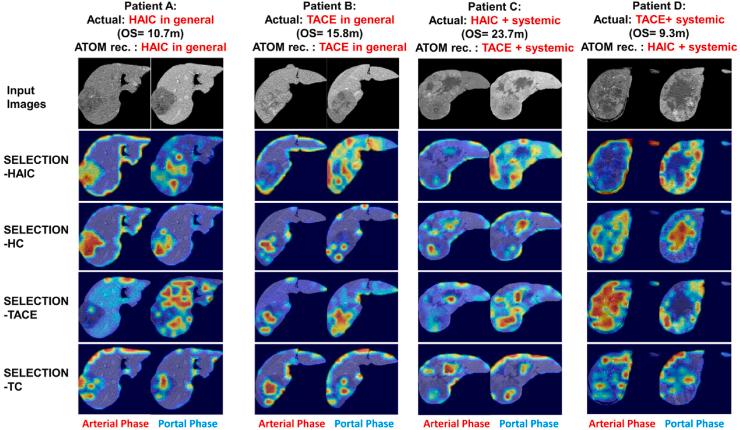
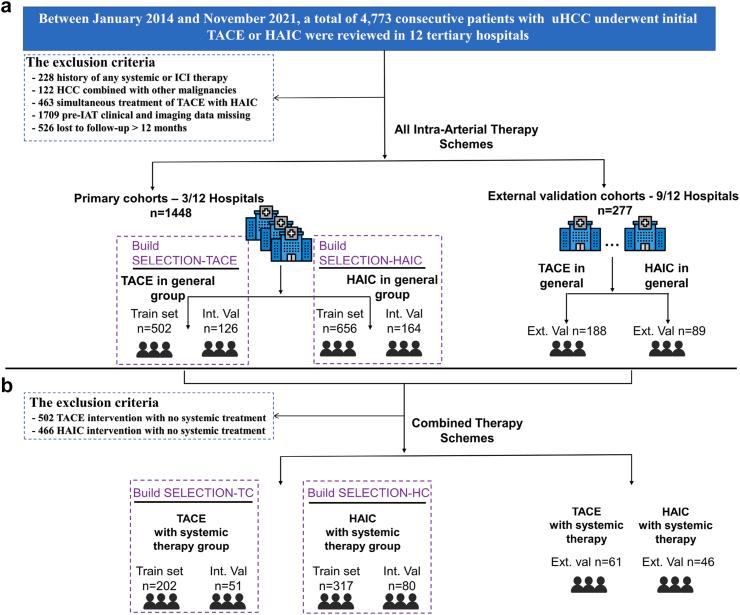
Between January 2014 and November 2021, a total of 1725 uHCC patients [mean age, 52.8 ± 11.5 years; 1529 males] received preoperative CECT scans and were eligible for TACE or HAIC. Patients were assigned to one of the four cohorts according to their treatment, four transformer models (SELECTION) were trained and validated on each cohort; AUC was used to determine the prognostic performance of the trained models. Patients were stratified into high and low-risk groups based on the survival scores computed by SELECTION. The proposed AI-based treatment decision model (ATOM) utilizes survival scores to further inform final therapeutic recommendation.
FINDINGS
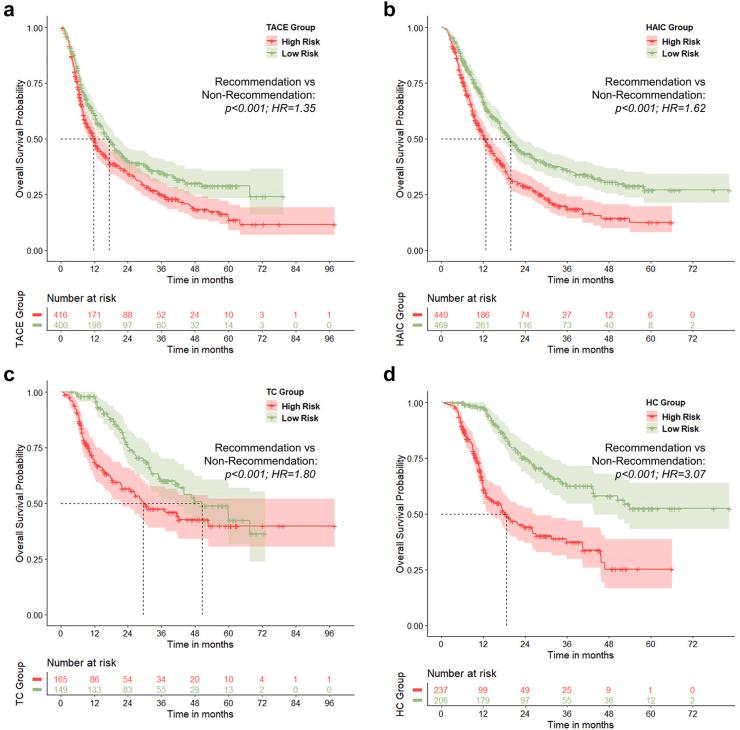
In this study, the training and validation sets included 1448 patients, with an additional 277 patients allocated to the external validation sets. The SELECTION model outperformed both clinical models and the ResNet approach in terms of AUC. Specifically, SELECTION-TACE and SELECTION-HAIC achieved AUCs of 0.761 (95% CI, 0.693-0.820) and 0.805 (95% CI, 0.707-0.881) respectively, in predicting ORR in their external validation cohorts. In predicting OS, SELECTION-TC and SELECTION-HC demonstrated AUCs of 0.736 (95% CI, 0.608-0.841) and 0.748 (95% CI, 0.599-0.865) respectively, in their external validation sets. SELECTION-derived survival scores effectively stratified patients into high and low-risk groups, showing significant differences in survival probabilities (P < 0.05 across all four cohorts). Additionally, the concordance between ATOM and clinician recommendations was associated with significantly higher response/survival rates in cases of agreement, particularly within the TACE, HAIC, and TC cohorts in the external validation sets (P < 0.05).
INTERPRETATION
ATOM was proposed based on SELECTION-derived survival scores, emerges as a promising tool to inform the selection among different intra-arterial interventional therapy techniques.
FUNDING
This study received funding from the Beijing Municipal Natural Science Foundation, China (Z190024); the Key Program of the National Natural Science Foundation of China, China (81930119); The Science and Technology Planning Program of Beijing Municipal Science & Technology Commission and Administrative Commission of Zhongguancun Science Park, China (Z231100004823012); Tsinghua University Initiative Scientific Research Program of Precision Medicine, China (10001020108); and Institute for Intelligent Healthcare, Tsinghua University, China (041531001).
背景
不可切除肝细胞癌(uHCC)对全球健康构成重大挑战,需要创新的预后和治疗规划工具以改善患者管理。主要治疗策略包括经动脉化疗栓塞术(TACE)和肝动脉灌注化疗(HAIC)。
方法
在2014年1月至2021年11月期间,共有1725例uHCC患者[平均年龄52.8±11.5岁;1529例男性]接受了术前CT增强扫描,且符合TACE或HAIC治疗条件。根据治疗方式将患者分为四个队列之一,在每个队列上训练并验证了四种变压器模型(SELECTION);使用AUC来确定训练模型的预后性能。根据SELECTION计算的生存分数将患者分为高风险和低风险组。所提出的基于人工智能的治疗决策模型(ATOM)利用生存分数进一步提供最终治疗建议。
结果
在本研究中,训练集和验证集包括1448例患者,另有277例患者分配到外部验证集。SELECTION模型在AUC方面优于临床模型和ResNet方法。具体而言,SELECTION - TACE和SELECTION - HAIC在预测其外部验证队列的客观缓解率(ORR)时,AUC分别为0.761(95%CI,0.693 - 0.820)和0.805(95%CI,0.707 - 0.881)。在预测总生存期(OS)时,SELECTION - TC和SELECTION - HC在其外部验证集中的AUC分别为0.736(95%CI,0.608 - 0.841)和0.748(95%CI,0.599 - 0.865)。SELECTION得出的生存分数有效地将患者分为高风险和低风险组,在所有四个队列中生存概率显示出显著差异(P < 0.05)。此外,在一致性情况下,ATOM与临床医生建议之间的一致性与显著更高的缓解/生存率相关,特别是在外部验证集的TACE、HAIC和TC队列中(P < 0.05)。
解读
基于SELECTION得出的生存分数提出的ATOM,成为一种有前景的工具,可为不同动脉内介入治疗技术的选择提供依据。
资助
本研究获得了中国北京市自然科学基金(Z190024)、中国国家自然科学基金重点项目(81930119)、中国北京市科学技术委员会和中关村科学园管理委员会科学技术计划项目(Z231100004823012)、中国清华大学精准医学倡议科研项目(10001020108)以及中国清华大学智能医疗健康研究院(041531001)的资助。


 Zotero 插件