Demidov Lev, Kharkevich Galina, Petenko Natalia, Moiseenko Vladimir, Protsenko Svetlana, Semiglazova Tatiana, Zimina Anastasia, Kovalenko Nadezhda, Fadeeva Natalia, Kirtbaya Dmitry, Belogortsev Igor, Tantsyrev Denis, Odintsova Svetlana, Nesterova Alfia, Vorontsova Karina, Makarycheva Yulia, Linkova Yulia, Zinkina-Orikhan Arina, Siliutina Anna, Sorokina Irina, Liaptseva Daria, Chistyakov Vladimir, Lutsky Anton
FSBI "N.N. Blokhin National Medical Research Center of Oncology", Ministry of Health (MoH) of the Russian Federation, Moscow, Russia.
State Budgetary Healthcare Institution (SBHI) "St. Petersburg Clinical Scientific and Practical Center for Specialized Types of Medical Care (Oncology)", Saint Petersburg, Russia.
Front Oncol. 2024 Sep 4;14:1385685. doi: 10.3389/fonc.2024.1385685. eCollection 2024.
Prolgolimab is the first Russian PD-1 inhibitor approved for the first-line treatment of unresectable or metastatic melanoma and advanced non-small cell lung cancer. It was approved in two weight-based regimens of 1 mg/kg Q2W and 3 mg/kg Q3W, but because of re-evaluation of weight-based dosing paradigm, studying of a fixed-dose regimen was considered perspective.
We conducted a multicenter, single-arm, open-label efficacy, pharmacokinetics, and safety study to obtain data that would allow the approval of the new flat dosing regimen of prolgolimab in patients with previously untreated unresectable or metastatic melanoma (BCD-100-8/FLAT, NCT05783882). The primary objective was to prove the non-inferiority of prolgolimab 250 mg Q3W versus prolgolimab 1 mg/kg Q2W for the treatment of patients with unresectable or metastatic melanoma in terms of ORR according to RECIST 1.1. Patients from the MIRACULUM study (BCD-100-2/MIRACULUM, NCT03269565) comprised a historical control group.
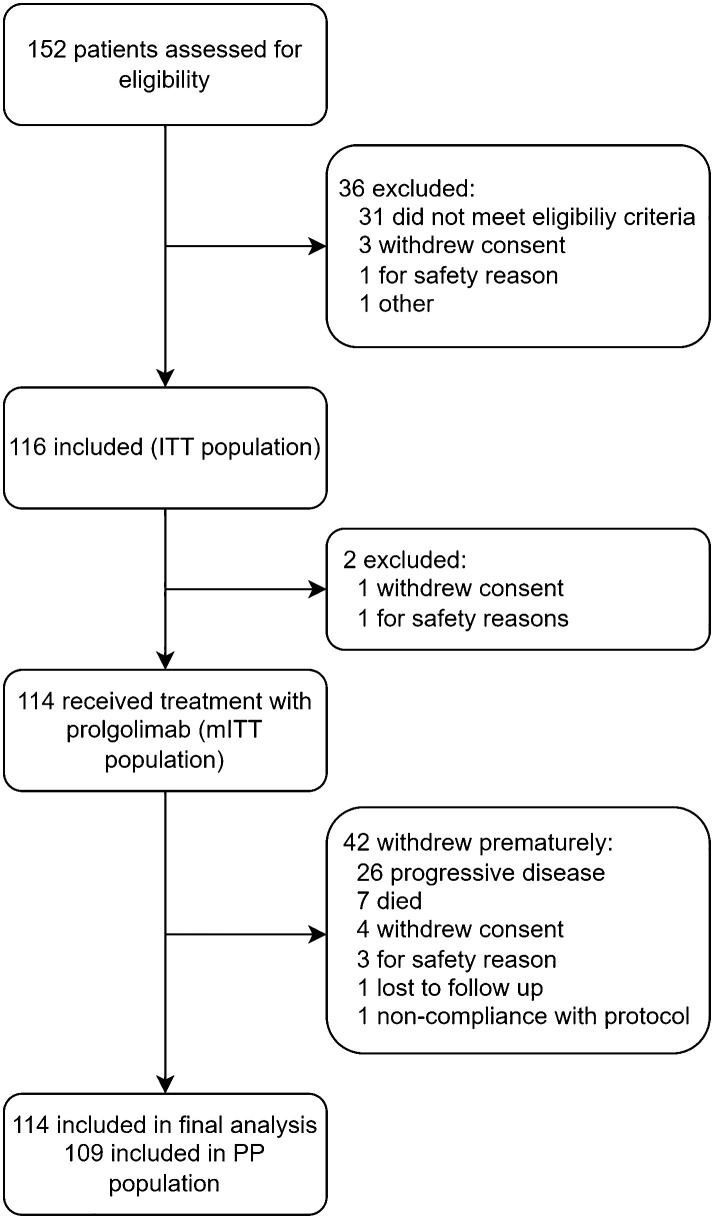
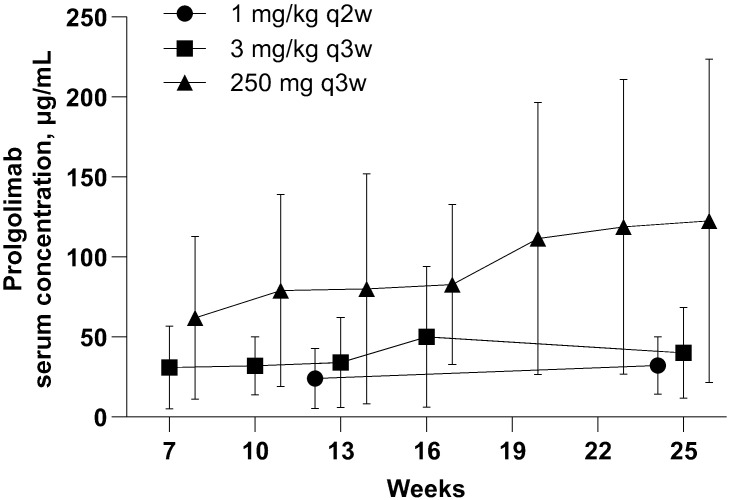
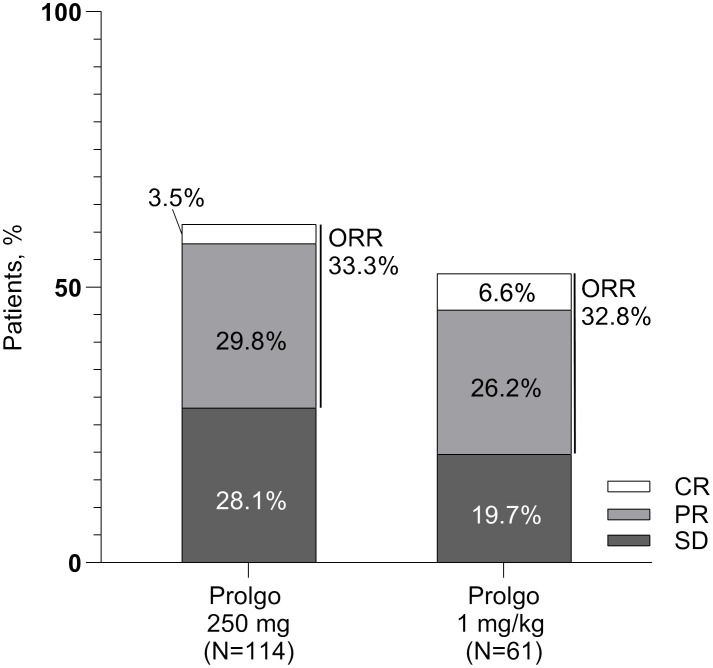
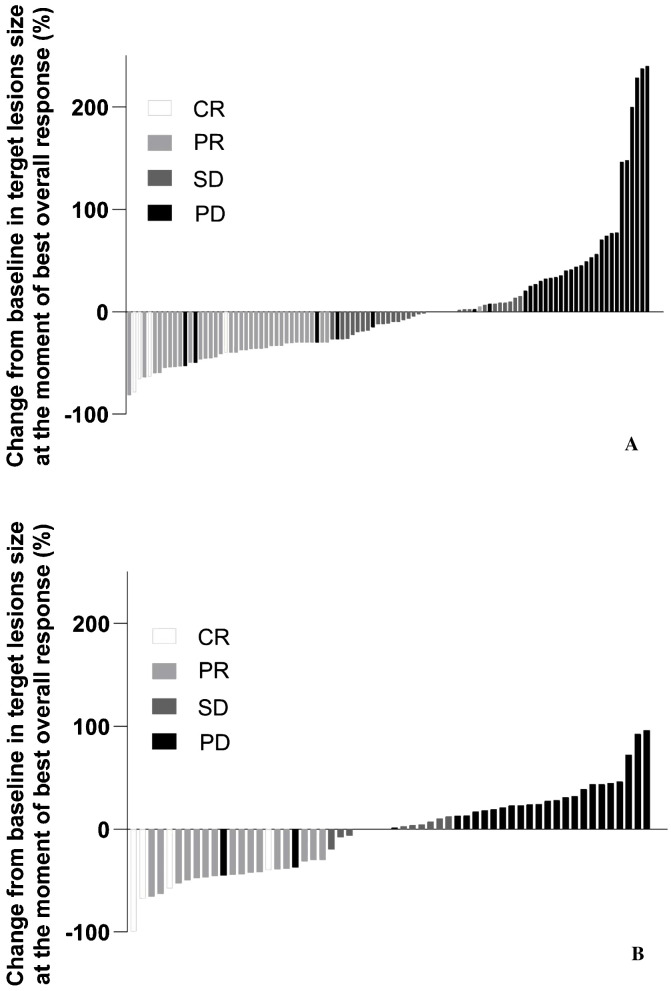
One hundred fourteen patients received prolgolimab 250 mg Q3W, and 61 patients received prolgolimab (Prolgo) 1 mg/kg Q2W (historical control). Objective response was achieved by 33.3% [95% confidence interval (CI): 24.8, 42.8] of patients in the Prolgo 250 mg group compared with 32.8% (95% CI: 21.3, 46.0) of patients in the Prolgo 1 mg/kg group. Risk difference was 0.00, 95% CI (-0.12; NA), = 0.0082. Both regimens were well tolerated, and safety profiles were comparable. The pharmacokinetic analysis (PK) showed that the regimen with the fixed dose of 250 mg Q3W was characterized by higher PK parameters. The immunogenicity study did not detect binding antibodies to prolgolimab in any of the subjects.
The obtained results showed that the selected fixed dosing regimen of prolgolimab 250 mg Q3W is characterized by efficacy and safety parameters comparable to that observed for the 1 mg/kg Q2W regimen.
普罗戈利单抗是首个被俄罗斯批准用于一线治疗不可切除或转移性黑色素瘤及晚期非小细胞肺癌的PD-1抑制剂。它以两种基于体重的给药方案获批,即1mg/kg每2周一次和3mg/kg每3周一次,但由于对基于体重给药模式的重新评估,固定剂量方案的研究被认为具有前景。
我们开展了一项多中心、单臂、开放标签的疗效、药代动力学和安全性研究,以获取数据,使普罗戈利单抗新的固定剂量方案能够在先前未治疗的不可切除或转移性黑色素瘤患者中获批(BCD-100-8/FLAT,NCT05783882)。主要目标是根据RECIST 1.1,证明普罗戈利单抗250mg每3周一次与普罗戈利单抗1mg/kg每2周一次治疗不可切除或转移性黑色素瘤患者时在客观缓解率方面的非劣效性。来自MIRACULUM研究(BCD-100-2/MIRACULUM,NCT03269565)的患者组成一个历史对照组。
114例患者接受普罗戈利单抗250mg每3周一次,61例患者接受普罗戈利单抗(Prolgo)1mg/kg每2周一次(历史对照)。普罗戈利单抗250mg组33.3%[95%置信区间(CI):24.8,42.8]的患者达到客观缓解,而普罗戈利单抗1mg/kg组为32.8%(95%CI:21.3,46.0)。风险差异为0.00,95%CI(-0.12;无可用值),P = 0.0082。两种方案耐受性均良好,安全性特征相当。药代动力学分析(PK)表明,固定剂量250mg每3周一次的方案具有更高的PK参数。免疫原性研究在任何受试者中均未检测到针对普罗戈利单抗的结合抗体。
所得结果表明,所选的普罗戈利单抗250mg每3周一次固定给药方案的疗效和安全性参数与1mg/kg每2周一次方案相当。