Hennings Elisa, Aeschbacher Stefanie, Coslovsky Michael, Paladini Rebecca E, Voellmin Gian, Lampart Maurin, Ziegler André, Müller Christian, Conen David, Zuern Christine S, Kühne Michael, Osswald Stefan, Pfister Otmar
Cardiovascular Research Institute Basel, University Hospital Basel, University of Basel, Basel, Switzerland.
Cardiology, University Hospital Basel, University of Basel, Petersgraben 4, 4031, Basel, Switzerland.
Clin Res Cardiol. 2025 Feb;114(2):239-250. doi: 10.1007/s00392-024-02546-8. Epub 2024 Sep 19.
The role of biomarkers in diagnosing pulmonary hypertension (PH) and distinguishing between pre- and post-capillary PH remains poorly understood. We aimed to identify biomarkers with a strong association with mean pulmonary arterial pressure, mPAP (PH diagnosis) and pulmonary vascular resistance, PVR (pre-capillary component), but not with pulmonary arterial wedge pressure, PAWP (post-capillary component).
Blood samples were collected in patients undergoing right heart catheterization within a prospective cross-sectional study. Biomarkers measured included BMP10, NT-proBNP, ANG2, ESM1/endocan, FGF23, GDF15, IGFBP7, IL6, MyBPC3, proC3, and proC6/endotrophin. Primary outcomes were mPAP, PVR, and PAWP, while secondary outcomes included PH diagnosis (mPAP > 20 mmHg) and elevated PVR (> 2 Wood units). Multivariable linear and logistic regression models were used to assess the relationship between biomarkers and outcomes.
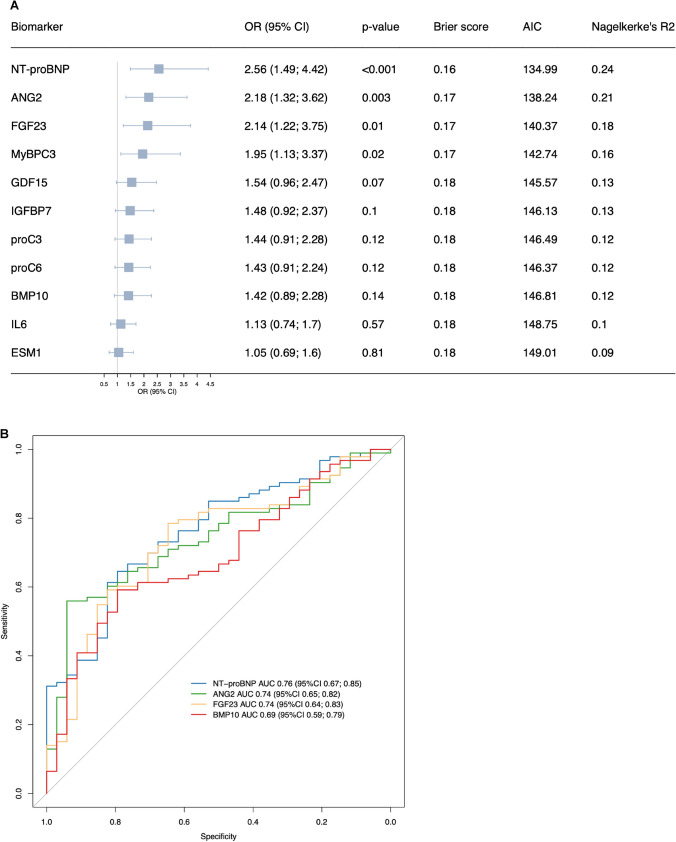
Of the 127 patients included (age 66 ± 13 years, 54% female), 73% were diagnosed with PH. BMP10, NT-proBNP, ANG2, MyBPC3, and FGF23 showed a strong association with mPAP (p < 0.001). BMP10 and NT-proBNP were strongly associated with PVR (p < 0.001), while NT-proBNP and ANG2 were strongly associated with PAWP (p < 0.001). NT-proBNP had the strongest association with the diagnosis of PH (area under the curve = 0.76). BMP10 was the only biomarker associated with elevated PVR (OR 1.60, 95%CI 1.01-2.54, p = 0.04) but not with PAWP (p = 0.86).
Several biomarkers were strongly associated with mPAP, PAWP, and PVR. BMP10 was the only biomarker strongly associated with mPAP and PVR, but not with PAWP, thus reflecting the pre-capillary PH component. Measurement of BMP10 along with NT-proBNP may aid in diagnosing PH.
生物标志物在诊断肺动脉高压(PH)以及区分毛细血管前和毛细血管后PH方面的作用仍未得到充分理解。我们旨在识别与平均肺动脉压、mPAP(PH诊断)和肺血管阻力、PVR(毛细血管前成分)密切相关,但与肺动脉楔压、PAWP(毛细血管后成分)无关的生物标志物。
在一项前瞻性横断面研究中,对接受右心导管检查的患者采集血样。检测的生物标志物包括骨形态发生蛋白10(BMP10)、N末端脑钠肽前体(NT-proBNP)、血管生成素2(ANG2)、内皮抑素/内抑素(ESM1/endocan)、成纤维细胞生长因子23(FGF23)、生长分化因子15(GDF15)、胰岛素样生长因子结合蛋白7(IGFBP7)、白细胞介素6(IL6)、肌球蛋白结合蛋白C3(MyBPC3)、补体C3前体(proC3)和补体C6前体/内养蛋白(proC6/endotrophin)。主要结局指标为mPAP、PVR和PAWP,次要结局指标包括PH诊断(mPAP>20mmHg)和PVR升高(>2伍德单位)。采用多变量线性和逻辑回归模型评估生物标志物与结局之间的关系。
纳入的127例患者(年龄66±13岁,54%为女性)中,73%被诊断为PH。BMP10、NT-proBNP、ANG2、MyBPC3和FGF23与mPAP密切相关(p<0.001)。BMP10和NT-proBNP与PVR密切相关(p<0.001),而NT-proBNP和ANG2与PAWP密切相关(p<0.001)。NT-proBNP与PH诊断的相关性最强(曲线下面积=0.76)。BMP10是唯一与PVR升高相关(比值比1.60,95%置信区间1.01 - 2.54,p = 0.04)但与PAWP无关(p = 0.86)的生物标志物。
几种生物标志物与mPAP、PAWP和PVR密切相关。BMP10是唯一与mPAP和PVR密切相关但与PAWP无关的生物标志物,因此反映了毛细血管前PH成分。联合检测BMP10和NT-proBNP可能有助于PH的诊断。