Institut Pasteur, Université Paris Cité, Centre National de la Recherche Scientifique, Unité Mixte de Recherche 3571, Perception and Action Unit, F-75015, Paris, France.
Sorbonne Université, Collège doctoral, Paris, France.
Transl Psychiatry. 2024 Sep 19;14(1):382. doi: 10.1038/s41398-024-03085-6.
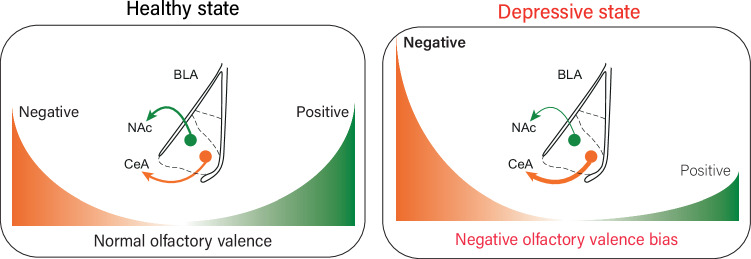
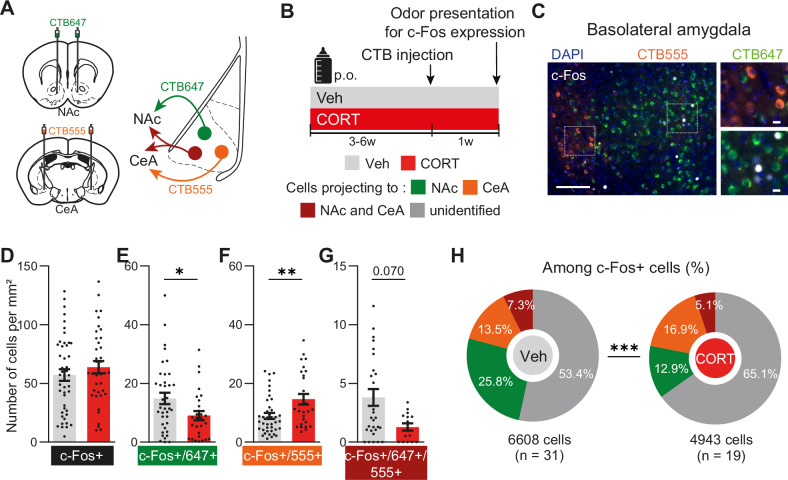
Negative bias is an essential characteristic of depressive episodes leading patients to attribute more negative valence to environmental cues. This negative bias affects all levels of information processing including emotional response, attention and memory, leading to the development and maintenance of depressive symptoms. In this context, pleasant stimuli become less attractive and unpleasant ones more aversive, yet the related neural circuits underlying this bias remain largely unknown. By studying a mice model for depression chronically receiving corticosterone (CORT), we showed a negative bias in valence attribution to olfactory stimuli that responds to antidepressant drug. This result paralleled the alterations in odor value assignment we observed in bipolar depressed patients. Given the crucial role of amygdala in valence coding and its strong link with depression, we hypothesized that basolateral amygdala (BLA) circuits alterations might support negative shift associated with depressive states. Contrary to humans, where limits in spatial resolution of imaging tools impair easy amygdala segmentation, recently unravelled specific BLA circuits implicated in negative and positive valence attribution could be studied in mice. Combining CTB and rabies-based tracing with ex vivo measurements of neuronal activity, we demonstrated that negative valence bias is supported by disrupted activity of specific BLA circuits during depressive states. Chronic CORT administration induced decreased recruitment of BLA-to-NAc neurons preferentially involved in positive valence encoding, while increasing recruitment of BLA-to-CeA neurons preferentially involved in negative valence encoding. Importantly, this dysfunction was dampened by chemogenetic hyperactivation of BLA-to-NAc neurons. Moreover, altered BLA activity correlated with durable presynaptic connectivity changes coming from the paraventricular nucleus of the thalamus, recently demonstrated as orchestrating valence assignment in the amygdala. Together, our findings suggest that specific BLA circuits alterations might support negative bias in depressive states and provide new avenues for translational research to understand the mechanisms underlying depression and treatment efficacy.
负性偏向是导致患者将更多的负性效价归因于环境线索的抑郁发作的一个基本特征。这种负性偏向影响信息处理的各个层次,包括情绪反应、注意力和记忆,从而导致抑郁症状的发展和维持。在这种情况下,愉快的刺激变得不那么有吸引力,不愉快的刺激变得更厌恶,但这种偏向背后的相关神经回路在很大程度上仍然未知。通过研究慢性接受皮质酮(CORT)的抑郁小鼠模型,我们发现对嗅觉刺激的效价归因存在负性偏向,这种偏向对抗抑郁药物有反应。这一结果与我们在双相抑郁患者中观察到的气味值分配变化相平行。鉴于杏仁核在效价编码中的关键作用及其与抑郁的强烈联系,我们假设基底外侧杏仁核(BLA)回路的改变可能支持与抑郁状态相关的负性转变。与人类不同,由于成像工具的空间分辨率限制,难以对杏仁核进行分割,最近发现的与负性和正性效价归因相关的特定 BLA 回路可以在小鼠中进行研究。我们结合 CTB 和基于狂犬病毒的示踪技术以及体外神经元活动测量,证明了在抑郁状态下,特定的 BLA 回路的活动中断支持了负性效价偏向。慢性 CORT 给药诱导优先参与正性效价编码的 BLA 到 NAc 神经元的募集减少,而优先参与负性效价编码的 BLA 到 CeA 神经元的募集增加。重要的是,BLA 到 NAc 神经元的化学遗传超激活减弱了这种功能障碍。此外,改变的 BLA 活性与来自丘脑室旁核的持久的突触前连接变化相关,最近的研究表明,这种变化在杏仁核中协调效价分配。总之,我们的发现表明,特定的 BLA 回路的改变可能支持抑郁状态下的负性偏向,并为理解抑郁的机制和治疗效果提供了新的转化研究途径。