Max Planck Institute for Evolutionary Anthropology, Department of Archaeogenetics, Leipzig, Germany.
Division of Clinical Anatomy and Biological Anthropology, Department of Human Biology, University of Cape Town, Cape Town, South Africa.
Nat Ecol Evol. 2024 Nov;8(11):2121-2134. doi: 10.1038/s41559-024-02532-3. Epub 2024 Sep 19.
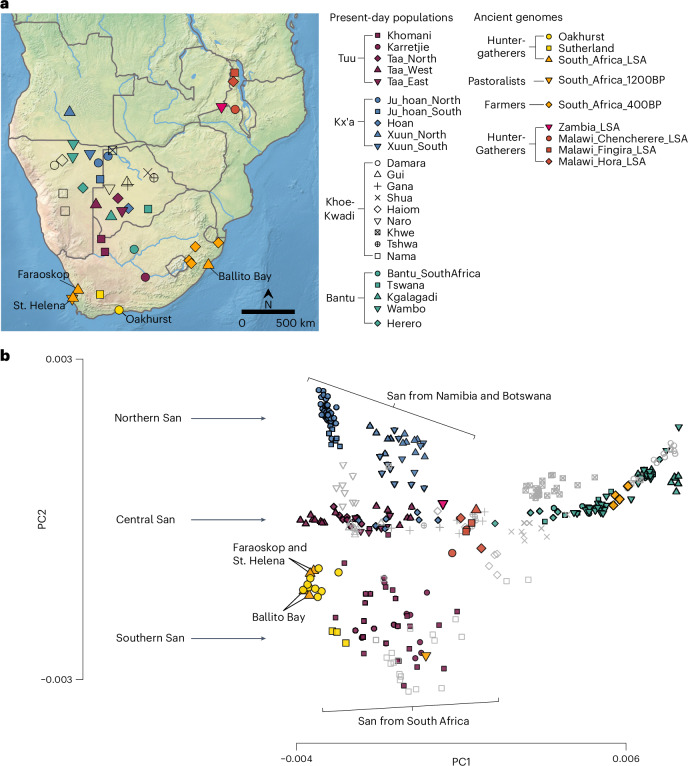
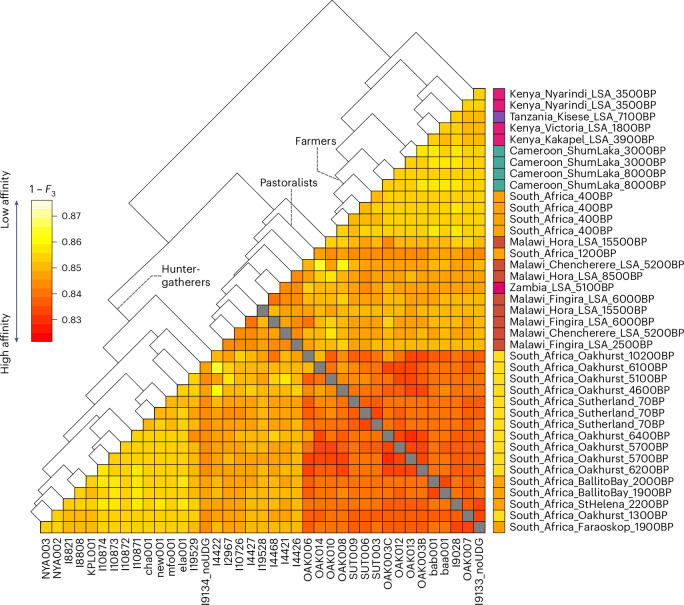
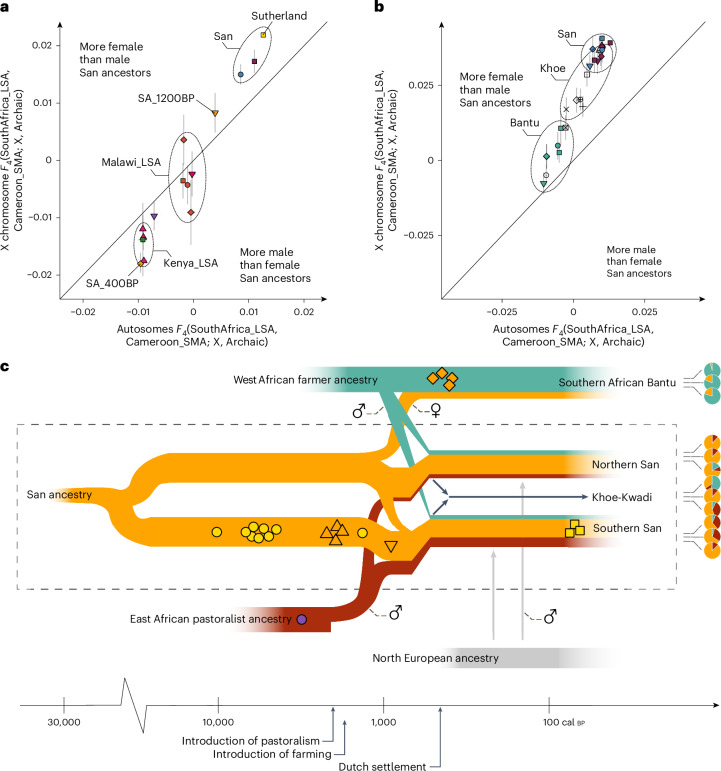
Southern Africa has one of the longest records of fossil hominins and harbours the largest human genetic diversity in the world. Yet, despite its relevance for human origins and spread around the globe, the formation and processes of its gene pool in the past are still largely unknown. Here, we present a time transect of genome-wide sequences from nine individuals recovered from a single site in South Africa, Oakhurst Rockshelter. Spanning the whole Holocene, the ancient DNA of these individuals allows us to reconstruct the demographic trajectories of the indigenous San population and their ancestors during the last 10,000 years. We show that, in contrast to most regions around the world, the population history of southernmost Africa was not characterized by several waves of migration, replacement and admixture but by long-lasting genetic continuity from the early Holocene to the end of the Later Stone Age. Although the advent of pastoralism and farming substantially transformed the gene pool in most parts of southern Africa after 1,300 BP, we demonstrate using allele-frequency and identity-by-descent segment-based methods that the ‡Khomani San and Karretjiemense from South Africa still show direct signs of relatedness to the Oakhurst hunter-gatherers, a pattern obscured by recent, extensive non-Southern African admixture. Yet, some southern San in South Africa still preserve this ancient, Pleistocene-derived genetic signature, extending the period of genetic continuity until today.
南非拥有最悠久的古人类化石记录之一,拥有世界上最大的人类遗传多样性。然而,尽管它与人类起源和在全球范围内的传播有关,但过去其基因库的形成和过程在很大程度上仍然未知。在这里,我们展示了从南非一个名为奥克赫斯特岩棚的单一地点中提取的九个人的全基因组序列的时间剖面。这些个体的古 DNA 跨越了整个全新世,使我们能够重建当地桑人及其祖先在过去 10000 年中的人口轨迹。我们表明,与世界上大多数地区不同,南非最南端的人口历史并不是由几次移民、替代和混合的浪潮所特征化,而是由从全新世早期到晚期石器时代结束的持久遗传连续性所特征化。尽管畜牧业和农业的出现大大改变了 1300 年 BP 后南非大部分地区的基因库,但我们使用等位基因频率和基于身份识别的片段方法证明,南非的‡Khomani San 和 Karretjiemense 仍然与奥克赫斯特狩猎采集者有直接的亲缘关系,这种模式被最近广泛的非南非混合所掩盖。然而,南非的一些南部桑人仍然保留着这种古老的、来自更新世的遗传特征,将遗传连续性的时期延长到今天。