Human Evolution, Department of Organismal Biology and SciLifeLab, Uppsala University, Uppsala, Sweden.
Departamento de Historia, Universidad de Córdoba, Cordoba, Spain.
Nature. 2023 Jun;618(7965):550-556. doi: 10.1038/s41586-023-06166-6. Epub 2023 Jun 7.
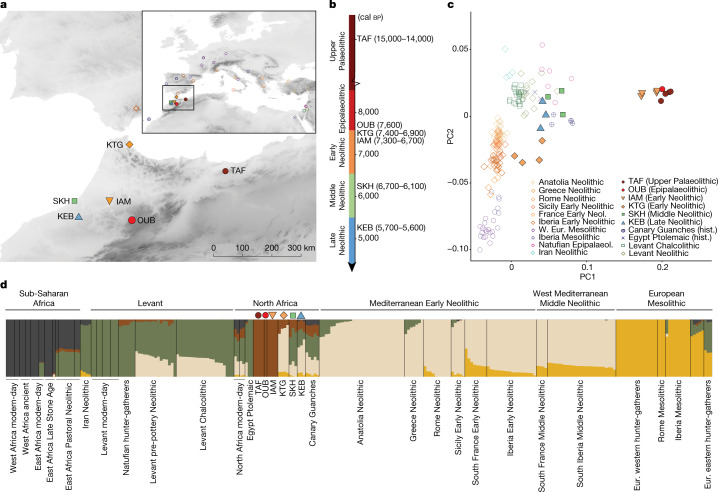
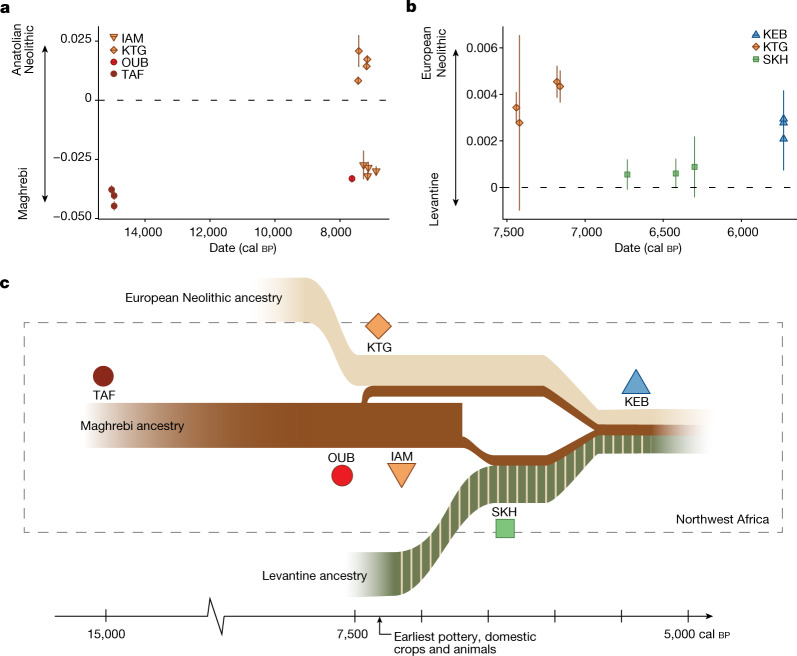
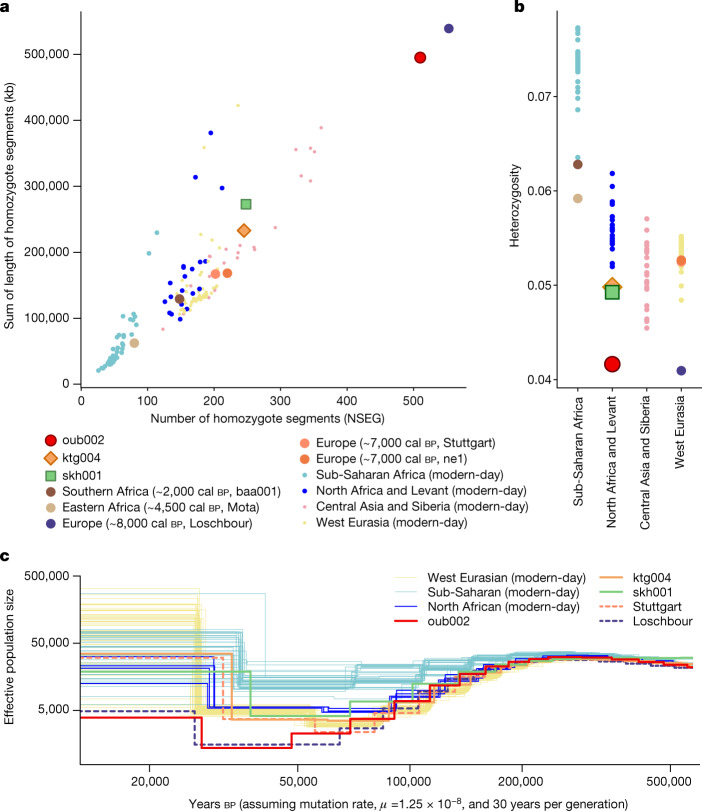
In northwestern Africa, lifestyle transitioned from foraging to food production around 7,400 years ago but what sparked that change remains unclear. Archaeological data support conflicting views: (1) that migrant European Neolithic farmers brought the new way of life to North Africa or (2) that local hunter-gatherers adopted technological innovations. The latter view is also supported by archaeogenetic data. Here we fill key chronological and archaeogenetic gaps for the Maghreb, from Epipalaeolithic to Middle Neolithic, by sequencing the genomes of nine individuals (to between 45.8- and 0.2-fold genome coverage). Notably, we trace 8,000 years of population continuity and isolation from the Upper Palaeolithic, via the Epipaleolithic, to some Maghrebi Neolithic farming groups. However, remains from the earliest Neolithic contexts showed mostly European Neolithic ancestry. We suggest that farming was introduced by European migrants and was then rapidly adopted by local groups. During the Middle Neolithic a new ancestry from the Levant appears in the Maghreb, coinciding with the arrival of pastoralism in the region, and all three ancestries blend together during the Late Neolithic. Our results show ancestry shifts in the Neolithization of northwestern Africa that probably mirrored a heterogeneous economic and cultural landscape, in a more multifaceted process than observed in other regions.
在北非,生活方式在 7400 年前从采集到食物生产发生了转变,但引发这种转变的原因尚不清楚。考古数据支持相互矛盾的观点:(1) 欧洲新石器时代的移民农民将新生活方式带到了北非,或 (2) 当地的狩猎采集者采用了技术创新。后一种观点也得到了考古遗传学数据的支持。在这里,我们通过对 9 个人的基因组进行测序(覆盖度在 45.8 到 0.2 倍之间),填补了马格里布从旧石器时代晚期到中石器时代的关键时间和考古遗传学空白。值得注意的是,我们追溯了 8000 年来从旧石器时代晚期到新石器时代早期的人口连续性和隔离,通过旧石器时代晚期到一些马格里布新石器时代的农业群体。然而,最早的新石器时代的样本主要显示了欧洲新石器时代的血统。我们认为,农业是由欧洲移民引入的,然后被当地群体迅速采用。在中石器时代,来自黎凡特的新血统出现在马格里布,与该地区的畜牧业的到来相吻合,在新石器时代晚期,这三种血统融合在一起。我们的研究结果表明,在北非的新石器时代转变过程中存在着祖先的转变,这可能反映了一个更加多样化的经济和文化景观,其过程比在其他地区观察到的更为复杂。