School of Public Health, University of California, Berkeley.
Benioff Homelessness and Housing Initiative, University of California, San Francisco.
JAMA Netw Open. 2022 Jul 1;5(7):e2223891. doi: 10.1001/jamanetworkopen.2022.23891.
Some jurisdictions used hotels to provide emergency noncongregate shelter and support services to reduce the risk of COVID-19 infection among people experiencing homelessness (PEH). A subset of these shelter-in-place (SIP) hotel guests were high users of acute health services, and the association of hotel placement with their service use remains unknown.
To evaluate the association of SIP hotel placements with health services use among a subset of PEH with prior high acute health service use.
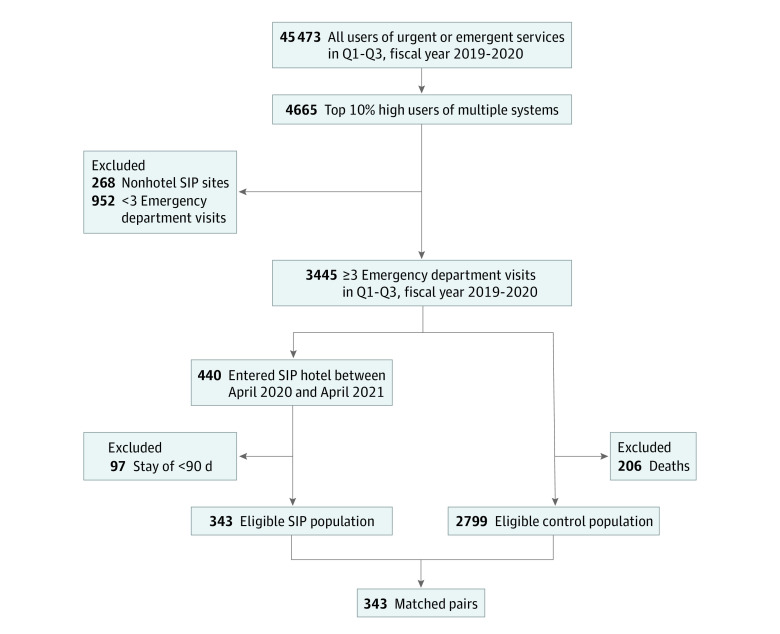
DESIGN, SETTING, AND PARTICIPANTS: This study used a matched retrospective cohort design comparing health services use between PEH with prior high service use who did and did not receive a SIP hotel placement, from April 2020 to April 2021. The setting was 25 SIP hotels in San Francisco, California, with a daily capacity of 2500 people. Participants included PEH who were among the top 10% high users of acute medical, mental health, and substance use services and who had 3 or more emergency department (ED) visits in the 9 months before the implementation of the SIP hotel program. Data analysis for this study was performed from February 2021 to May 2022.
SIP hotel placement with on-site supportive services.
The primary outcomes were ED visits, hospitalizations and bed days, psychiatric emergency visits, psychiatric hospitalizations, outpatient mental health and substance use visits, and outpatient medical visits.
Of 2524 SIP guests with a minimum of 90-day stays, 343 (13.6%) met criteria for high service use. Of 686 participants with high service use (343 SIP group; 343 control), the median (IQR) age was 54 (43-61) years, 485 (70.7%) were male, 283 (41.3%) were Black, and 337 (49.1%) were homeless for more than 10 years. The mean number of ED visits decreased significantly in the high-user SIP group (1.84 visits [95% CI, 1.52-2.17 visits] in the 90 days before SIP placement to 0.82 visits [95% CI, 0.66-0.99 visits] in the 90 days after SIP placement) compared with high-user controls (decrease from 1.33 visits [95% CI, 1.39-1.58 visits] to 1.00 visits [95% CI, 0.80-1.20 visits]) (incidence rate ratio [IRR], 0.60; 95% CI, 0.47-0.75; P < .001). The mean number of hospitalizations decreased significantly from 0.41 (95% CI, 0.30-0.51) to 0.14 (95% CI, 0.09-0.19) for SIP guests vs 0.27 (95% CI, 0.19-0.34) to 0.22 (95% CI, 0.15-0.29) for controls (IRR, 0.41; 95% CI, 0.27-063; P < .001). Inpatient hospital days decreased significantly from a mean of 4.00 (95% CI, 2.44-5.56) to 0.81 (95% CI, 0.40-1.23) for SIP guests vs 2.27 (95% CI, 1.27-3.27) to 1.85 (95% CI, 1.06-2.65) for controls (IRR, 0.25; 95% CI, 0.12-0.54; P < .001), as did psychiatric emergency visits, from a mean of 0.03 (95% CI, 0.01-0.05) to 0.01 (95% CI, 0.00-0.01) visits for SIP guests vs no change in the control group (IRR, 0.25; 95% CI, 0.11-0.51; P < .001).
These findings suggest that in a population of PEH with high use of acute health services, SIP hotel placement was associated with significantly reduced acute care use compared with high users without a placement.
一些司法管辖区使用酒店为无家可归者(PEH)提供紧急非集体避难所和支持服务,以降低他们感染 COVID-19 的风险。这些避难所中的一部分庇护所(SIP)酒店客人是急性卫生服务的高使用者,酒店安置与他们的服务使用之间的关联尚不清楚。
评估 SIP 酒店安置与先前有过大量急性卫生服务使用史的 PEH 亚组的服务使用之间的关联。
设计、地点和参与者:本研究使用匹配的回顾性队列设计,比较了 2020 年 4 月至 2021 年 4 月期间,在加利福尼亚州旧金山的 25 家 SIP 酒店中,有过 3 次或以上急诊就诊史的急性医疗、心理健康和物质使用服务高使用者中,接受 SIP 酒店安置和未接受 SIP 酒店安置的 PEH 之间的服务使用情况。这项研究的数据分析是在 2021 年 2 月至 2022 年 5 月进行的。
提供现场支持服务的 SIP 酒店安置。
主要结果是急诊就诊、住院和住院天数、精神科急诊就诊、精神科住院、门诊心理健康和物质使用就诊、以及门诊医疗就诊。
在至少 90 天入住的 2524 名 SIP 客人中,有 343 名(13.6%)符合高服务使用标准。在 686 名高服务使用者(343 名 SIP 组;343 名对照组)中,中位(IQR)年龄为 54(43-61)岁,485 名(70.7%)为男性,283 名(41.3%)为黑人,337 名(49.1%)无家可归超过 10 年。与高使用者对照组相比,高使用者 SIP 组的急诊就诊次数显著减少(SIP 安置前 90 天内就诊 1.84 次[95%CI,1.52-2.17 次],SIP 安置后 90 天内就诊 0.82 次[95%CI,0.66-0.99 次])(发病率比[IRR],0.60;95%CI,0.47-0.75;P<.001)。住院人数也显著减少,从 SIP 客人的 0.41(95%CI,0.30-0.51)降至 0.14(95%CI,0.09-0.19),而对照组从 0.27(95%CI,0.19-0.34)降至 0.22(95%CI,0.15-0.29)(IRR,0.41;95%CI,0.27-0.63;P<.001)。住院天数也显著减少,从 SIP 客人的平均 4.00(95%CI,2.44-5.56)降至 0.81(95%CI,0.40-1.23),而对照组从 2.27(95%CI,1.27-3.27)降至 1.85(95%CI,1.06-2.65)(IRR,0.25;95%CI,0.12-0.54;P<.001),精神科急诊就诊也显著减少,从 SIP 客人的平均 0.03(95%CI,0.01-0.05)降至 0.01(95%CI,0.00-0.01),而对照组无变化(IRR,0.25;95%CI,0.11-0.51;P<.001)。
这些发现表明,在有大量急性卫生服务使用史的 PEH 人群中,与未安置者相比,SIP 酒店安置与急性护理使用显著减少相关。
