University Medicine Greifswald, Greifswald, Germany.
Department of Psychiatry and Psychotherapy, University Medicine Greifswald, Greifswald, Germany.
Eur Psychiatry. 2024 Sep 20;67(1):e55. doi: 10.1192/j.eurpsy.2024.1764.
Obesity-related cardiometabolic comorbidity is common in major depressive disorder (MDD). However, sex differences and MDD recurrence may modify the MDD-obesity-link.
Sex-specific associations of MDD recurrence (single [MDD] or recurrent episodes [MDD]) and obesity-related traits were analyzed in 4.100 adults (51.6% women) from a cross-sectional population-based cohort in Germany (SHIP-Trend-0). DSM-IV-based lifetime MDD diagnoses and MDD recurrence status were obtained through diagnostic interviews. Obesity-related outcomes included anthropometrics (weight, body mass index, waist- and hip-circumference, waist-to-hip ratio, waist-to-height ratio), bioelectrical impedance analysis of body fat mass and fat-free mass, and subcutaneous (SAT) and visceral adipose tissue (VAT) from abdominal magnetic resonance imaging. Sex-stratified linear regression models predicting obesity-related traits from MDD recurrence status were adjusted for age, education, and current depressive symptoms.
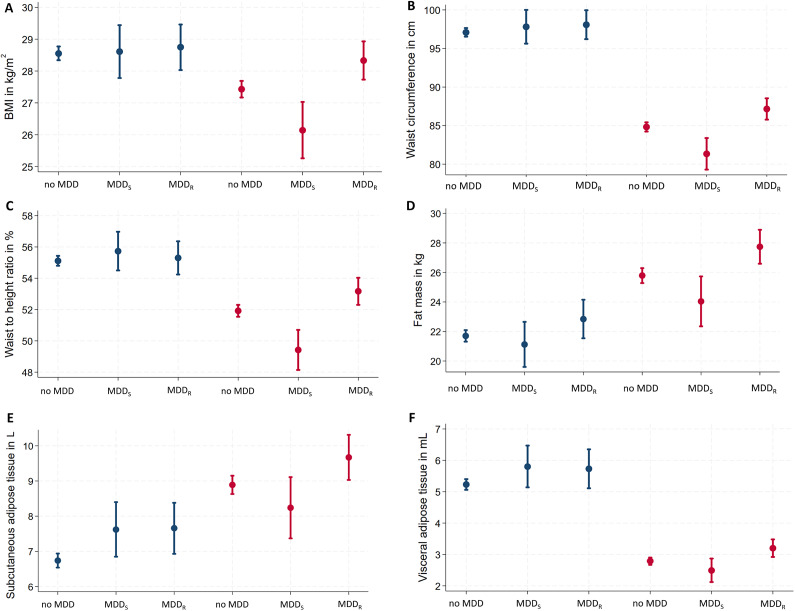
790 participants (19.3%) fulfilled lifetime MDD criteria (23.8% women vs. 14.5% men, p<0.001). In women, MDD was inversely associated with anthropometric indicators of general and central obesity, while MDD was positively associated with all obesity-related traits, except waist-to-hip ratio and fat-free mass. In women, MDD versus MDD was associated with higher levels of obesity across all outcomes except fat-free mass. In men, MDD was positively associated with SAT regardless of MDD recurrence. Additionally, lifetime MDD was positively associated with VAT in men. Results remained significant in sensitivity analyses after exclusion of participants with current use of antidepressants.
The MDD-obesity association is modified by MDD recurrence and sex independent of current depressive symptoms. Accounting for sex and MDD recurrence may identify individuals with MDD at increased cardiometabolic risk.
肥胖相关的心脏代谢合并症在重度抑郁症(MDD)中很常见。然而,性别差异和 MDD 复发可能会改变 MDD 与肥胖之间的联系。
在德国一项横断面基于人群的队列研究(SHIP-Trend-0)中,对 4100 名成年人(女性占 51.6%)进行了 MDD 复发(单一 [MDD] 或复发性发作 [MDD])和肥胖相关特征的性别特异性关联分析。通过诊断访谈获得基于 DSM-IV 的终生 MDD 诊断和 MDD 复发情况。肥胖相关的结果包括人体测量学(体重、体重指数、腰围和臀围、腰臀比、腰高比)、生物电阻抗分析体脂肪量和去脂体重,以及腹部磁共振成像的皮下(SAT)和内脏脂肪组织(VAT)。对 MDD 复发状态预测肥胖相关特征的性别分层线性回归模型进行了年龄、教育和当前抑郁症状的调整。
790 名参与者(19.3%)符合终生 MDD 标准(女性占 23.8%,男性占 14.5%,p<0.001)。在女性中,MDD 与一般和中心性肥胖的人体测量指标呈负相关,而 MDD 与除腰臀比和去脂体重外的所有肥胖相关特征呈正相关。在女性中,MDD 与除去脂体重外的所有肥胖相关结果的水平均高于 MDD。在男性中,无论 MDD 复发与否,MDD 均与 SAT 呈正相关。此外,终生 MDD 与男性的 VAT 呈正相关。在排除当前使用抗抑郁药的参与者后,敏感性分析结果仍然显著。
MDD 复发和性别独立于当前抑郁症状,改变了 MDD 与肥胖之间的关联。考虑到性别和 MDD 复发可以识别出患有 MDD 且心血管代谢风险增加的个体。