German Center for Neurodegenerative Diseases (DZNE), Bonn, Germany.
CNRS, NeuroSpin, Baobab, Université Paris-Saclay, Commissariat à' l'Energie Atomique, Gif sur Yvette, France.
Magn Reson Med. 2025 Feb;93(2):630-642. doi: 10.1002/mrm.30305. Epub 2024 Sep 20.
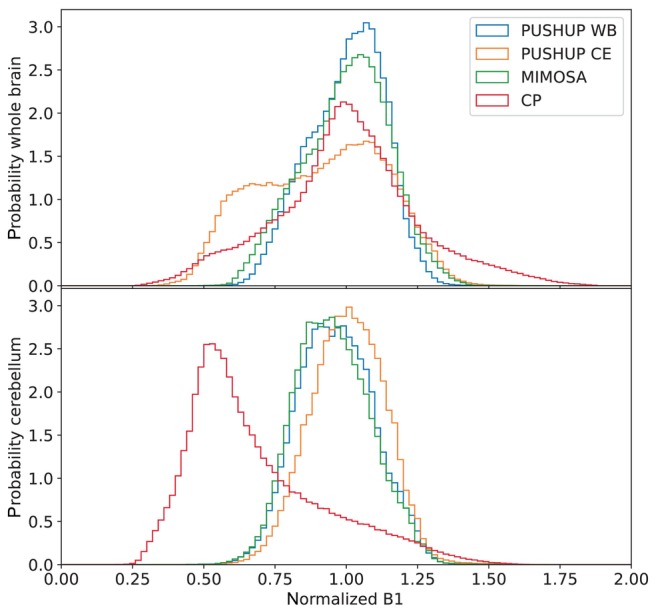
Chemical exchange saturation transfer (CEST) measurements at ultra-high field (UHF) suffer from strong saturation inhomogeneity. Retrospective correction of this inhomogeneity is possible to some extent, but requires a time-consuming repetition of the measurement. Here, we propose a calibration-free parallel transmit (pTx)-based saturation scheme that homogenizes the saturation over the imaging volume, which we call PUlse design for Saturation Homogeneity utilizing Universal Pulses (PUSHUP).
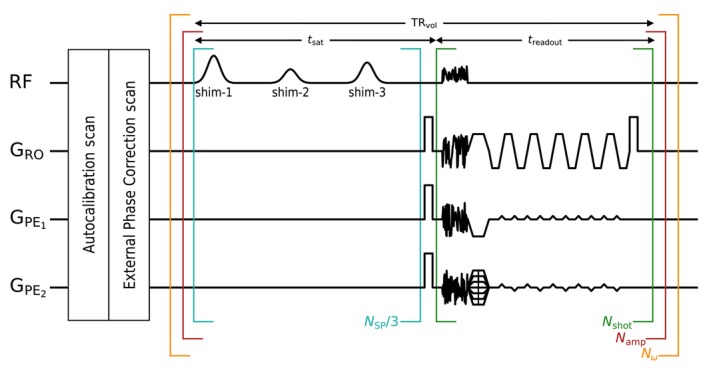
Magnetization transfer effects depend on the saturation . PUSHUP homogenizes the saturation by using multiple saturation pulses with alternating -shims. Using a database of maps, universal pulses are calculated that remove the necessity of time-consuming, subject-based pulse calculation during the measurement.
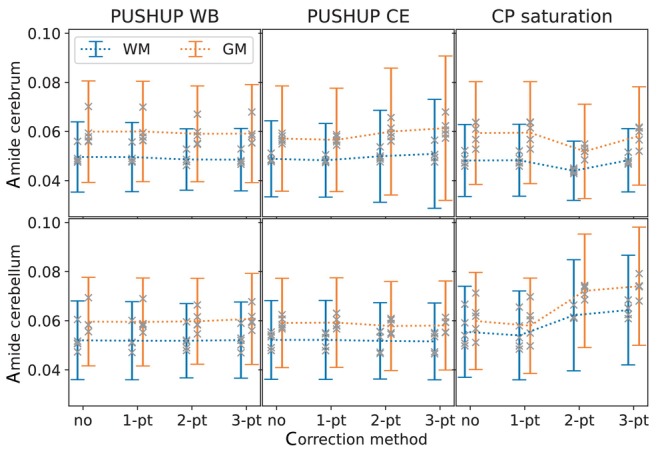
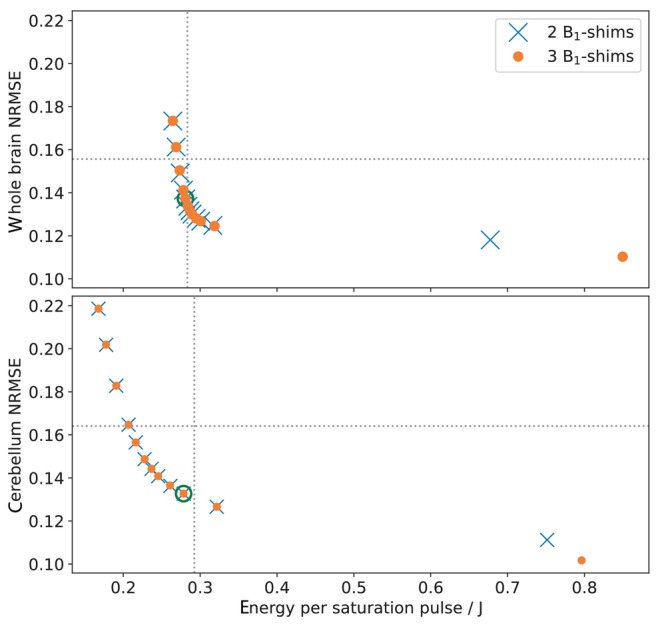
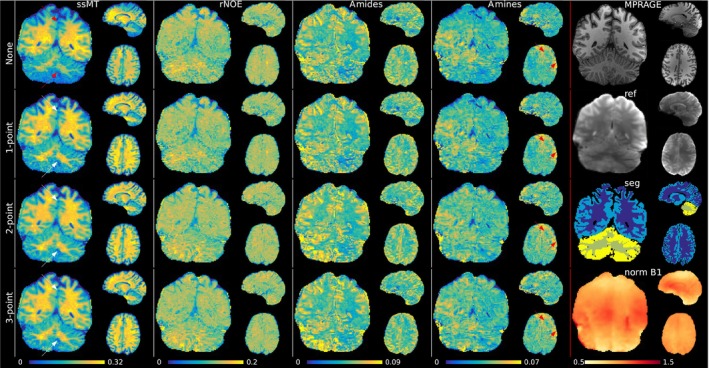
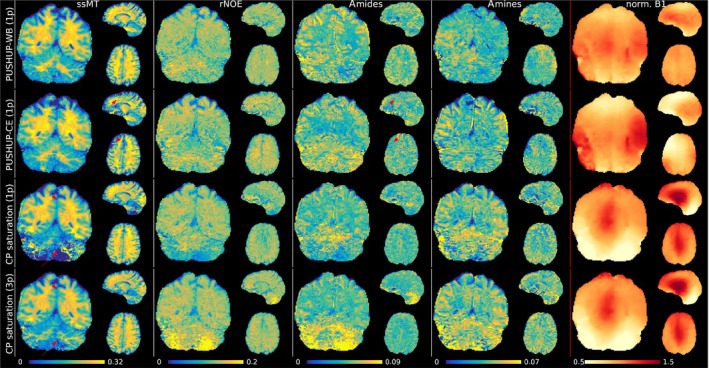
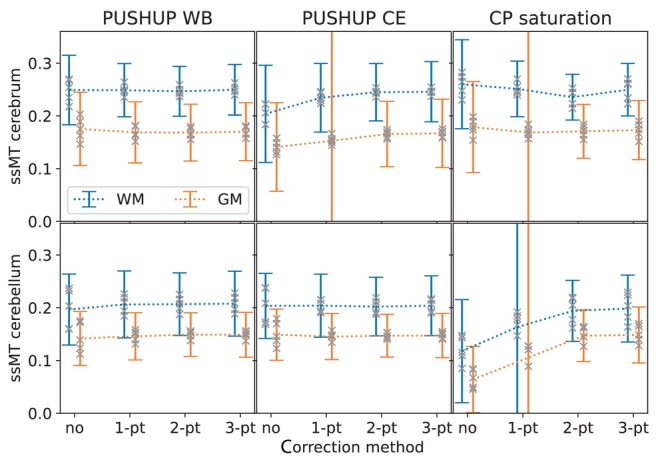
PUSHUP was combined with a whole-brain three-dimensional-echo planar imaging (3D-EPI) readout. Two PUSHUP saturation modules were calculated by either applying whole-brain or cerebellum masks to the database maps. The saturation homogeneity and the group mean CEST amplitudes were calculated for different -correction methods and were compared to circular polarized (CP) saturation in five healthy volunteers using an eight-channel transmit coil at 7 Tesla.
In contrast to CP saturation, where accurate CEST maps were impossible to obtain in the cerebellum, even with extensive -correction, PUSHUP CEST maps were artifact-free throughout the whole brain. A 1-point retrospective -correction, that does not need repeated measurements, sufficiently removed the effect of residual saturation inhomogeneity.
The presented method allows for homogeneous whole-brain CEST imaging at 7 Tesla without the need of a repetition-based -correction or online pulse calculation. With the fast 3D-EPI readout, whole-brain CEST imaging with 45 saturation offsets is possible at 1.6 mm resolution in under 4 min.
超高场(UHF)下的化学交换饱和传递(CEST)测量会受到强烈的饱和不均匀性的影响。在某种程度上,可以对这种不均匀性进行回顾性校正,但这需要重复测量,耗时较长。在这里,我们提出了一种无需校准的基于并行传输(pTx)的饱和方案,可以使整个成像体积的饱和均匀化,我们称之为利用通用脉冲进行饱和均匀化的脉冲设计(PUSHUP)。
磁化转移效应取决于饱和 。PUSHUP 通过使用具有交替 - 补偿的多个饱和脉冲来使饱和均匀化。使用 映射数据库,计算出通用脉冲,从而在测量过程中无需耗时的、基于个体的脉冲计算。
将 PUSHUP 与全脑三维回波平面成像(3D-EPI)读出相结合。通过将全脑或小脑掩模应用于数据库地图,计算出两个 PUSHUP 饱和模块。为不同的 - 校正方法计算了饱和均匀性和组平均 CEST 幅度,并与 7T 时使用 8 通道发射线圈的五名健康志愿者的圆形极化(CP)饱和进行了比较。
与 CP 饱和相比,即使进行了广泛的 - 校正,小脑中的准确 CEST 图谱也无法获得,而 PUSHUP CEST 图谱在整个大脑中都没有伪影。不需要重复测量的 1 点回顾性 - 校正足以消除残余饱和不均匀性的影响。
所提出的方法允许在 7T 下进行均匀的全脑 CEST 成像,无需基于重复的 - 校正或在线脉冲计算。使用快速 3D-EPI 读出,在不到 4 分钟的时间内可以在 1.6mm 分辨率下以 45 个饱和偏移进行全脑 CEST 成像。