Carnegie Applied Rugby Research (CARR) Centre, Carnegie School of Sport, Leeds Beckett University, Leeds, UK.
Premiership Rugby, London, UK.
Eur J Sport Sci. 2024 Nov;24(11):1552-1563. doi: 10.1002/ejsc.12188. Epub 2024 Sep 21.
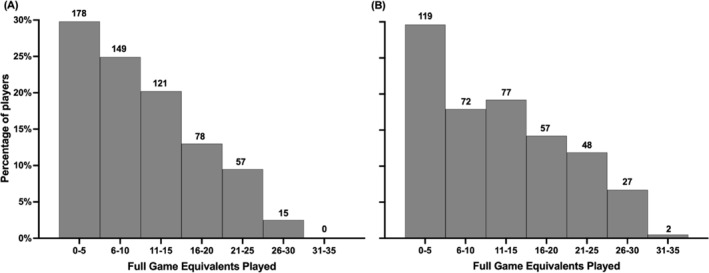
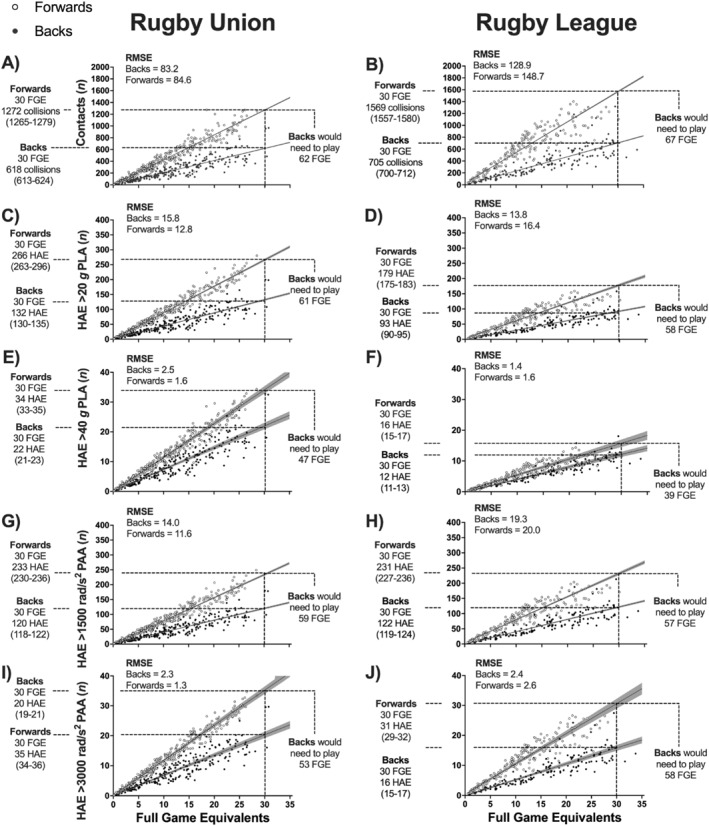
The study aimed to illustrate how contact (from match-event data) and head acceleration event (HAE) (from instrumented mouthguard [iMG]) data can be combined to inform match limits within rugby. Match-event data from one rugby union and rugby league season, including all competitive matches involving players from the English Premiership and Super League, were used. Playing exposure was summarised as full game equivalents (FGE; total minutes played/80). Expected contact and HAE exposures at arbitrary thresholds were estimated using match-event and iMG data. Generalised linear models were used to identify differences in contact and HAE exposure per FGE. For 30 FGEs, forwards had greater contact than backs in rugby union (n = 1272 vs. 618) and league (n = 1569 vs. 706). As HAE magnitude increased, the differences between positional groups decreased (e.g., rugby union; n = 34 and 22 HAE >40 g for forwards and backs playing 30 FGEs). Currently, only a relatively small proportion of rugby union (2.5%) and league (7.3%) players exceeded 25 FGEs. Estimating contact and HAEs per FGE allows policymakers to prospectively plan and model estimated overall and position-specific loads over a season and longer term. Reducing FGE limits by a small amount would currently only affect contact and HAE exposure for a small proportion of players who complete the most minutes. This may be beneficial for this cohort but is not an effective HAE and contact exposure reduction strategy at a population level, which requires individual player management. Given the positional differences, FGE limits should exist to manage appropriate HAE and contact exposure.
本研究旨在阐明如何将接触(来自比赛事件数据)和头部加速事件(HAE)(来自仪器化的牙套[iMG])数据结合起来,为橄榄球比赛设定限制。使用了一个橄榄球联盟和橄榄球联赛赛季的比赛事件数据,包括涉及英格兰超级联赛和超级联赛球员的所有竞技比赛。比赛暴露被总结为全场比赛等效物(FGE;总比赛时间/80)。使用比赛事件和 iMG 数据估计任意阈值下的预期接触和 HAE 暴露。使用广义线性模型确定每 FGE 的接触和 HAE 暴露差异。在 30 个 FGE 中,橄榄球联盟中前锋的接触次数多于后卫(n=1272 对 618),而橄榄球联赛中前锋的接触次数多于后卫(n=1569 对 706)。随着 HAE 幅度的增加,位置组之间的差异减小(例如,橄榄球联盟;n=34 和 22 HAE >40 g 用于在 30 个 FGE 中比赛的前锋和后卫)。目前,只有橄榄球联盟(2.5%)和橄榄球联赛(7.3%)的相对较小比例的球员超过 25 FGE。估计每个 FGE 的接触和 HAE 允许政策制定者前瞻性地规划和模拟整个赛季和更长期的总体和特定位置的负荷。少量减少 FGE 限制目前只会影响完成最多分钟的一小部分球员的接触和 HAE 暴露。这可能对这部分球员有益,但不是在人群层面上减少 HAE 和接触暴露的有效策略,这需要对个别球员进行管理。鉴于位置差异,应该存在 FGE 限制来管理适当的 HAE 和接触暴露。