Gilmore Amanda, Barnes-Holmes Dermot, Sivaraman Maithri
School of Psychology, Ulster University, Northern Ireland, UK.
Department of Health and Behavior Studies, Teachers College, Columbia University, New York, NY USA.
Perspect Behav Sci. 2024 Feb 21;47(3):581-601. doi: 10.1007/s40614-024-00399-0. eCollection 2024 Sep.
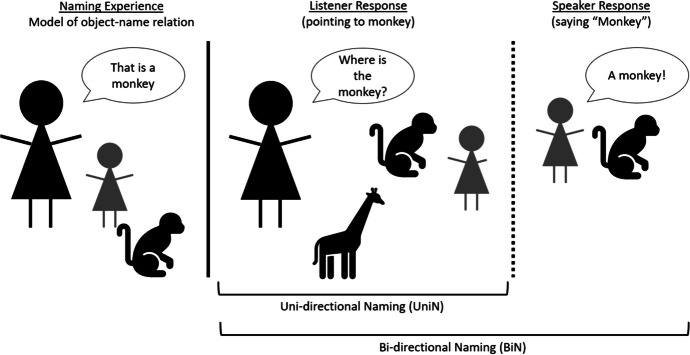
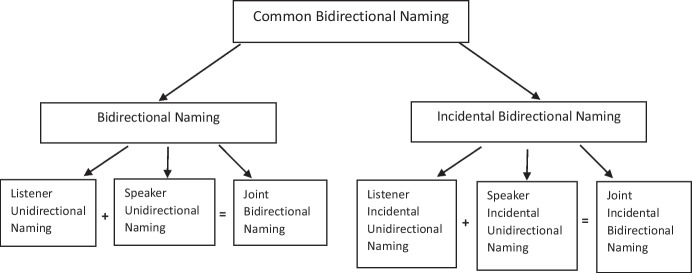
An important distinction has been drawn within the behavior-analytic literature between two types of naming. Naming that is reinforced is referred to as bidirectional naming, and naming that is not reinforced is referred to as incidental bidirectional naming. According to verbal behavior development theory children who demonstrate incidental naming have developed a verbal behavioral cusp, and often learn new language more rapidly as a result. A growing body of research has assessed incidental naming using what is described as an incidental naming experience, in which novel stimuli are presented and named by a researcher but with no direct differential reinforcement for subsequent naming responses by the participant. According to relational frame theory, such studies on incidental naming have typically involved presenting contextual cues that likely serve to establish the name relations between an object and its name. As such, contextual cues may play a critical role in the emergence of incidental naming responses, but there are no published studies that have systematically tested the potential role of contextual cues in relation to incidental naming. The current article provides a narrative review of the incidental naming literature, highlighting variables that remain to be explored in future research.
行为分析文献中对两种命名类型进行了重要区分。得到强化的命名被称为双向命名,未得到强化的命名被称为附带双向命名。根据言语行为发展理论,表现出附带命名的儿童已经发展出言语行为的关键期,因此往往能更快地学习新语言。越来越多的研究使用所谓的附带命名体验来评估附带命名,即在这种体验中,新刺激由研究者呈现并命名,但参与者随后的命名反应没有直接的差别强化。根据关系框架理论,此类关于附带命名的研究通常涉及呈现可能有助于建立物体与其名称之间名称关系的情境线索。因此,情境线索可能在附带命名反应的出现中起关键作用,但尚无已发表的研究系统地测试情境线索在附带命名方面的潜在作用。本文对附带命名文献进行了叙述性综述,强调了未来研究中有待探索的变量。