Nnyagu Henry, Obiegbu Henry Obinna, Anyaehie Udo, Henry Ikeabbah Emeka
National Orthopaedic Hospital, Enugu, Nigeria.
Department of Orthopaedic Surgery, Nnamdi Azikiwe University Teaching Hospital, Nnewi, Anambra State, Nigeria.
J West Afr Coll Surg. 2024 Oct-Dec;14(4):408-411. doi: 10.4103/jwas.jwas_172_23. Epub 2024 Jul 18.
Angular deformities of the lower extremities are common in children and are a frequent reason for orthopaedic referral. These deformities, which are usually encountered when children start to walk are typically measured using the tibiofemoral angle (TFA), which represents the angle formed by the intersection of the anatomical axis of the femur with the anatomical axis of the tibia.
This study aimed to determine the TFA in healthy South-Eastern Nigerian children, and to determine the effect of gender and age on this angle.
This cross-sectional study was done in Enugu metropolis with 3147 school children and adolescents aged 3-17 years.
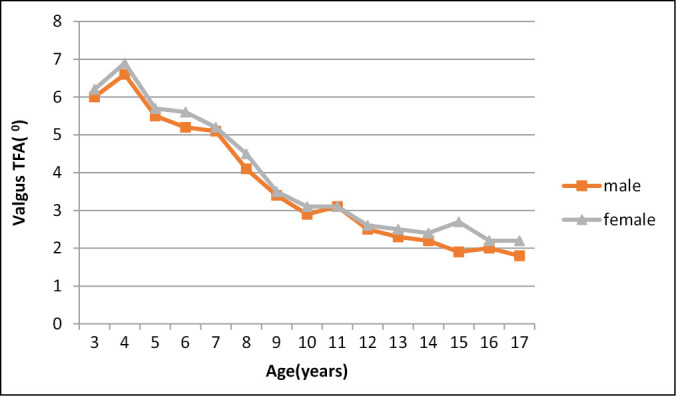
It was found that the majority of the subjects (97.6%) had valgus TFA. The maximum knee valgus angle from the study was 6.8° ± 0.80° at 4 years. Thereafter, the knee valgus angle declined to a mean of 2° at 17 years.
There were physiological changes in TFAs noted, which vary with regards to both age and gender of the subject.
下肢角畸形在儿童中很常见,是骨科转诊的常见原因。这些畸形通常在儿童开始行走时出现,通常使用胫股角(TFA)进行测量,该角代表股骨解剖轴与胫骨解剖轴相交形成的角度。
本研究旨在确定尼日利亚东南部健康儿童的胫股角,并确定性别和年龄对该角度的影响。
这项横断面研究在埃努古市对3147名3至17岁的学童和青少年进行。
发现大多数受试者(97.6%)有外翻胫股角。研究中最大的膝外翻角在4岁时为6.8°±0.80°。此后,膝外翻角在17岁时降至平均2°。
注意到胫股角存在生理变化,这因受试者的年龄和性别而异。