Xiang Dao-Chun, Xie Wen-Long, Cheng Gang-Ying, Yue Ming, Du Xiao-Yi, Jiang Jue
Department of Pharmacy, The Central Hospital of Wuhan, Tongji Medical College, Huazhong University of Science and Technology, Wuhan, 430014, China.
Department of Pediatrics, Maternal and Child Hospital of Hubei Province, Tongji Medical College, Huazhong University of Science and Technology, Wuhan, 430070, China.
Heliyon. 2024 Sep 7;10(18):e37547. doi: 10.1016/j.heliyon.2024.e37547. eCollection 2024 Sep 30.
Fluoroquinolones, including ciprofloxacin, levofloxacin, and moxifloxacin, are extensively employed as broad-spectrum antibacterial agents. However, their use is discouraged during pregnancy due to potential adverse events (AEs). The aim of this study is to systematically investigate the association between fluoroquinolones (specifically ciprofloxacin, levofloxacin, and moxifloxacin) and AEs related to pregnancy, as well as their potential impact on congenital disorders.
A disproportionality analysis was conducted utilizing FDA Adverse Event Reporting System (FAERS) data spanning from the first quarter of 2004 to September 2023. The objective was to identify potential AEs signatures associated with fluoroquinolones through conducting reporting odds ratios (RORs) and Bayesian confidence propagation neural networks (BCPNN). Assessing the potential risk of pregnancy-associated AEs involved comparing each fluoroquinolone with all other medications. Additionally, in-depth comparative analyses were carried out between various fluoroquinolones and a reference drug (azithromycin).
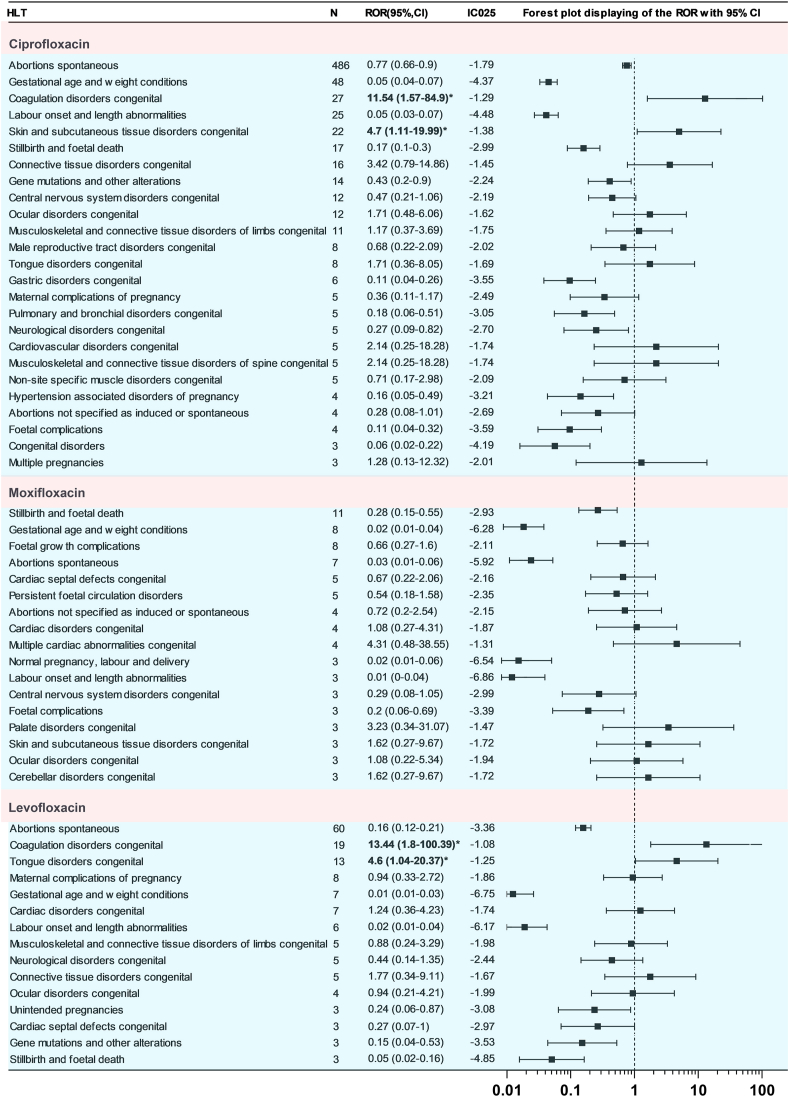
A total of 1159 cases were identified, involving AEs related to pregnancy and congenital disorders. Obvious disproportionate association of abortion spontaneous and other nine AEs was identified for fluoroquinolone during gestation. Upon comparison with all the other drugs, ciprofloxacin exhibited an elevated risk of spontaneous abortion, non-site specific bone disorders congenital and 10 other significant signals. Levofloxacin demonstrated an increased risk of congenital tongue disorders and three other significant signals. Moxifloxacin displayed a noteworthy signal indicating multiple congenital cardiac abnormalities.
We present compelling evidence regarding pregnancy-related AEs and congenital disorders linked to fluoroquinolones. Considering perinatal and genotoxicity aspects, we explore whether levofloxacin or moxifloxacin might be preferable when fluoroquinolones are deemed necessary to balance the benefits of pregnant women and fetuses.
氟喹诺酮类药物,包括环丙沙星、左氧氟沙星和莫西沙星,被广泛用作广谱抗菌剂。然而,由于潜在的不良事件(AE),在怀孕期间不鼓励使用它们。本研究的目的是系统地调查氟喹诺酮类药物(特别是环丙沙星、左氧氟沙星和莫西沙星)与妊娠相关不良事件之间的关联,以及它们对先天性疾病的潜在影响。
利用美国食品药品监督管理局不良事件报告系统(FAERS)2004年第一季度至2023年9月的数据进行不成比例分析。目的是通过计算报告比值比(ROR)和贝叶斯置信传播神经网络(BCPNN)来识别与氟喹诺酮类药物相关的潜在不良事件特征。评估妊娠相关不良事件的潜在风险包括将每种氟喹诺酮与所有其他药物进行比较。此外,还对各种氟喹诺酮与一种参考药物(阿奇霉素)进行了深入的比较分析。
共识别出1159例病例,涉及与妊娠和先天性疾病相关的不良事件。在妊娠期,氟喹诺酮类药物与自然流产和其他九种不良事件存在明显的不成比例关联。与所有其他药物相比,环丙沙星出现自然流产、非特定部位先天性骨骼疾病及其他10个显著信号的风险升高。左氧氟沙星出现先天性舌疾病及其他三个显著信号的风险增加。莫西沙星显示出一个值得注意的信号,表明存在多种先天性心脏异常。
我们提供了关于氟喹诺酮类药物与妊娠相关不良事件和先天性疾病的有力证据。考虑到围产期和遗传毒性方面,我们探讨了在认为有必要使用氟喹诺酮类药物时,左氧氟沙星或莫西沙星是否可能更可取,以平衡孕妇和胎儿的利益。