Collins Reagan A, Nimmer Kaitlyn, Sheriff Salma A, Arora Tania K, Kothari Anai N, Cunningham Carrie, Clarke Callisia N
From the Department of Surgery, Massachusetts General Hospital, Boston, MA.
School of Medicine, Texas Tech University Health Sciences Center, Lubbock, TX.
Ann Surg Open. 2024 Jul 11;5(3):e469. doi: 10.1097/AS9.0000000000000469. eCollection 2024 Sep.
To evaluate characteristics of matched and unmatched general surgery residency (GSR) applicants.
Given the recent change of the United States Medical Licensing Exam Step 1 grading to pass/fail, understanding the factors that influence GSR match success is integral to identifying potential interventions to improve match rates for diverse medical students.
Retrospective review of GSR National Residency Matching Program (NRMP) applicant and Accreditation Council for Graduate Medical Education (ACGME) active resident data between 2011 and 2022. Data included application characteristics for United States ("US") and "independent" applicants, factors cited by program directors in the interview and ranking process, paths pursued if applicants went unmatched, and racial/ethnic representation.
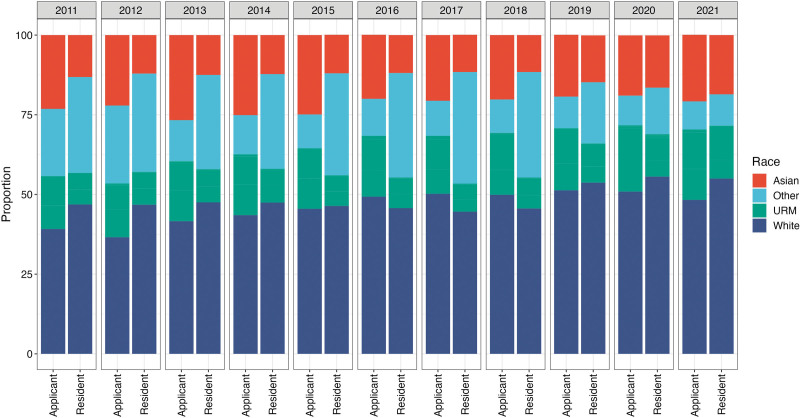
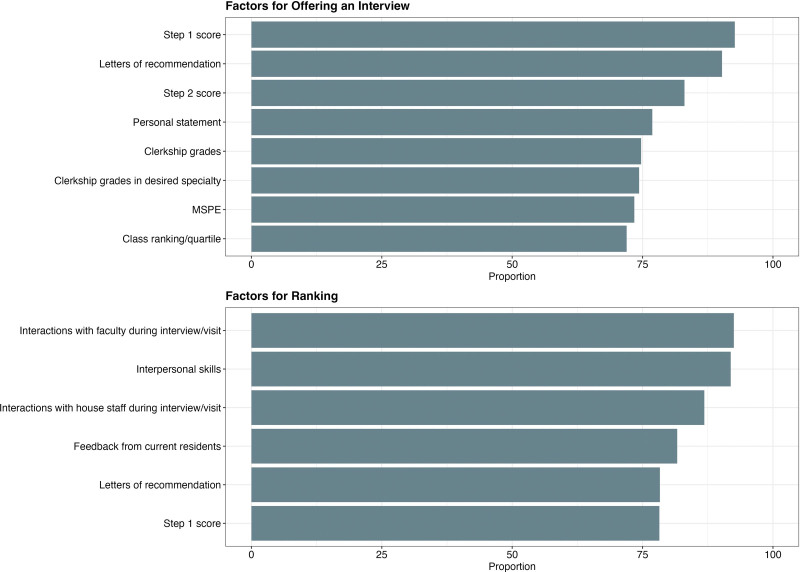
A total of 9149 US and 3985 independent applicants applied to GSR between 2011 and 2021. Matched unmatched applicants had higher step 1 scores (US: 236 218, 0.005; independent: 237 228, 0.001), higher step 2 scores (US: 248 232, 0.006; independent: 245 234, 0.001), more likely to belong to alpha omega alpha (US: 17.1% 1.6%, 0.002) or to attend a top 40 National Institutes of Health-funded school (US: 31.0% 19.4%, 0.002) compared to unmatched applicants. Program directors heavily factored step 1 and step 2 scores, letters of recommendation, interactions with faculty and trainees, and interpersonal skills when interviewing and ranking applicants. The proportion of active general surgery residents applicants was lower for Asians (12.3% 20.9%, 0.001), Black/African American (5.0% 8.8%, 0.001), Hispanic/Latino (5.0% 9.4%, 0.001), and underrepresented in medicine students (10.3% 19.1%, 0.001).
In the pass/fail step 1 era, factors including step 2 score and other subjective metrics may be more heavily weighted in the GSR match process.
评估普通外科住院医师培训(GSR)匹配和未匹配申请人的特征。
鉴于美国医师执照考试第一步评分最近改为通过/失败,了解影响GSR匹配成功的因素对于确定潜在干预措施以提高不同医学生的匹配率至关重要。
对2011年至2022年期间GSR全国住院医师匹配计划(NRMP)申请人和研究生医学教育认证委员会(ACGME)在职住院医师数据进行回顾性审查。数据包括美国(“US”)和“独立”申请人的申请特征、项目主任在面试和排名过程中提到的因素、申请人未匹配时所走的路径以及种族/族裔代表性。
2011年至2021年期间,共有9149名美国申请人和3985名独立申请人申请GSR。匹配的申请人与未匹配的申请人相比,第一步成绩更高(美国:236对218,P<0.005;独立:237对228,P<0.001),第二步成绩更高(美国:248对232,P<0.006;独立:245对234,P<0.001),更有可能属于αΩα(美国:17.1%对1.6%,P<0.002)或就读于国立卫生研究院资助的前40名学校(美国:31.0%对19.4%,P<0.002)。项目主任在面试和排名申请人时,会重点考虑第一步和第二步成绩、推荐信、与教员和学员的互动以及人际交往能力。亚裔(12.3%对20.9%,P<0.001)、黑人/非裔美国人(5.0%对8.8%,P<0.001)、西班牙裔/拉丁裔(5.0%对9.4%,P<0.001)以及医学领域代表性不足的学生(10.3%对19.1%,P<0.001)中在职普通外科住院医师与申请人的比例较低。
在第一步考试为通过/失败的时代,包括第二步成绩和其他主观指标在内的因素在GSR匹配过程中可能权重更大。