Husband R J, Liermann H P, McHardy J D, McWilliams R S, Goncharov A F, Prakapenka V B, Edmund E, Chariton S, Konôpková Z, Strohm C, Sanchez-Valle C, Frost M, Andriambariarijaona L, Appel K, Baehtz C, Ball O B, Briggs R, Buchen J, Cerantola V, Choi J, Coleman A L, Cynn H, Dwivedi A, Graafsma H, Hwang H, Koemets E, Laurus T, Lee Y, Li X, Marquardt H, Mondal A, Nakatsutsumi M, Ninet S, Pace E, Pepin C, Prescher C, Stern S, Sztuk-Dambietz J, Zastrau U, McMahon M I
Deutsches Elektronen-Synchrotron DESY, Hamburg, Germany.
SUPA, School of Physics and Astronomy, and Centre for Science at Extreme Conditions, The University of Edinburgh, Edinburgh, UK.
Nat Commun. 2024 Sep 23;15(1):8256. doi: 10.1038/s41467-024-52505-0.
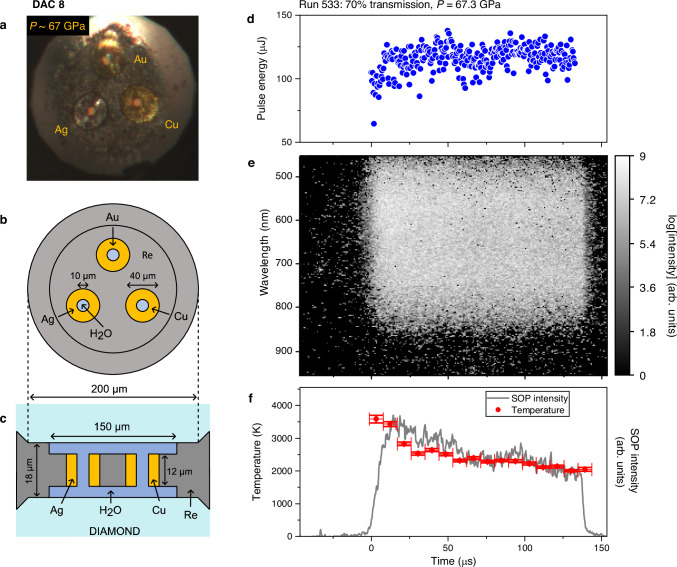
HO transforms to two forms of superionic (SI) ice at high pressures and temperatures, which contain highly mobile protons within a solid oxygen sublattice. Yet the stability field of both phases remains debated. Here, we present the results of an ultrafast X-ray heating study utilizing MHz pulse trains produced by the European X-ray Free Electron Laser to create high temperature states of HO, which were probed using X-ray diffraction during dynamic cooling. We confirm an isostructural transition during heating in the 26-69 GPa range, consistent with the formation of SI-bcc. In contrast to prior work, SI-fcc was observed exclusively above ~50 GPa, despite evidence of melting at lower pressures. The absence of SI-fcc in lower pressure runs is attributed to short heating timescales and the pressure-temperature path induced by the pump-probe heating scheme in which HO was heated above its melting temperature before the observation of quenched crystalline states, based on the earlier theoretical prediction that SI-bcc nucleates more readily from the fluid than SI-fcc. Our results may have implications for the stability of SI phases in ice-rich planets, for example during dynamic freezing, where the preferential crystallization of SI-bcc may result in distinct physical properties across mantle ice layers.
在高压和高温下,HO会转变为两种超离子(SI)冰形式,它们在固体氧亚晶格中含有高度移动的质子。然而,这两个相的稳定域仍存在争议。在此,我们展示了一项超快X射线加热研究的结果,该研究利用欧洲X射线自由电子激光产生的兆赫兹脉冲序列来创建HO的高温状态,并在动态冷却过程中使用X射线衍射对其进行探测。我们证实了在26 - 69吉帕范围内加热过程中的同结构转变,这与SI - bcc的形成一致。与先前的工作不同,尽管有证据表明在较低压力下会发生熔化,但仅在约50吉帕以上观察到了SI - fcc。在较低压力运行中未出现SI - fcc归因于加热时间尺度较短以及泵浦 - 探测加热方案所诱导的压力 - 温度路径,在该方案中,基于早期理论预测SI - bcc比SI - fcc更容易从流体中形核,HO在观察到淬火晶体状态之前就被加热到了其熔化温度以上。我们的结果可能对富含冰的行星中SI相的稳定性有影响,例如在动态冻结过程中,SI - bcc的优先结晶可能导致地幔冰层具有不同的物理性质。