Lu Nike, Lau Patrick W C, Song Huiqi, Zhang Yuxin, Ghani Ruhina Binta A, Wang Chenglong
Department of Sport, Physical Education and Health, Hong Kong Baptist University, China.
JC School of Public Health and Primary Care, The Chinese University of Hong Kong, China.
J Exerc Sci Fit. 2024 Oct;22(4):417-428. doi: 10.1016/j.jesf.2024.09.002. Epub 2024 Sep 11.
BACKGROUND/OBJECTIVE: Physical activity (PA) self-efficacy plays a crucial role in maintaining and enhancing PA behaviors in children. However, the effectiveness of eHealth interventions in boosting PA self-efficacy among children remains uncertain. Furthermore, which behavior change techniques (BCTs) used in eHealth interventions can positively influence children's PA self-efficacy needs further exploration for designing tailored eHealth interventions. Therefore, this systematic review and meta-analysis aimed to identify the effectiveness of eHealth interventions and BCTs in promoting children's PA self-efficacy.
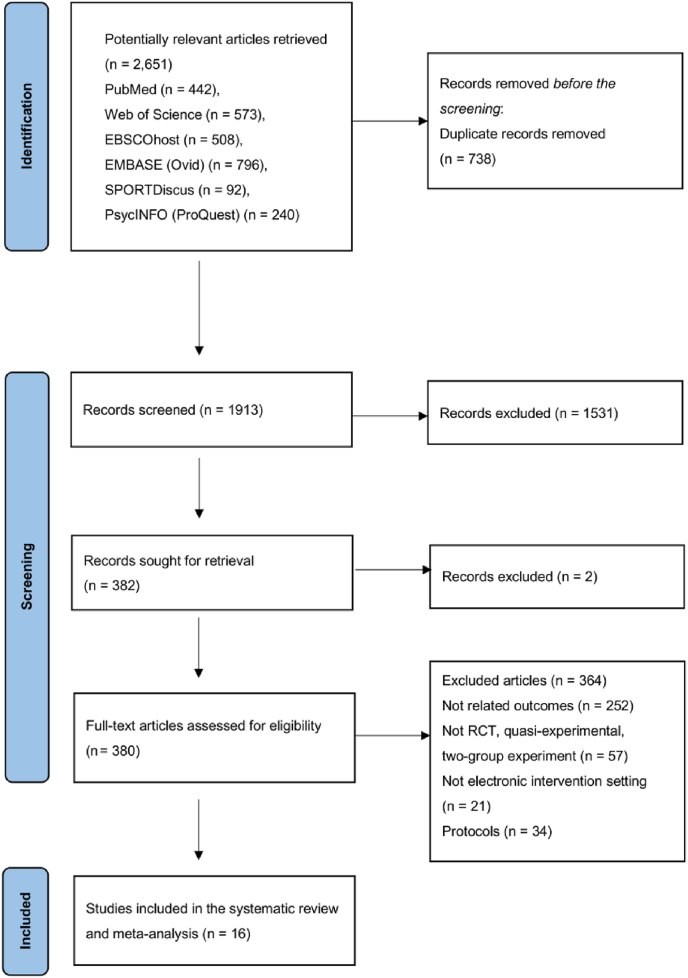
Following the Preferred Reporting Items for Systematic Reviews and Meta-Analyses (PRISMA) guidelines, a comprehensive search was conducted across six databases (PubMed, Web of Science, EBSCOhost, Ovid, SPORTDiscus, PsycINFO) up to January 8, 2024. Inclusion criteria included randomized controlled trials (RCT), quasi-experimental, and two-group experiments that examined the effect of eHealth interventions on PA self-efficacy among healthy children aged 0-18 years. The Physiotherapy Evidence Database (PEDro) scale was utilized to assess the risk of bias. Random effects meta-analysis was performed to determine the effectiveness of eHealth interventions and BCTs in selected studies.
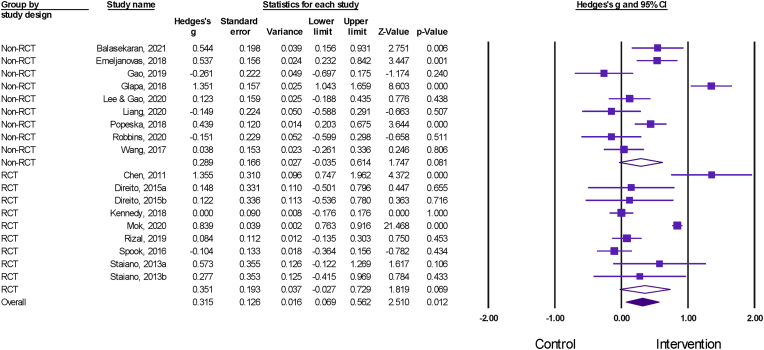
Sixteen studies were screened, including 6020 participants with an average age of 11.58 years (SD = 2.87). The result showed small but significant intervention effects with high heterogeneity (I = 92.34 %) for postintervention PA self-efficacy ( = 0.315; 95 % CI = 0.069, 0.562, = .012). Two BCTs were significantly associated with enhanced PA self-efficacy: (p = .003) and ( = .036). Additionally, studies that adopted social support (unspecified) a nd prompt/cues were significantly less effective than studies that did not use these BCTs (p = .001).
The findings showed that eHealth interventions positively affect children's PA self-efficacy. This review is the pioneer in focusing on BCTs in eHealth interventions for children. The insights gained provide valuable knowledge about tailored BCTs incorporated into eHealth interventions that promote children's PA self-efficacy.
International Prospective Register of Systematic Review (PROSPERO): CRD42024512058.
背景/目的:身体活动(PA)自我效能在维持和增强儿童的PA行为方面起着关键作用。然而,电子健康干预在提高儿童PA自我效能方面的有效性仍不确定。此外,电子健康干预中使用的哪些行为改变技术(BCTs)能对儿童的PA自我效能产生积极影响,这需要进一步探索以设计量身定制的电子健康干预措施。因此,本系统评价和荟萃分析旨在确定电子健康干预和BCTs在促进儿童PA自我效能方面的有效性。
按照系统评价和荟萃分析的首选报告项目(PRISMA)指南,截至2024年1月8日,在六个数据库(PubMed、科学网、EBSCOhost、Ovid、SPORTDiscus、PsycINFO)中进行了全面检索。纳入标准包括随机对照试验(RCT)、准实验和两组实验,这些实验研究了电子健康干预对0至18岁健康儿童PA自我效能的影响。使用物理治疗证据数据库(PEDro)量表评估偏倚风险。进行随机效应荟萃分析以确定电子健康干预和BCTs在所选研究中的有效性。
筛选出16项研究,包括6020名参与者,平均年龄为11.58岁(标准差 = 2.87)。结果显示,干预后PA自我效能有小但显著的干预效果,异质性高(I = 92.34%)(效应量 = 0.315;95%置信区间 = 0.069,0.562,P = 0.012)。两种BCTs与增强的PA自我效能显著相关:[具体技术1](P = 0.003)和[具体技术2](P = 0.036)。此外,采用社会支持(未明确说明)和提示/线索的研究比未使用这些BCTs的研究效果显著更差(P = 0.001)。
研究结果表明,电子健康干预对儿童的PA自我效能有积极影响。本综述是专注于儿童电子健康干预中的BCTs的先驱。所获得的见解为纳入促进儿童PA自我效能的电子健康干预中的量身定制的BCTs提供了宝贵的知识。
国际系统评价前瞻性注册库(PROSPERO):CRD42024512058