Department of Animal and Range Sciences, Montana State University, Bozeman, MT 59717-2900, USA.
J Anim Sci. 2024 Jan 3;102. doi: 10.1093/jas/skae284.
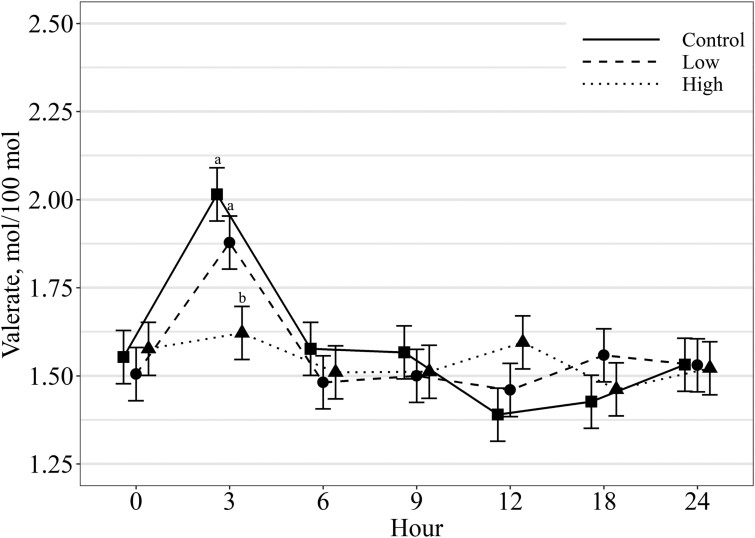
The objectives of this study were to evaluate the levels of supplemental salt on low-quality forage intake, water intake, dry matter (DM) digestibility, and rumen fermentation. Six ruminally cannulated, Angus crossbred heifers (14 mo of age; 449 kg ± 24 kg body weight [BW]) were used in a dual 3 × 3 Latin square design. The heifers were housed in individual stalls with 2 animals assigned to each treatment per period. Salt treatments were mixed into a protein supplement of 50% cracked corn and 50% soybean meal and fed at 0.3% of shrunk BW. Salt treatments consisted of 1) control, no salt (CON), 2) 0.05% of BW salt (LOW), and 3) 0.1% of BW salt (HIGH). Chopped, low-quality (CP = 7.4%; NDF = 64.2%), grass hay was used as the base ration and was provided daily at 120% of the average daily intake of the previous 3 d. Each period included a 14-d diet adaptation, 6 d of sample collection, 1 d collection of rumen fluid samples for ruminal and microbial profiles. Individual forage dry matter intake, water intake, and DM digestibility were measured during the 6-d collection period. Rumen pH, ammonia levels, and volatile fatty acid (VFA) concentrations were measured during the 1-d ruminal profile. Rumen DM and liquid fill were determined with a 5-h post-feeding rumen evacuation. Supplemental salt had no influence on forage intake (P = 0.19) expressed on a kg/d basis yet tended to decrease linearly (P = 0.06) with increasing levels of salt when expressed on a grams/kg BW basis. DM digestibility was not influenced by salt levels (P > 0.05), but DM fill tended to increase linearly with increasing salt levels (P = 0.06). Water intake and liquid fill, however, increased linearly with increasing levels of salt (P < 0.01) with an 18.9% increase in water intake and 17.0% increase in liquid fill compared to control animals. Ruminal pH and ammonia levels both decreased linearly with increasing salt (P < 0.01). Acetate concentration and acetate: propionate ratio increased linearly with increasing levels of salt (P < 0.01). In contrast, isobutyrate and butyrate concentrations decreased linearly with increasing levels of salt (P < 0.01). Our research suggests that increasing levels of salt tends to influence dry matter intake, DM fill, liquid kinetics, and rumen fermentation characteristics. Results from this research provide additional information on how salt-limited supplements may impact beef cattle consuming low-quality forage diets.
本研究的目的是评估补充盐对低质饲料采食量、饮水量、干物质(DM)消化率和瘤胃发酵的影响。选用 6 头安装有永久性瘤胃瘘管的安格斯杂交小母牛(14 月龄;449 ± 24 kg 体重),采用双重 3×3 拉丁方设计。小母牛单独饲养,每周期每处理 2 头。盐处理是将盐混合到 50%破碎玉米和 50%豆粕的蛋白质补充料中,按收缩体重的 0.3%添加。盐处理包括 1)对照,无盐(CON),2)0.05% BW 盐(LOW)和 3)0.1% BW 盐(HIGH)。用切碎的低质量(CP=7.4%;NDF=64.2%)、草干草作为基础日粮,每天提供的量为前 3d 平均日采食量的 120%。每个周期包括 14d 的饮食适应期、6d 的样品收集期和 1d 的瘤胃液样本收集期,用于瘤胃和微生物分析。在 6d 的采样期内测量个体饲料干物质采食量、饮水量和 DM 消化率。在 1d 的瘤胃分析期间测量瘤胃 pH 值、氨水平和挥发性脂肪酸(VFA)浓度。在 5h 的餐后瘤胃排空后测量补充盐对瘤胃 DM 和液体填充的影响。补充盐对饲料采食量(P=0.19)没有影响,按 kg/d 表示,但按 g/kg BW 表示时,随着盐水平的增加呈线性趋势(P=0.06)。DM 消化率不受盐水平的影响(P>0.05),但 DM 填充量随盐水平的增加呈线性趋势(P=0.06)。然而,随着盐水平的增加,饮水量和液体填充量呈线性增加(P<0.01),与对照组相比,饮水量增加 18.9%,液体填充量增加 17.0%。瘤胃 pH 值和氨水平均随盐水平的增加呈线性下降(P<0.01)。乙酸浓度和乙酸:丙酸比随盐水平的增加呈线性增加(P<0.01)。相反,异丁酸和丁酸浓度随盐水平的增加呈线性下降(P<0.01)。我们的研究表明,盐水平的增加往往会影响干物质采食量、DM 填充量、液体动力学和瘤胃发酵特性。本研究的结果提供了有关盐限制补充料如何影响采食低质饲料的肉牛的更多信息。