Emerg Infect Dis. 2024 Oct;30(10):2118-2127. doi: 10.3201/eid3010.240159.
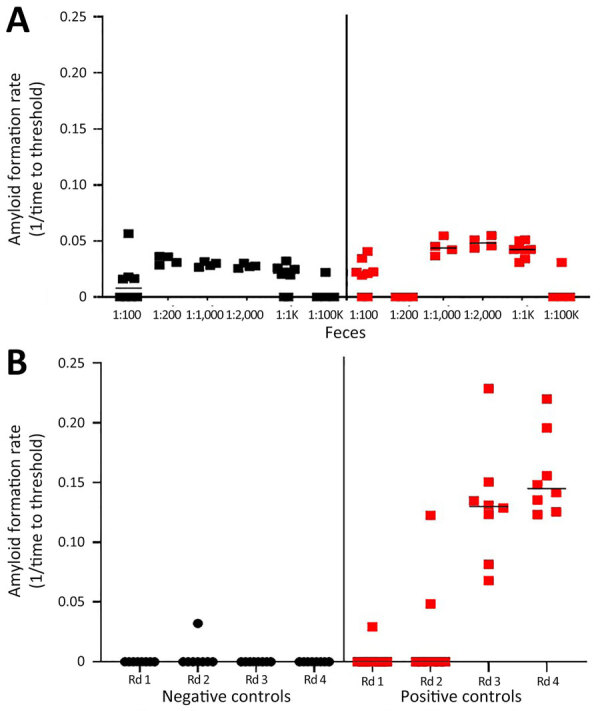
Chronic wasting disease (CWD) affects cervids in North America, Asia, and Scandinavia. CWD is unique in its efficient spread, partially because of contact with infectious prions shed in secreta. To assess temporal profiles of CWD prion shedding, we collected saliva, urine, and feces from white-tailed deer for 66 months after exposure to low oral doses of CWD-positive brain tissue or saliva. We analyzed prion seeding activity by using modified amyloid amplification assays incorporating iron oxide bead extraction, which improved CWD detection and reduced false positives. CWD prions were detected in feces, urine, and saliva as early as 6 months postinfection. More frequent and consistent shedding was observed in deer homozygous for glycine at prion protein gene codon 96 than in deer expressing alternate genotypes. Our findings demonstrate that improved amplification methods can be used to identify early antemortem CWD prion shedding, which might aid in disease surveillance of cervids.
慢性消耗病(CWD)影响北美洲、亚洲和斯堪的纳维亚的有蹄类动物。CWD 的传播效率很高,部分原因是与传染性朊病毒接触,这些病毒会在分泌物中排出。为了评估 CWD 朊病毒排出的时间分布,我们在接触低剂量口服 CWD 阳性脑组织或唾液后,对 66 个月的白尾鹿的唾液、尿液和粪便进行了收集。我们使用改良的淀粉样蛋白扩增测定法分析了朊病毒的接种活性,其中包括氧化铁珠提取,这提高了 CWD 的检测能力并减少了假阳性。早在感染后 6 个月,就在粪便、尿液和唾液中检测到了 CWD 朊病毒。在朊病毒蛋白基因密码子 96 处为甘氨酸纯合的鹿中,比表达其他基因型的鹿中,更频繁和一致地观察到朊病毒的排出。我们的研究结果表明,改进的扩增方法可用于识别早期的死后 CWD 朊病毒排出,这可能有助于有蹄类动物疾病的监测。