Cheng Yo Ching, Hannaoui Samia, John Theodore R, Dudas Sandor, Czub Stefanie, Gilch Sabine
Dept. of Ecosystem and Public Health, Faculty of Veterinary Medicine, University of Calgary, Calgary, Canada.
Dept. of Molecular Biology, University of Wyoming, Laramie, United States of America.
PLoS One. 2016 Nov 9;11(11):e0166187. doi: 10.1371/journal.pone.0166187. eCollection 2016.
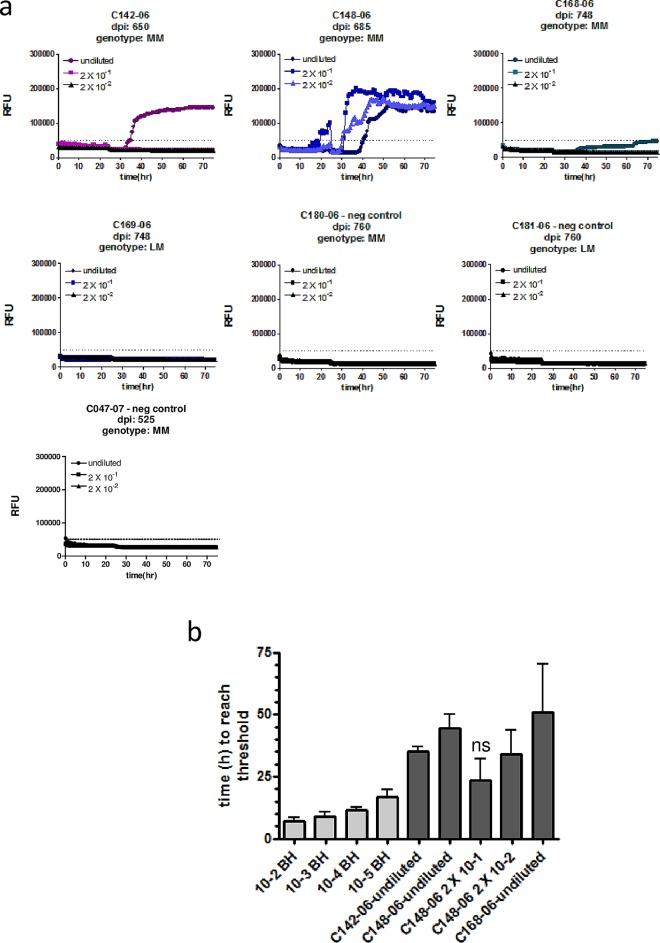
Chronic wasting disease (CWD) is a fatal prion disease of wild and captive cervids in North America. Prions are infectious agents composed of a misfolded version of a host-encoded protein, termed PrPSc. Infected cervids excrete and secrete prions, contributing to lateral transmission. Geographical distribution is expanding and case numbers in wild cervids are increasing. Recently, the first European cases of CWD have been reported in a wild reindeer and two moose from Norway. Therefore, methods to detect the infection early in the incubation time using easily available samples are desirable to facilitate effective disease management. We have adapted the real-time quaking induced conversion (RT-QuIC) assay, a sensitive in vitro prion amplification method, for pre-clinical detection of prion seeding activity in elk feces. Testing fecal samples from orally inoculated elk taken at various time points post infection revealed early shedding and detectable prion seeding activity throughout the disease course. Early shedding was also found in two elk encoding a PrP genotype associated with reduced susceptibility for CWD. In summary, we suggest that detection of CWD prions in feces by RT-QuIC may become a useful tool to support CWD surveillance in wild and captive cervids. The finding of early shedding independent of the elk's prion protein genotype raises the question whether prolonged survival is beneficial, considering accumulation of environmental prions and its contribution to CWD transmission upon extended duration of shedding.
慢性消耗病(CWD)是北美洲野生和圈养鹿科动物的一种致命朊病毒病。朊病毒是由宿主编码蛋白的错误折叠形式组成的感染性因子,称为PrPSc。受感染的鹿科动物会排泄和分泌朊病毒,导致横向传播。其地理分布正在扩大,野生鹿科动物中的病例数量也在增加。最近,在挪威的一头野生驯鹿和两头驼鹿中报告了欧洲首例慢性消耗病病例。因此,需要利用易于获取的样本在潜伏期早期检测感染的方法,以促进有效的疾病管理。我们对实时颤抖诱导转化(RT-QuIC)检测法(一种灵敏的体外朊病毒扩增方法)进行了改进,用于临床前检测麋鹿粪便中的朊病毒播种活性。检测感染后不同时间点采集的经口接种麋鹿的粪便样本,发现在整个病程中都有早期排泄和可检测到的朊病毒播种活性。在两头编码与慢性消耗病易感性降低相关的PrP基因型的麋鹿中也发现了早期排泄。总之,我们认为通过RT-QuIC检测粪便中的慢性消耗病朊病毒可能成为支持野生和圈养鹿科动物慢性消耗病监测的有用工具。不依赖于麋鹿朊病毒蛋白基因型而发现早期排泄,这就提出了一个问题:考虑到环境中朊病毒的积累及其在延长排泄期时对慢性消耗病传播的作用,延长存活时间是否有益。