Applied Cognitive and Brain Sciences, Department of Psychology, Drexel University, Philadelphia, PA 19104, United States of America.
Starfish Neuroscience, Bellevue, WA 98004, United States of America.
J Neural Eng. 2024 Oct 24;21(5):056035. doi: 10.1088/1741-2552/ad7f87.
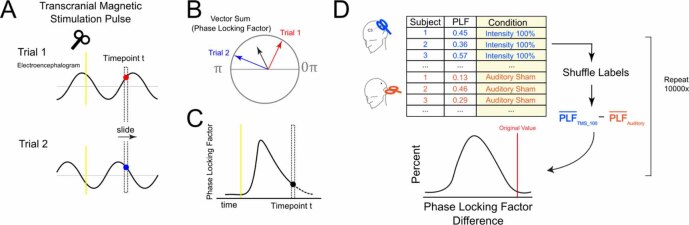
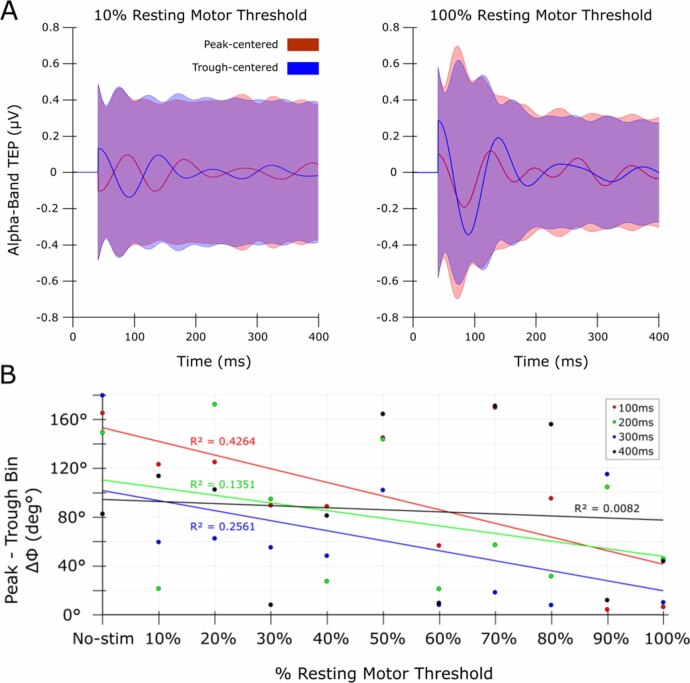
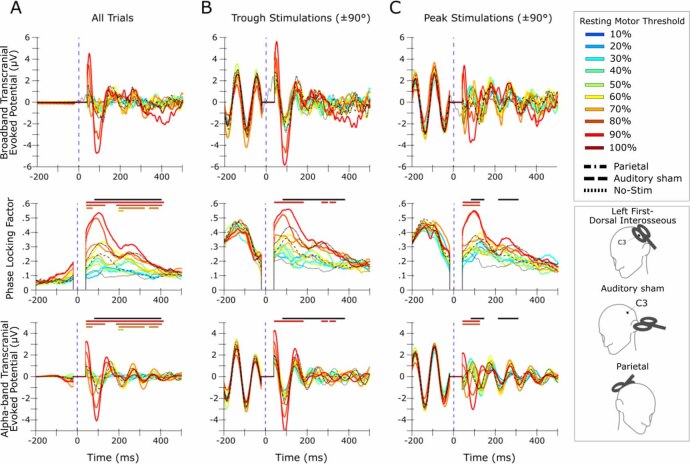
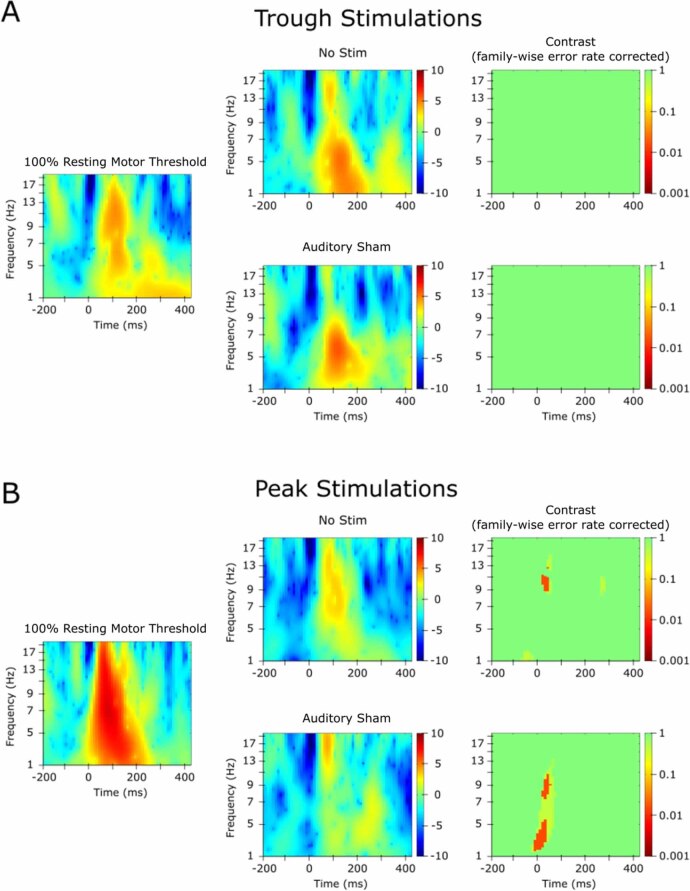
. The phase of the electroencephalographic (EEG) signal predicts performance in motor, somatosensory, and cognitive functions. Studies suggest that brain phase resets align neural oscillations with external stimuli, or couple oscillations across frequency bands and brain regions. Transcranial Magnetic Stimulation (TMS) can cause phase resets noninvasively in the cortex, thus providing the potential to control phase-sensitive cognitive functions. However, the relationship between TMS parameters and phase resetting is not fully understood. This is especially true of TMS intensity, which may be crucial to enabling precise control over the amount of phase resetting that is induced. Additionally, TMS phase resetting may interact with the instantaneous phase of the brain. Understanding these relationships is crucial to the development of more powerful and controllable stimulation protocols.To test these relationships, we conducted a TMS-EEG study. We applied single-pulse TMS at varying degrees of stimulation intensity to the motor area in an open loop. Offline, we used an autoregressive algorithm to estimate the phase of the intrinsic-Alpha rhythm of the motor cortex at the moment each TMS pulse was delivered.. We identified post-stimulation epochs where-Alpha phase resetting and N100 amplitude depend parametrically on TMS intensity and are significantperipheral auditory sham stimulation. We observed-Alpha phase inversion after stimulations near peaks but not troughs in the endogenous-Alpha rhythm.. These data suggest that low-intensity TMS primarily resets existing oscillations, while at higher intensities TMS may activate previously silent neurons, but only when endogenous oscillations are near the peak phase. These data can guide future studies that seek to induce phase resetting, and point to a way to manipulate the phase resetting effect of TMS by varying only the timing of the pulse with respect to ongoing brain activity.
. 脑电(EEG)信号的相位可以预测运动、感觉和认知功能的表现。研究表明,大脑相位重置使神经振荡与外部刺激同步,或使不同频率带和脑区的振荡耦合。经颅磁刺激(TMS)可以非侵入性地在皮层中引起相位重置,从而提供控制相位敏感认知功能的潜力。然而,TMS 参数与相位重置之间的关系尚未完全了解。TMS 强度尤其如此,它可能对精确控制诱导的相位重置量至关重要。此外,TMS 相位重置可能与大脑的瞬时相位相互作用。了解这些关系对于开发更强大和可控的刺激方案至关重要。为了测试这些关系,我们进行了一项 TMS-EEG 研究。我们在开环中以不同程度的刺激强度将单脉冲 TMS 施加到运动区。离线时,我们使用自回归算法来估计每个 TMS 脉冲施加时运动皮层固有 Alpha 节律的相位。我们确定了后刺激时段,其中-Alpha 相位重置和 N100 幅度取决于 TMS 强度的参数,并且在外周听觉假刺激时具有统计学意义。我们观察到在刺激接近内源性-Alpha 节律的波峰而不是波谷时会发生-Alpha 相位反转。这些数据表明,低强度 TMS 主要重置现有的振荡,而在更高强度下,TMS 可能会激活先前沉默的神经元,但仅当内源性振荡接近峰值相位时才会激活。这些数据可以指导未来的研究,这些研究旨在通过仅改变与正在进行的脑活动相关的脉冲时间来诱导相位重置,并指出一种通过改变脉冲相对于正在进行的脑活动的时间来操纵 TMS 的相位重置效果的方法。