Elliott Matthew V, John Oliver P, Allen J D, Johnson Sheri L
Department of Psychology, University of California, Berkeley, Berkeley, CA, United States.
Front Psychiatry. 2024 Sep 12;15:1412001. doi: 10.3389/fpsyt.2024.1412001. eCollection 2024.
Urgency has been defined as the tendency towards rash speech and behavior in the context of emotion. Measures of Urgency have been found to have robust predictive power for psychopathologies and problematic behaviors. In the current study, we question whether emotions are unique drivers of urgency, or if emotions are potent exemplars of contexts that lead to rash speech and behavior. The Emotion Specific model and the Broader Contexts model correspond with these two conceptualizations of urgency, and they frame our pre-registered hypotheses.
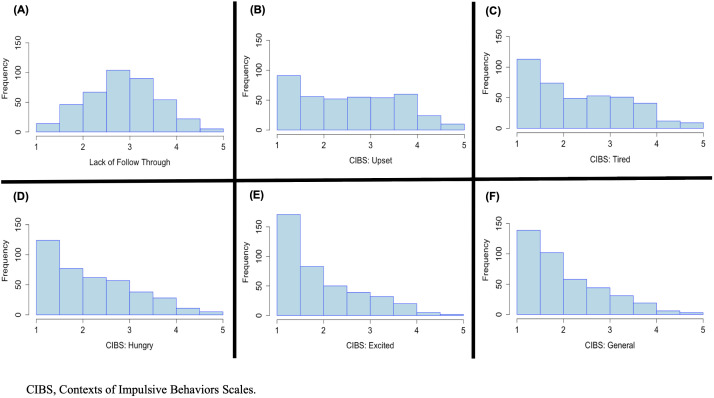
Participants from two well-powered samples ( = 600, = 588) completed 9 modified items from the Urgency and Positive Urgency scales to assess rash responses in each of four contexts - "Upset," "Excited," "Tired," and "Hungry" - and a fifth "In General" set. After data cleaning, we used principal components analysis to construct a unidimensional, 4-item set that was applied to capture impulsive behavior across the five contexts.
We found that this research tool, called the Contexts of Impulsive Behaviors (CIBS), replicated in the second dataset, and it had adequate internal reliability in both samples. Although the Emotion Specific model was supported by the fact that the Upset context had a greater mean and greater variance than the Tired and Hungry contexts, most results supported the Broader Contexts model. That is, CIBS contexts were highly intercorrelated, and bivariate correlations with psychopathology were not significantly different across contexts. In partial correlations, effects of the Upset and Excited contexts were partially or fully statistically mediated by the Tired and Hungry contexts.
These findings suggest that emotions are potent contexts for impulsive behaviors. At the same time, those with high urgency are vulnerable to impulsivity in other contexts, such as fatigue and hunger, that challenge the regulatory functions of the prefrontal cortex. Limitations, future directions, and clinical implications are discussed.
冲动性被定义为在情绪背景下出现轻率言语和行为的倾向。研究发现,冲动性测量指标对精神病理学和问题行为具有强大的预测能力。在当前研究中,我们质疑情绪是否是冲动性的独特驱动因素,或者情绪是否是导致轻率言语和行为的情境的有力例证。情绪特定模型和更广泛情境模型与冲动性的这两种概念化相对应,它们构成了我们预先注册的假设。
来自两个样本量充足的样本(分别为600人和588人)的参与者完成了冲动性和积极冲动性量表中的9个修改项目,以评估在“心烦意乱”“兴奋”“疲惫”“饥饿”这四种情境以及第五种“一般情况”下的轻率反应。在数据清理后,我们使用主成分分析构建了一个单维度的、包含4个项目的量表,用于捕捉这五种情境下的冲动行为。
我们发现,这个名为冲动行为情境量表(CIBS)的研究工具在第二个数据集中得到了重复验证,并且在两个样本中都具有足够的内部信度。尽管心烦意乱情境的均值和方差大于疲惫和饥饿情境这一事实支持了情绪特定模型,但大多数结果支持更广泛情境模型。也就是说,CIBS情境之间高度相互关联,并且与精神病理学的双变量相关性在不同情境下没有显著差异。在偏相关分析中,心烦意乱和兴奋情境的效应部分或完全由疲惫和饥饿情境在统计上介导。
这些发现表明,情绪是冲动行为的有力情境。同时,那些冲动性高的人在其他情境中,如疲劳和饥饿时,也容易出现冲动行为,这些情境会挑战前额叶皮层的调节功能。我们还讨论了研究的局限性、未来方向和临床意义。