Department of Nephrology The Second Affiliated Hospital Jiangxi Medical College Nanchang University, Nanchang, Jiangxi 330006, China.
Biomed Res Int. 2024 Sep 18;2024:5674711. doi: 10.1155/2024/5674711. eCollection 2024.
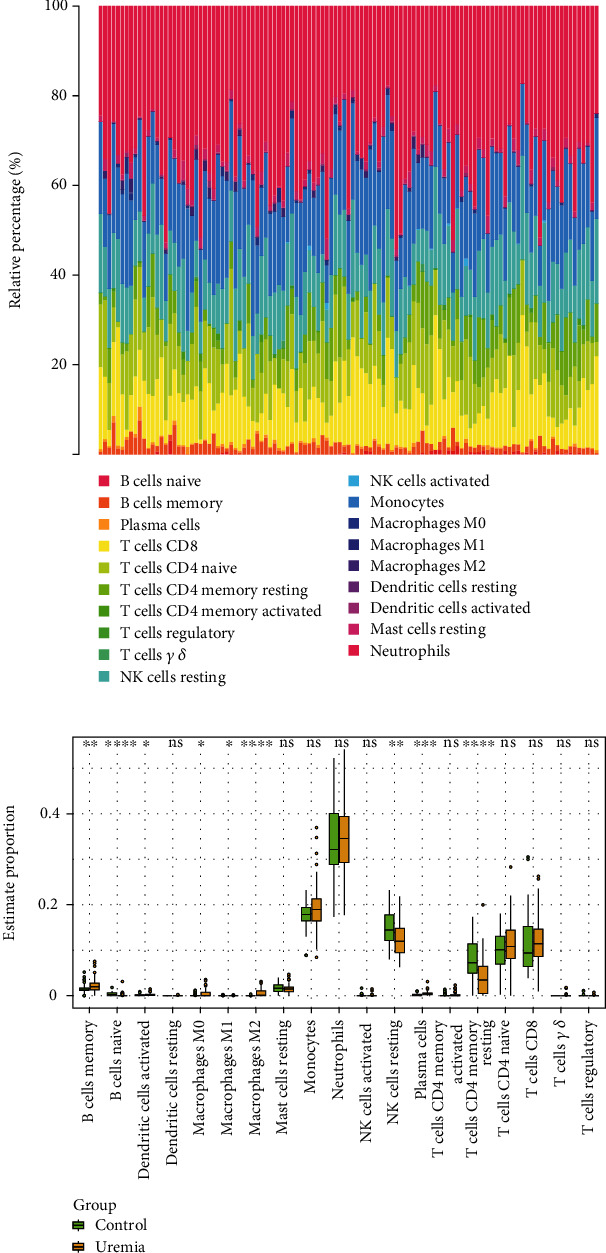
The continuous accumulation of M2 macrophages may potentially contribute to the development of kidney fibrosis in chronic kidney disease (CKD). The purpose of this study was to analyze the infiltration of M2 macrophages in uremic patients and to seek new strategies to slow down the progression of renal fibrosis. We conducted a comprehensive search for expression data pertaining to uremic samples within the Gene Expression Omnibus (GEO) database, encompassing the time frame from 2010 to 2022. Control and uremic differentially expressed genes (DEGs) were identified. Immune cell infiltration was investigated by CIBERSORT and modules associated with M2 macrophage infiltration were identified by weighted gene coexpression network analysis (WGCNA). Consistent genes were identified using the least absolute shrinkage and selection operator (LASSO) and selection and visualization of the most relevant features (SVM-RFE) methods to search for overlapping genes. Receiver operating characteristic (ROC) curves were examined for the diagnostic value of candidate genes. Quantitative real-time PCR (qPCR) examined the expression levels of candidate genes obtained from uremic patients in M2 macrophage. A total of 1298 DEGs were identified within the GSE37171 dataset. Significant enrichment of DEGs was observed in 20 biological processes (BP), 19 cellular components (CC), 6 molecular functions (MF), and 70 Kyoto Encyclopedia of Genes and Genomes (KEGG) pathways. CIBERSORT analysis observed a significant increase in B-cell memory, dendritic cell activation, M0, M1, M2, and plasma cell numbers in uremic samples. We identified the 10 most interrelated genes. In particular, adenomatous polyposis coli (APC) and zinc finger and BTB structural domain 2 (ZBTB2) were adversely associated with the infiltration of M2 macrophages. Importantly, the expression levels of APC and ZBTB2 were far lower in M2 macrophages from uremic patients than those in healthy individuals. The development of renal fibrosis may be the result of M2 macrophage infiltration promoted by APC and ZBTB2.
M2 巨噬细胞的持续积累可能有助于慢性肾脏病 (CKD) 患者肾脏纤维化的发展。本研究旨在分析尿毒症患者中 M2 巨噬细胞的浸润,并寻求新的策略来减缓肾纤维化的进展。我们在基因表达综合数据库 (GEO) 中对与尿毒症样本相关的表达数据进行了全面搜索,涵盖了 2010 年至 2022 年的时间段。鉴定了尿毒症的差异表达基因(DEGs)。通过 CIBERSORT 分析免疫细胞浸润,通过加权基因共表达网络分析(WGCNA)鉴定与 M2 巨噬细胞浸润相关的模块。使用最小绝对收缩和选择算子 (LASSO) 以及选择和可视化最相关特征 (SVM-RFE) 方法识别一致基因,以搜索重叠基因。通过接收者操作特征 (ROC) 曲线检查候选基因的诊断价值。定量实时 PCR (qPCR) 检查从尿毒症患者 M2 巨噬细胞中获得的候选基因的表达水平。在 GSE37171 数据集中鉴定了 1298 个 DEGs。DEGs 在 20 个生物过程 (BP)、19 个细胞成分 (CC)、6 个分子功能 (MF) 和 70 个京都基因与基因组百科全书 (KEGG) 途径中显著富集。CIBERSORT 分析观察到尿毒症样本中 B 细胞记忆、树突状细胞激活、M0、M1、M2 和浆细胞数量显著增加。我们鉴定了 10 个最相关的基因。特别是,腺瘤性结肠息肉病基因 (APC) 和锌指和 BTB 结构域 2 (ZBTB2) 与 M2 巨噬细胞浸润呈负相关。重要的是,尿毒症患者 M2 巨噬细胞中 APC 和 ZBTB2 的表达水平远低于健康个体。肾纤维化的发展可能是 APC 和 ZBTB2 促进 M2 巨噬细胞浸润的结果。