Department of Medicine, Makerere University College of Health Sciences, Kampala, Uganda.
Infectious Diseases Institute, Makerere University College of Health Sciences, Kampala, Uganda.
BMC Nephrol. 2024 Sep 27;25(1):321. doi: 10.1186/s12882-024-03761-1.
People living with HIV (PLWH) are at risk of kidney function impairment due to HIV-related inflammation, antiretroviral therapy (ART), diabetes mellitus, and hypertension. Older persons may experience a higher burden of chronic kidney disease (CKD) as kidney function declines with increasing age. There is a paucity of data comparing the prevalence of kidney function impairment in older PLWH to that in people without HIV in sub-Saharan Africa.
We conducted a cross-sectional study among people aged ≥ 60 years living with and without HIV in Kampala, Uganda who were matched 1:1 by community location. We collected data on sociodemographics, comorbidities, and HIV-related clinical characteristics. We defined kidney function impairment as an estimated glomerular filtration rate(eGFR) < 60mls/min/1.73m with or without proteinuria. We constructed multivariable logistic regression models to study associations between participant characteristics and kidney function impairment.
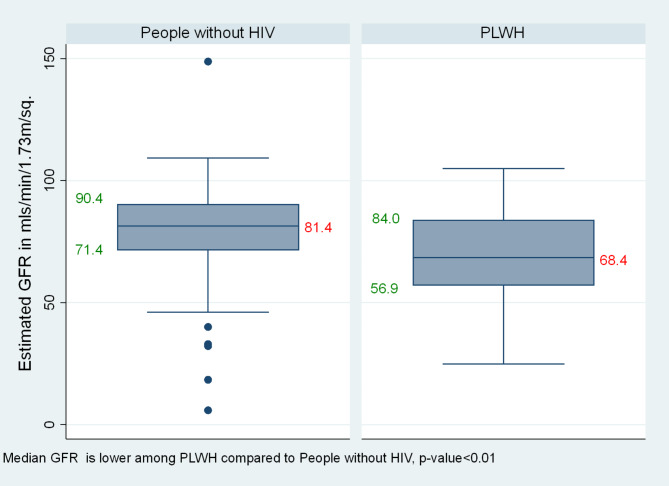
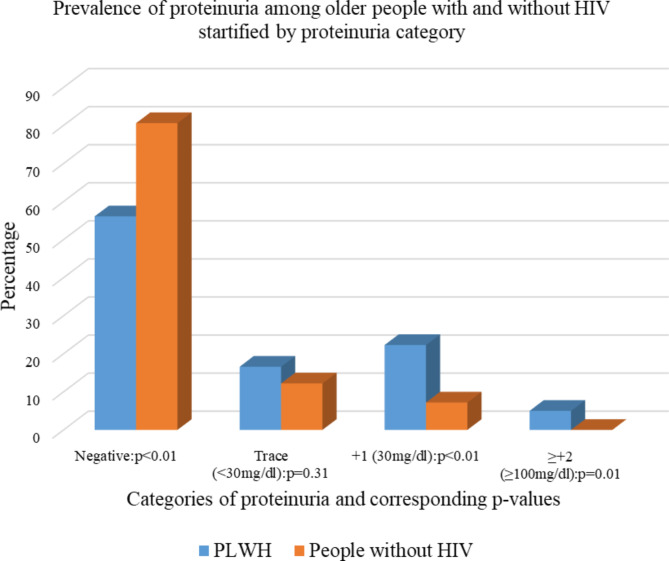
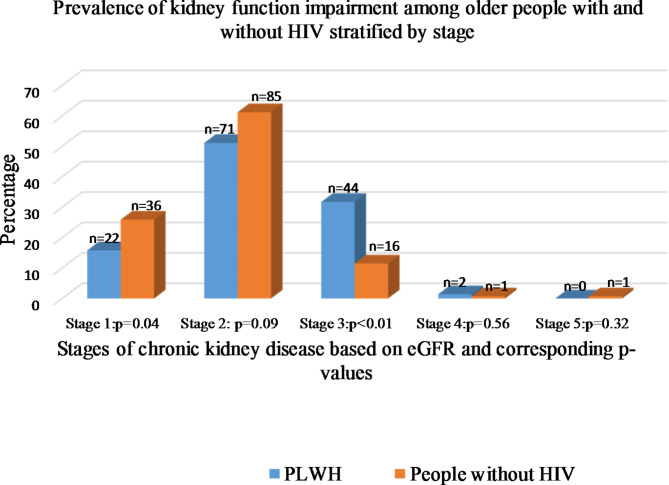
We enrolled 278 people (median age 66 years); 50% were PLWH, and 51.8% were female. Among PLWH, 33.1% (95% CI: 25.7-41.4%) had kidney function impairment versus 12.9% (95% CI: 8.3-19.7%) among people without HIV, (p-value < 0.01). The prevalence of proteinuria among PLWH versus people without HIV was 43.9% (95% CI:35.8-52.3%) versus 19.4% (95% CI:13.6-26.9%) p-value < 0.01. Living with HIV (OR = 3.89(95% CI: 2.04-7.41), p-value < 0.01), older age (OR = 1.13, (95% CI:1.07-1.20), p-value < 0.01), female sex (OR = 1.95, (95% CI:1.06-3.62), p-value = 0.03) and a prior diagnosis of hypertension (OR = 2.19(95% CI:1.02-4.67), p-value = 0.04) were significantly associated with kidney function impairment.
HIV infection is strongly associated with kidney function impairment among older PLWH. Prioritizing routine measurements of kidney function and proteinuria in older PLWH will enable early detection and institution of measures to reduce the progression of kidney disease.
由于 HIV 相关炎症、抗逆转录病毒疗法 (ART)、糖尿病和高血压,HIV 感染者 (PLWH) 存在肾功能损害的风险。老年人随着年龄的增长,肾功能下降,可能会承受更高的慢性肾脏病 (CKD) 负担。在撒哈拉以南非洲,与没有 HIV 的人群相比,针对老年 PLWH 肾功能损害的流行情况,数据较为匮乏。
我们在乌干达坎帕拉开展了一项针对年龄≥60 岁的 HIV 感染者和非 HIV 感染者的横断面研究,根据社区位置进行 1:1 匹配。我们收集了社会人口统计学、合并症和与 HIV 相关的临床特征数据。我们将肾功能损害定义为估算肾小球滤过率 (eGFR) < 60mls/min/1.73m 伴有或不伴有蛋白尿。我们构建了多变量逻辑回归模型,以研究参与者特征与肾功能损害之间的关联。
我们共纳入了 278 人(中位年龄 66 岁);50%为 PLWH,51.8%为女性。在 PLWH 中,33.1%(95%CI:25.7-41.4%)存在肾功能损害,而非 HIV 感染者为 12.9%(95%CI:8.3-19.7%)(p 值<0.01)。PLWH 中蛋白尿的患病率高于非 HIV 感染者,分别为 43.9%(95%CI:35.8-52.3%)和 19.4%(95%CI:13.6-26.9%)(p 值<0.01)。感染 HIV(OR=3.89(95%CI:2.04-7.41),p 值<0.01)、年龄较大(OR=1.13(95%CI:1.07-1.20),p 值<0.01)、女性(OR=1.95(95%CI:1.06-3.62),p 值=0.03)和既往高血压诊断(OR=2.19(95%CI:1.02-4.67),p 值=0.04)与肾功能损害显著相关。
HIV 感染与老年 PLWH 的肾功能损害密切相关。在老年 PLWH 中,优先考虑常规测量肾功能和蛋白尿,将有助于早期发现并采取措施减缓肾脏疾病的进展。