University of California, San Francisco, California, United States of America.
Kidney Health Research Collaborative, San Francisco Veterans Affairs Medical Center, San Francisco, California, United States of America.
PLoS One. 2020 Mar 4;15(3):e0229649. doi: 10.1371/journal.pone.0229649. eCollection 2020.
Chronic kidney disease (CKD) may be common among individuals living in sub-Saharan Africa due to the confluence of CKD risk factors and genetic predisposition.
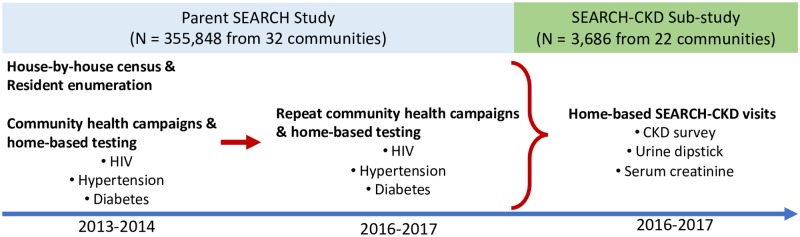
We ascertained the prevalence of CKD and its risk factors among a sample of 3,686 participants of a population-based HIV trial in rural Uganda and Kenya. Prevalent CKD was defined as a serum creatinine-based estimated glomerular filtration rate <60 mL/min/1.73m2 or proteinuria (urine dipstick ≥1+). We used inverse-weighting to estimate the population prevalence of CKD, and multivariable log-link Poisson models to assess the associations of potential risk factors with CKD.
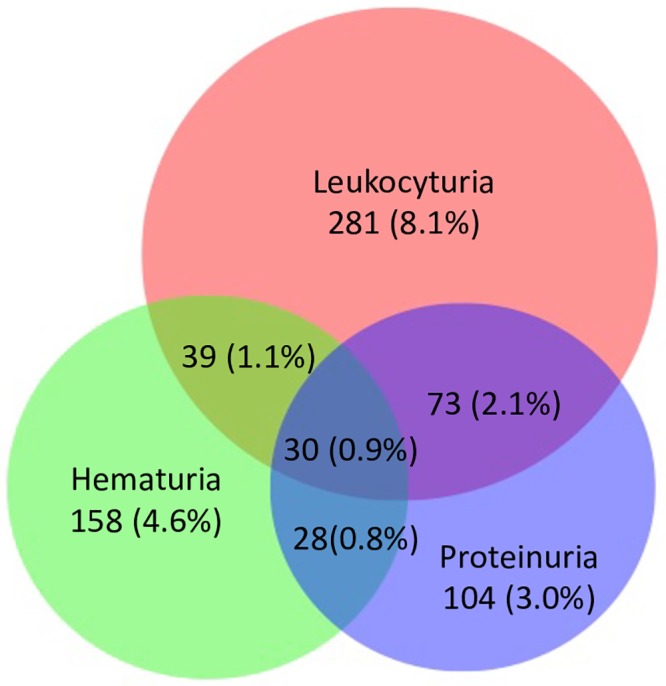
The estimated CKD prevalence was 6.8% (95% CI 5.7-8.1%) overall and varied by region, being 12.5% (10.1-15.4%) in eastern Uganda, 3.9% (2.2-6.8%) in southwestern Uganda and 3.7% (2.7-5.1%) in western Kenya. Risk factors associated with greater CKD prevalence included age ≥60 years (adjusted prevalence ratio [aPR] 3.5 [95% CI 1.9-6.5] compared with age 18-29 years), HIV infection (aPR 1.6 [1.1-2.2]), and residence in eastern Uganda (aPR 3.9 [2.6-5.9]). However, two-thirds of individuals with CKD did not have HIV, diabetes, or hypertension as risk factors. Furthermore, we noted many individuals who did not have proteinuria had dipstick positive leukocyturia or hematuria.
The prevalence of CKD is appreciable in rural East Africa and there are considerable regional differences. Conventional risk factors appear to only explain a minority of cases, and leukocyturia and hematuria were common, highlighting the need for further research into understanding the nature of CKD in sub-Saharan Africa.
由于慢性肾脏病(CKD)的风险因素和遗传易感性的共同作用,居住在撒哈拉以南非洲的个体中 CKD 可能很常见。
我们在乌干达和肯尼亚农村进行的一项基于人群的 HIV 试验中,确定了 3686 名参与者中 CKD 及其危险因素的流行情况。通过基于血清肌酐的估算肾小球滤过率<60 mL/min/1.73m2 或蛋白尿(尿试纸≥1+)来定义现患 CKD。我们使用反加权法估计 CKD 的人群患病率,并使用多变量对数链接泊松模型评估潜在危险因素与 CKD 的关联。
总体而言,估计的 CKD 患病率为 6.8%(95%CI 5.7-8.1%),且因地区而异,在乌干达东部为 12.5%(10.1-15.4%),乌干达西南部为 3.9%(2.2-6.8%),肯尼亚西部为 3.7%(2.7-5.1%)。与 CKD 患病率增加相关的危险因素包括年龄≥60 岁(调整后患病率比[aPR]3.5 [95%CI 1.9-6.5]与 18-29 岁年龄组相比)、HIV 感染(aPR 1.6 [1.1-2.2])和居住在乌干达东部(aPR 3.9 [2.6-5.9])。然而,三分之二的 CKD 患者没有 HIV、糖尿病或高血压等危险因素。此外,我们注意到许多没有蛋白尿的患者尿试纸呈阳性白细胞尿或血尿。
农村东非的 CKD 患病率相当可观,且存在显著的地区差异。传统的危险因素似乎只能解释少数病例,白细胞尿和血尿很常见,这凸显了需要进一步研究以了解撒哈拉以南非洲 CKD 的性质。