• 文献检索
  • 文档翻译
  • 深度研究
  • 学术资讯
  • Suppr Zotero 插件Zotero 插件
  • 邀请有礼
  • 套餐&价格
  • 历史记录
应用&插件
Suppr Zotero 插件Zotero 插件浏览器插件Mac 客户端Windows 客户端微信小程序
定价
高级版会员购买积分包购买API积分包
服务
文献检索文档翻译深度研究API 文档MCP 服务
关于我们
关于 Suppr公司介绍联系我们用户协议隐私条款
关注我们

Suppr 超能文献

核心技术专利:CN118964589B侵权必究
粤ICP备2023148730 号-1Suppr @ 2026

文献检索

告别复杂PubMed语法,用中文像聊天一样搜索,搜遍4000万医学文献。AI智能推荐,让科研检索更轻松。

立即免费搜索

文件翻译

保留排版,准确专业,支持PDF/Word/PPT等文件格式,支持 12+语言互译。

免费翻译文档

深度研究

AI帮你快速写综述,25分钟生成高质量综述,智能提取关键信息,辅助科研写作。

立即免费体验

加拿大C1抑制剂功能正常的遗传性血管性水肿患者和病因不明的特发性血管性水肿患者的真实世界转归

Real-world outcomes of patients with hereditary angioedema with normal C1-inhibitor function and patients with idiopathic angioedema of unknown etiology in Canada.

作者信息

Adatia Adil, Boursiquot Jean-Nicolas, Goodyear Dawn, Kalicinsky Chrystyna, Kanani Amin, Waserman Susan, Nguyen Michelle M L, Wadhwa Abhinav, Weiss Jessica, El-Zoeiby Ahmed, Betschel Stephen

机构信息

Alberta Health Services, University of Alberta, Edmonton, AB, Canada.

CHU de Québec, Université Laval, Québec, QC, Canada.

出版信息

Allergy Asthma Clin Immunol. 2024 Sep 27;20(1):50. doi: 10.1186/s13223-024-00910-x.

DOI:10.1186/s13223-024-00910-x
PMID:39334461
原文链接:https://pmc.ncbi.nlm.nih.gov/articles/PMC11438182/
Abstract

BACKGROUND

Hereditary angioedema with normal C1-inhibitor function (HAE nC1-INH) and idiopathic angioedema of unknown etiology (AE-UNK) are rare conditions that cause recurrent subcutaneous and submucosal swelling. The characteristics and clinical outcomes of patients with these conditions in Canada have not been studied.

METHODS

The aim of this study was to extract real-world evidence from the electronic health records of patients with HAE nC1-INH or AE-UNK who were managed in selected practices of Canadian HAE-treating specialist physicians between 01-Jan-2012 and 01-Jan-2022, to examine case numbers, treatment, clinical outcomes, and healthcare utilization.

RESULTS

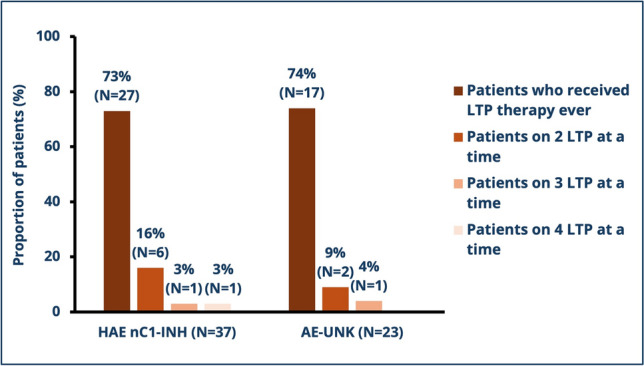
Of 60 patients (37 with HAE nC1-INH, 23 with AE-UNK), median (range) age at symptom onset was 21.5 (5.0-57.0) and 23.0 (10.0-54.0) years, respectively. Time to diagnosis from onset of symptoms was 7.0 (0.0-43.0) and 2.0 (- 10.0 to 50.0) years. Significant differences were observed in terms of the predominant triggers for angioedema attacks between patients with HAE nC1-INH and AE-UNK: stress (65% vs. 26%, p = 0.007) and estrogen therapy (35% vs. 9%, p = 0.031). Before diagnosis, most patients received antihistamines (50% of HAE nC1-INH and 61% of AE-UNK patients). Post-diagnosis, 73% and 74% of HAE nC1-INH and AE-UNK patients received long-term prophylaxis (LTP), with the most common LTP treatments being subcutaneous pdC1-INH (43% of HAE nC1-INH patients and 39% of AE-UNK patients) and tranexamic acid (41% of HAE nC1-INH patients and 35% of AE-UNK patients). Of patients with HAE nC1-INH, and patients with AE-UNK, 22% and 13%, respectively, were taking more than one LTP treatment concurrently. Before HAE treatment initiation, significantly fewer patients with AE-UNK compared to patients with HAE nC1-INH had angioedema attacks affecting their extremities (13% vs. 38%, p = 0.045) and GI system (22% vs. 57%, p = 0.015). In the three months following treatment initiation, patients with AE-UNK experienced significantly fewer angioedema attacks compared to patients with HAE nC1-INH (median 2.0 attacks [0.0-48.0] vs. 6.0 attacks [0.0-60.0], p = 0.044). Additionally, fewer patients with AE-UNK compared to HAE nC1-INH experienced attacks affecting their GI system (26% vs. 57%, p = 0.032). Attack duration and frequency significantly decreased for patients with HAE nC1-INH from a median of 1.00 day (range: 0.00-7.00) to 0.29 day (range: 0.02-4.00; p = 0.001) and from 10.50 attacks (range: 0.00-90.00) to 6.00 attacks (range: 0.00-60.00; p = 0.004) in the three months following HAE treatment initiation.

CONCLUSIONS

Using Canadian real-world evidence, these data demonstrate differing clinical trajectories between patients with HAE nC1-INH and AE-UNK, including diagnostic delays, varied attack characteristics, treatment responses and healthcare utilization. Despite treatment response, many patients still experienced frequent angioedema attacks. These results suggest an unmet need for treatment guidelines and therapies specifically for patients with HAE nC1-INH and AE-UNK and better understanding of the pathophysiology accounting for the reported differences between the two.

摘要

背景

C1抑制物功能正常的遗传性血管性水肿(HAE nC1-INH)和病因不明的特发性血管性水肿(AE-UNK)是导致反复皮下和黏膜下肿胀的罕见病症。加拿大患有这些病症的患者的特征和临床结局尚未得到研究。

方法

本研究的目的是从2012年1月1日至2022年1月1日在加拿大遗传性血管性水肿治疗专科医生的选定诊所接受治疗的HAE nC1-INH或AE-UNK患者的电子健康记录中提取真实世界证据,以检查病例数量、治疗、临床结局和医疗保健利用情况。

结果

在60例患者中(37例HAE nC1-INH,23例AE-UNK),症状发作时的中位(范围)年龄分别为21.5(5.0 - 57.0)岁和23.0(10.0 - 54.0)岁。从症状发作到诊断的时间分别为7.0(0.0 - 43.0)年和2.0(-10.0至50.0)年。在HAE nC1-INH患者和AE-UNK患者的血管性水肿发作的主要触发因素方面观察到显著差异:压力(65%对26%,p = 0.007)和雌激素治疗(35%对9%,p = 0.031)。在诊断之前,大多数患者接受了抗组胺药治疗(HAE nC1-INH患者的50%和AE-UNK患者的61%)。诊断后,73%的HAE nC1-INH患者和74%的AE-UNK患者接受了长期预防(LTP),最常见的LTP治疗是皮下注射pdC1-INH(HAE nC1-INH患者的43%和AE-UNK患者的39%)和氨甲环酸(HAE nC1-INH患者的41%和AE-UNK患者的35%)。在HAE nC1-INH患者和AE-UNK患者中,分别有22%和13%的患者同时接受多种LTP治疗。在开始HAE治疗之前,与HAE nC1-INH患者相比,AE-UNK患者中血管性水肿发作影响其四肢的患者明显更少(13%对38%,p = 0.045),影响胃肠道系统的患者也更少(22%对57%,p = 0.015)。在开始治疗后的三个月内,与HAE nC1-INH患者相比,AE-UNK患者经历的血管性水肿发作明显更少(中位2.0次发作[0.0 - 48.0]对6.0次发作[0.0 - 60.0],p = 0.044)。此外,与HAE nC1-INH患者相比,AE-UNK患者中经历影响其胃肠道系统发作的患者更少(26%对57%,p = 0.032)。HAE nC1-INH患者的发作持续时间和频率在开始HAE治疗后的三个月内从中位1.oo天(范围:0.00 - 7.00)显著降至0.29天(范围:0.02 - 4.00;p = 0.001),发作次数从10.50次(范围:0.00 - 90.00)降至6.00次(范围:0.00 - 60.00;p = 0.
https://cdn.ncbi.nlm.nih.gov/pmc/blobs/2ef5/11438182/0417e1d1351f/13223_2024_910_Fig1_HTML.jpg

相似文献

1
Real-world outcomes of patients with hereditary angioedema with normal C1-inhibitor function and patients with idiopathic angioedema of unknown etiology in Canada.加拿大C1抑制剂功能正常的遗传性血管性水肿患者和病因不明的特发性血管性水肿患者的真实世界转归
Allergy Asthma Clin Immunol. 2024 Sep 27;20(1):50. doi: 10.1186/s13223-024-00910-x.
2
A Retrospective Analysis of Long-Term Prophylaxis with Berotralstat in Patients with Hereditary Angioedema and Acquired C1-Inhibitor Deficiency-Real-World Data.遗传性血管性水肿和获得性C1抑制剂缺乏患者使用贝罗他司他长期预防的回顾性分析——真实世界数据
Clin Rev Allergy Immunol. 2023 Dec;65(3):354-364. doi: 10.1007/s12016-023-08972-2. Epub 2023 Nov 2.
3
Icatibant use in Brazilian patients with hereditary angioedema (HAE) type 1 or 2 and HAE with normal C1-INH levels: findings from the Icatibant Outcome Survey Registry Study.依替巴肽在巴西 1 型或 2 型遗传性血管性水肿(HAE)和 C1-INH 水平正常的 HAE 患者中的应用:依替巴肽结局调查登记研究的结果。
An Bras Dermatol. 2022 Jul-Aug;97(4):448-457. doi: 10.1016/j.abd.2021.09.009. Epub 2022 May 30.
4
Physician- and patient-reported outcomes by hereditary angioedema type: Data from a real-world study.基于真实世界研究的遗传性血管性水肿类型的医生和患者报告结局数据。
Allergy Asthma Proc. 2024 Jul 1;45(4):247-254. doi: 10.2500/aap.2024.45.240021.
5
Hereditary angioedema with normal C1 inhibitor in a French cohort: Clinical characteristics and response to treatment with icatibant.遗传性血管性水肿伴正常 C1 抑制剂:法国队列的临床特征和依替巴肽治疗反应。
Immun Inflamm Dis. 2017 Jan 11;5(1):29-36. doi: 10.1002/iid3.137. eCollection 2017 Mar.
6
Hereditary Angioedema with Normal C1 Esterase Inhibitor Refractory to Long-Term Prophylaxis: A Case Report.长期预防难治性C1酯酶抑制剂正常的遗传性血管性水肿:一例报告
Cureus. 2023 Jan 15;15(1):e33800. doi: 10.7759/cureus.33800. eCollection 2023 Jan.
7
Pregnancy in Patients With Hereditary Angioedema and Normal C1 Inhibitor.遗传性血管性水肿且C1抑制剂正常患者的妊娠情况
Front Allergy. 2022 Feb 17;3:846968. doi: 10.3389/falgy.2022.846968. eCollection 2022.
8
Clinical profile and treatment outcomes in patients with hereditary angioedema with normal C1 esterase inhibitor.C1酯酶抑制剂正常的遗传性血管性水肿患者的临床特征及治疗结果
World Allergy Organ J. 2022 Jan 27;15(1):100621. doi: 10.1016/j.waojou.2021.100621. eCollection 2022 Jan.
9
Clinical Characteristics and Safety of Plasma-Derived C1-Inhibitor Therapy in Children and Adolescents with Hereditary Angioedema-A Long-Term Survey.遗传性血管性水肿儿童和青少年血浆源性C1抑制剂治疗的临床特征与安全性——一项长期调查
J Allergy Clin Immunol Pract. 2020 Jul-Aug;8(7):2379-2383. doi: 10.1016/j.jaip.2020.02.043. Epub 2020 Mar 17.
10
Review of the Manitoba cohort of patients with hereditary angioedema with normal C1 inhibitor.对曼尼托巴省C1抑制剂正常的遗传性血管性水肿患者队列的回顾。
Allergy Asthma Clin Immunol. 2019 Nov 12;15:66. doi: 10.1186/s13223-019-0381-y. eCollection 2019.

引用本文的文献

1
Erratum: Effect of Fresh Frozen Plasma Infusion on Hospital Length of Stay for Patients With Hereditary Angioedema.勘误:新鲜冰冻血浆输注对遗传性血管性水肿患者住院时间的影响。
J Health Econ Outcomes Res. 2025 Aug 21;12(2):143440. eCollection 2025.
2
Expanding the Genetic and Clinical Spectrum of Hereditary Angioedema with Normal C1 Inhibitor: Novel Variants and Treatment Insights.扩大C1抑制剂正常的遗传性血管性水肿的遗传和临床谱:新变异及治疗见解
J Clin Immunol. 2025 Aug 23;45(1):124. doi: 10.1007/s10875-025-01912-z.
3
Exercise-Induced Angioedema, Urticaria, and Anaphylaxis-A Narrative Review.

本文引用的文献

1
Definition, acronyms, nomenclature, and classification of angioedema (DANCE): AAAAI, ACAAI, ACARE, and APAAACI DANCE consensus.血管性水肿的定义、缩略语、命名和分类(DANCE):美国过敏、哮喘和免疫学学会,美国过敏、哮喘和临床免疫学会,加拿大过敏、哮喘和临床免疫学会,亚太过敏、哮喘和临床免疫学会共识。
J Allergy Clin Immunol. 2024 Aug;154(2):398-411.e1. doi: 10.1016/j.jaci.2024.03.024. Epub 2024 Apr 25.
2
Successful use of lanadelumab in a patient with hereditary angioedema with normal C1 inhibitor and negative genetic testing.在一名C1抑制剂正常且基因检测呈阴性的遗传性血管性水肿患者中成功使用了lanadelumab。
J Allergy Clin Immunol Glob. 2023 Feb 21;2(2):100087. doi: 10.1016/j.jacig.2023.100087. eCollection 2023 May.
3
运动诱发的血管性水肿、荨麻疹和过敏反应——一篇叙述性综述
Sports (Basel). 2025 Jul 3;13(7):215. doi: 10.3390/sports13070215.
Significant response to berotralstat in 3 patients with hereditary angioedema of unknown origin.
3例不明原因遗传性血管性水肿患者对贝罗他司他有显著反应。
J Allergy Clin Immunol Pract. 2023 Dec;11(12):3804-3807.e2. doi: 10.1016/j.jaip.2023.08.018. Epub 2023 Aug 19.
4
Managing Diagnosis, Treatment, and Burden of Disease in Hereditary Angioedema Patients with Normal C1-Esterase Inhibitor.管理C1酯酶抑制剂水平正常的遗传性血管性水肿患者的诊断、治疗和疾病负担
J Asthma Allergy. 2023 Apr 22;16:447-460. doi: 10.2147/JAA.S398333. eCollection 2023.
5
Hereditary Angioedema: Diagnosis, Clinical Implications, and Pathophysiology.遗传性血管性水肿:诊断、临床意义和病理生理学。
Adv Ther. 2023 Mar;40(3):814-827. doi: 10.1007/s12325-022-02401-0. Epub 2023 Jan 7.
6
Case report: Recurrent angioedema: Diagnosing the rare and the frequent.病例报告:复发性血管性水肿:诊断罕见与常见情况。
Front Med (Lausanne). 2022 Dec 2;9:1048480. doi: 10.3389/fmed.2022.1048480. eCollection 2022.
7
Clinical profile and treatment outcomes in patients with hereditary angioedema with normal C1 esterase inhibitor.C1酯酶抑制剂正常的遗传性血管性水肿患者的临床特征及治疗结果
World Allergy Organ J. 2022 Jan 27;15(1):100621. doi: 10.1016/j.waojou.2021.100621. eCollection 2022 Jan.
8
The Expanding Spectrum of Mutations in Hereditary Angioedema.遗传性血管性水肿相关突变的不断扩展。
J Allergy Clin Immunol Pract. 2021 Jun;9(6):2229-2234. doi: 10.1016/j.jaip.2021.03.008. Epub 2021 Mar 19.
9
Hereditary Angioedema.遗传性血管性水肿
N Engl J Med. 2020 Mar 19;382(12):1136-1148. doi: 10.1056/NEJMra1808012.
10
The International/Canadian Hereditary Angioedema Guideline.《国际/加拿大遗传性血管性水肿指南》
Allergy Asthma Clin Immunol. 2019 Nov 25;15:72. doi: 10.1186/s13223-019-0376-8. eCollection 2019.