Morganti Francesca, Gattuso Maria, Singh Solorzano Claudio, Bonomini Cristina, Rosini Sandra, Ferrari Clarissa, Pievani Michela, Festari Cristina
Department of Human and Social Sciences, University of Bergamo, 24129 Bergamo, Italy.
CHL-Centre for Healthy Longevity, University of Bergamo, 24129 Bergamo, Italy.
Brain Sci. 2024 Aug 23;14(9):852. doi: 10.3390/brainsci14090852.
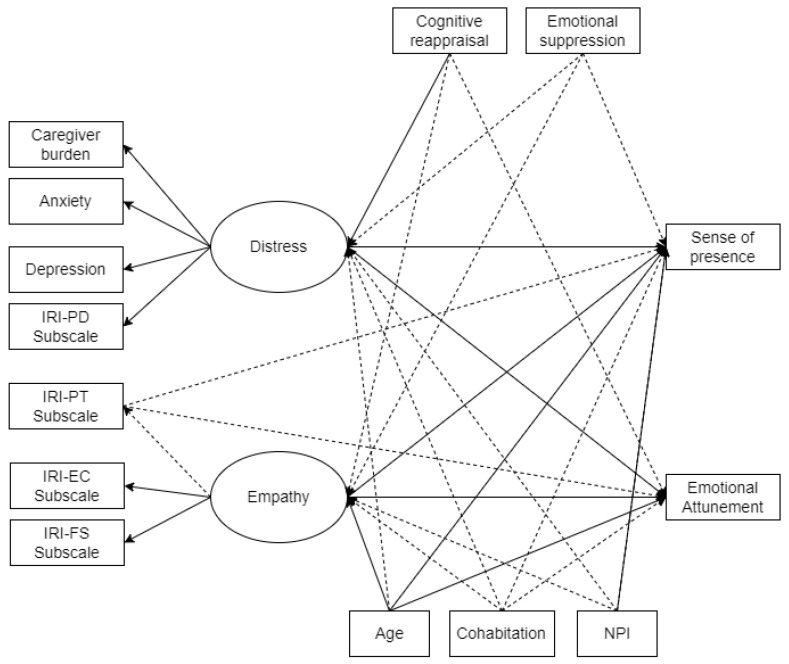
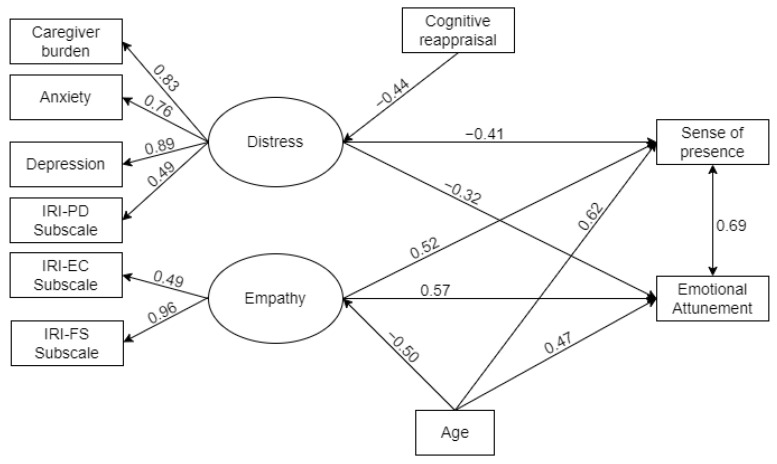
In neuropsychology and clinical psychology, the efficacy of virtual reality (VR) experiences for knowledge acquisition and the potential for modifying conduct are well documented. Consequently, the scope of VR experiences for educational purposes has expanded in the health field in recent years. In this study, we sought to assess the effectiveness of ViveDe in a psychoeducational caregiver program. ViveDe is a VR application that presents users with possible daily life situations from the perspective of individuals with dementia. These situations can be experienced in immersive mode through 360° video. This research aimed to ascertain the associations between the sense of presence that can be achieved in VR and some users' psychological characteristics, such as distress and empathetic disposition. The study involved 36 informal caregivers of individuals with Alzheimer's disease. These participants were assessed using scales of anxiety and depression, perceived stress, empathy, and emotional regulation. They were asked to participate in a six-session psychoeducation program conducted online on dementia topics, in addition to experiencing the ViveDe application. The immersive VR sessions enabled the caregivers to directly experience the symptoms of dementia (e.g., spatial disorientation, agnosia, difficulty in problem-solving, and anomia) in everyday and social settings. The results indicated that although the experience in ViveDe (evaluated using the XRPS scale and five questions about emotional attunement) showed efficacy in producing a sense of first-person participation in the symptoms of dementia, further research is needed to confirm this. The structural equation model provided evidence that the characteristics of individuals who enjoy the VR experience play a determining role in the perceived sense of presence, which in turn affects the efficacy of the VR experience as a psychoeducational tool. Further research will be conducted to ascertain the potential role of these elements in conveying change in the caregivers of people with dementia. This will help us study the long-term effectiveness of a large-scale psychoeducation program in VR.
在神经心理学和临床心理学领域,虚拟现实(VR)体验在知识获取方面的功效以及改变行为的潜力都有充分的文献记载。因此,近年来,用于教育目的的VR体验在健康领域的范围有所扩大。在本研究中,我们试图评估ViveDe在一项心理教育护理者项目中的有效性。ViveDe是一款VR应用程序,它从痴呆症患者的角度向用户呈现可能的日常生活场景。这些场景可以通过360°视频以沉浸式模式体验。本研究旨在确定VR中可实现的临场感与一些用户的心理特征(如痛苦和共情倾向)之间的关联。该研究涉及36名阿尔茨海默病患者的非正式护理者。使用焦虑和抑郁量表、感知压力量表、共情量表和情绪调节量表对这些参与者进行评估。除了体验ViveDe应用程序外,他们还被要求参加一个关于痴呆症主题的六节在线心理教育项目。沉浸式VR课程使护理者能够在日常和社交环境中直接体验痴呆症的症状(如空间定向障碍、失认症、解决问题困难和命名障碍)。结果表明,尽管ViveDe中的体验(使用XRPS量表和五个关于情感共鸣的问题进行评估)在产生对痴呆症症状的第一人称参与感方面显示出效果,但仍需要进一步研究来证实这一点。结构方程模型提供了证据,表明享受VR体验的个体特征在感知临场感中起决定性作用,而这反过来又影响VR体验作为一种心理教育工具的效果。将进行进一步研究以确定这些因素在传达痴呆症患者护理者变化方面的潜在作用。这将有助于我们研究大规模VR心理教育项目的长期有效性。