Malas Olga, Boustani Nada Mallah, Duradoni Mirko, Omotoso Dayo, Avşar Asiye Şengül, Shyroka Anastasiia, Colombini Giulia, Tolsá Maria Dolores
Department of Psychology, Sociology and Social Work, University of Lleida, Avinguda de l'Estudi General, 4, 25001 Lleida, Spain.
Faculty of Business and Management, Saint Joseph University, Mar Mikhael, Beirut 1104 2020, Lebanon.
Behav Sci (Basel). 2024 Aug 29;14(9):761. doi: 10.3390/bs14090761.
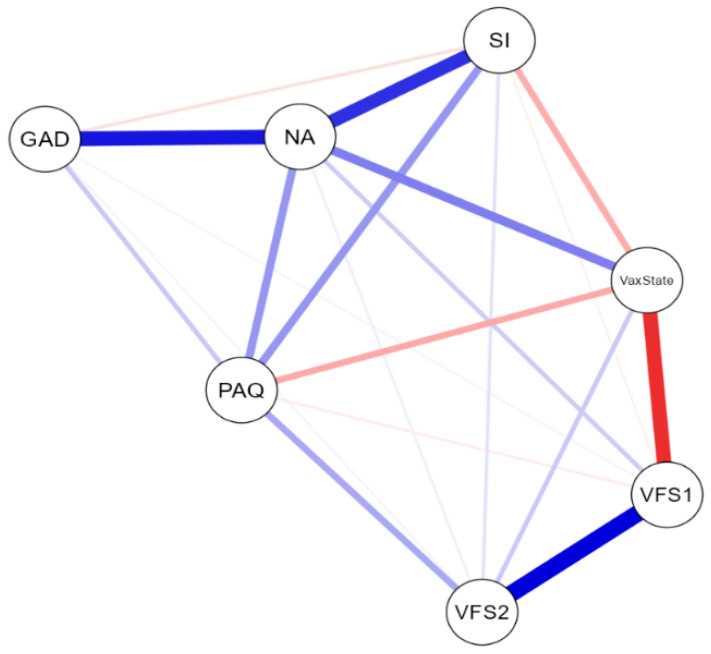
This study examines the links between vaccination status, fear of vaccination (cognitive and somatic symptoms), anxiety, alexithymia, and type D personality (negative affect and social inhibition), to propose policies to increase vaccination rates. A sample of university students ( = 2535; mean age = 20.59, = 2.04; male: 26.75%, female: 73.25%) from Spain, Italy, Lebanon, Nigeria, Turkey, and Ukraine completed the Vaccination Fear Scale (VFS-6), the Generalised Anxiety Disorder scale (GAD-7), the Perth Alexithymia Questionnaire-Short Form (PAQ-S), the Type D Scale (DS14), and also a question on vaccination status. Correlation, regression, and network analyses were applied. Cognitive symptoms of fear of vaccination and negative affect were the most significant in the correlation and regression analyses. In the network analysis, negative affect showed the highest values in all centrality indices and positive relationships with other nodes. Vaccination status showed negative relationships with fear of vaccination, alexithymia, and social inhibition. The network structure is similar between the sexes but varies between cultures and sexes within cultures. The relationship between vaccination status and cognitive symptoms of fear of vaccination was the most consistent, allowing for interventions at this level to be advised across cultures. For more specific interventions, cultural context must be considered for optimal results.
本研究探讨了疫苗接种状况、对疫苗接种的恐惧(认知和躯体症状)、焦虑、述情障碍和D型人格(消极情感和社交抑制)之间的联系,以提出提高疫苗接种率的政策。来自西班牙、意大利、黎巴嫩、尼日利亚、土耳其和乌克兰的大学生样本(n = 2535;平均年龄 = 20.59,标准差 = 2.04;男性:26.75%,女性:73.25%)完成了疫苗接种恐惧量表(VFS - 6)、广泛性焦虑障碍量表(GAD - 7)、珀斯述情障碍问卷简表(PAQ - S)、D型量表(DS14),以及一个关于疫苗接种状况的问题。应用了相关性分析、回归分析和网络分析。在相关性分析和回归分析中,对疫苗接种的恐惧的认知症状和消极情感最为显著。在网络分析中,消极情感在所有中心性指标中显示出最高值,并且与其他节点呈正相关。疫苗接种状况与对疫苗接种的恐惧、述情障碍和社交抑制呈负相关。网络结构在性别之间相似,但在不同文化之间以及同一文化内的不同性别之间存在差异。疫苗接种状况与对疫苗接种的恐惧的认知症状之间的关系最为一致,因此建议在跨文化层面针对这一水平进行干预。对于更具体的干预措施,必须考虑文化背景以获得最佳效果。