Faculty of Engineering, Universidad Andres Bello, Santiago 7500735, Chile.
Faculty of Dentistry, Universidad de las Américas, Quito 170513, Ecuador.
Sensors (Basel). 2024 Sep 19;24(18):6053. doi: 10.3390/s24186053.
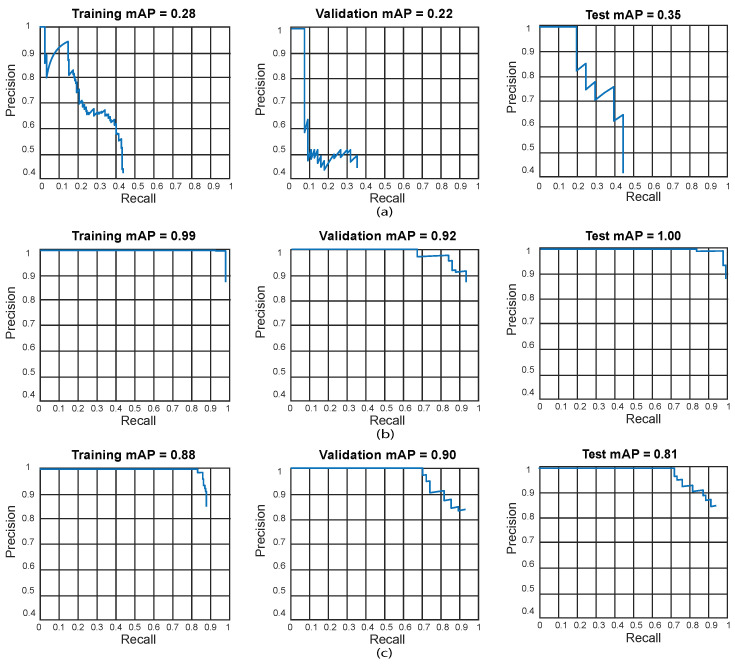
The use of artificial intelligence algorithms (AI) has gained importance for dental applications in recent years. Analyzing AI information from different sensor data such as images or panoramic radiographs (panoramic X-rays) can help to improve medical decisions and achieve early diagnosis of different dental pathologies. In particular, the use of deep learning (DL) techniques based on convolutional neural networks (CNNs) has obtained promising results in dental applications based on images, in which approaches based on classification, detection, and segmentation are being studied with growing interest. However, there are still several challenges to be tackled, such as the data quality and quantity, the variability among categories, and the analysis of the possible bias and variance associated with each dataset distribution. This study aims to compare the performance of three deep learning object detection models-Faster R-CNN, YOLO V2, and SSD-using different ResNet architectures (ResNet-18, ResNet-50, and ResNet-101) as feature extractors for detecting and classifying third molar angles in panoramic X-rays according to Winter's classification criterion. Each object detection architecture was trained, calibrated, validated, and tested with three different feature extraction CNNs which are ResNet-18, ResNet-50, and ResNet-101, which were the networks that best fit our dataset distribution. Based on such detection networks, we detect four different categories of angles in third molars using panoramic X-rays by using Winter's classification criterion. This criterion characterizes the third molar's position relative to the second molar's longitudinal axis. The detected categories for the third molars are distoangular, vertical, mesioangular, and horizontal. For training, we used a total of 644 panoramic X-rays. The results obtained in the testing dataset reached up to 99% mean average accuracy performance, demonstrating the YOLOV2 obtained higher effectiveness in solving the third molar angle detection problem. These results demonstrate that the use of CNNs for object detection in panoramic radiographs represents a promising solution in dental applications.
近年来,人工智能算法(AI)在牙科应用中变得越来越重要。分析来自不同传感器数据(如图像或全景 X 光片)的 AI 信息可以帮助改善医疗决策,并实现对不同牙科病理的早期诊断。特别是,基于卷积神经网络(CNN)的深度学习(DL)技术在基于图像的牙科应用中取得了有希望的结果,基于分类、检测和分割的方法正受到越来越多的关注。然而,仍然存在一些挑战需要解决,例如数据质量和数量、类别之间的可变性,以及与每个数据集分布相关的偏差和方差的分析。本研究旨在比较三种深度学习目标检测模型(Faster R-CNN、YOLO V2 和 SSD)的性能,使用不同的 ResNet 架构(ResNet-18、ResNet-50 和 ResNet-101)作为特征提取器,根据 Winter 分类标准,从全景 X 光片中检测和分类第三磨牙角度。每个目标检测架构都使用三种不同的特征提取 CNN 进行训练、校准、验证和测试,这三种 CNN 是 ResNet-18、ResNet-50 和 ResNet-101,它们是最适合我们数据集分布的网络。基于这些检测网络,我们使用 Winter 分类标准,通过全景 X 光片检测第三磨牙的四个不同角度类别。该标准描述了第三磨牙相对于第二磨牙纵轴的位置。检测到的第三磨牙类别为远中角、垂直角、近中角和水平角。在训练过程中,我们总共使用了 644 张全景 X 光片。在测试数据集上获得的结果最高可达 99%的平均准确率,表明 YOLOV2 在解决第三磨牙角度检测问题方面具有更高的有效性。这些结果表明,在全景 X 光片中使用 CNN 进行目标检测是牙科应用中的一种很有前途的解决方案。