Research Centre for Life and Sport Science (CLaSS), School of Health Sciences, Birmingham City University, Birmingham B42 2LR, UK.
Department of Sport, Hartpury University, Gloucestershire GL19 3BE, UK.
Nutrients. 2024 Sep 16;16(18):3123. doi: 10.3390/nu16183123.
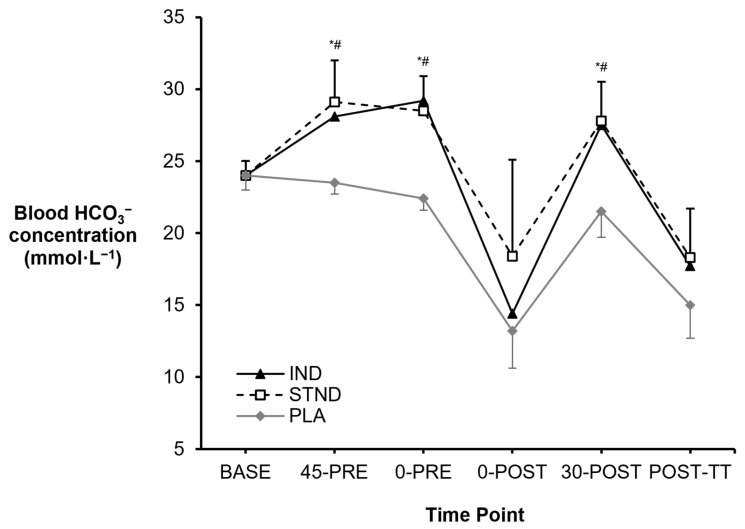
Inconsistent swimming performances are often observed following sodium bicarbonate (NaHCO) ingestion, possibly because the time taken to reach peak blood buffering capacity is highly variable between individuals. Personalising NaHCO ingestion based on time-to-peak blood bicarbonate (HCO) could be a solution; however, this strategy is yet to be explored in swimming, or adequately compared to standardised NaHCO approaches. Therefore, six highly trained female swimmers ingested 0.3 g·kg BM NaHCO in capsules to pre-determine their individual time-to-peak blood HCO. They then participated in three experimental trials, consisting of a 6 × 75 m repeated sprint swimming test, followed by a 200 m maximal time trial effort after 30 min active recovery. These experiments were conducted consuming a supplement at three different timings: individualised NaHCO (IND: 105-195 min pre-exercise); standardised NaHCO (STND: 150 min pre-exercise); and placebo (PLA: 90 min pre-exercise). Both NaHCO strategies produced similar increases in blood HCO prior to exercise (IND: +6.8 vs. STND: +6.1 mmol·L, < 0.05 vs. PLA) and fully recovered blood HCO during active recovery (IND: +6.0 vs. STND: +6.3 mmol·L vs. PLA, < 0.05). However, there were no improvements in the mean 75 m swimming time (IND: 48.2 ± 4.8 vs. STND: 48.9 ± 5.8 vs. PLA: 49.1 ± 5.1 s, = 0.302) nor 200 m maximal swimming (IND: 133.6 ± 5.0 vs. STND: 133.6 ± 4.7 vs. PLA: 133.3 ± 4.4 s, = 0.746). Regardless of the ingestion strategy, NaHCO does not appear to improve exercise performance in highly trained female swimmers.
在摄入碳酸氢钠(NaHCO)后,经常观察到游泳表现不一致,这可能是因为个体达到峰值血液缓冲能力所需的时间差异很大。基于达到峰值血液碳酸氢盐(HCO)的时间来个性化调整 NaHCO 的摄入可能是一种解决方案;然而,这种策略在游泳中尚未得到探索,也没有与标准化的 NaHCO 方法进行充分比较。因此,六名高水平女性游泳运动员以胶囊形式摄入 0.3 g·kg BM 的 NaHCO,以预先确定她们个人达到峰值血液 HCO 的时间。然后,她们参加了三项实验性试验,包括 6 次×75 m 重复冲刺游泳测试,然后在 30 分钟主动恢复后进行 200 m 最大时间试验。这些实验在三种不同的时间点摄入补充剂:个体化 NaHCO(IND:运动前 105-195 分钟);标准化 NaHCO(STND:运动前 150 分钟);和安慰剂(PLA:运动前 90 分钟)。两种 NaHCO 策略在运动前都产生了相似的血液 HCO 增加(IND:+6.8 与 STND:+6.1 mmol·L,<0.05 与 PLA),并在主动恢复期间完全恢复了血液 HCO(IND:+6.0 与 STND:+6.3 mmol·L 与 PLA,<0.05)。然而,75 m 平均游泳时间没有改善(IND:48.2 ± 4.8 与 STND:48.9 ± 5.8 与 PLA:49.1 ± 5.1 s,= 0.302),200 m 最大游泳时间也没有改善(IND:133.6 ± 5.0 与 STND:133.6 ± 4.7 与 PLA:133.3 ± 4.4 s,= 0.746)。无论摄入策略如何,NaHCO 似乎都不能提高高水平女性游泳运动员的运动表现。