
基于 AI 辅助肌肉超声的形态功能评估的高蛋白能量密集型口服补充剂对营养不良患者的有效性:一项真实世界的单臂研究。
Effectiveness of High-Protein Energy-Dense Oral Supplements on Patients with Malnutrition Using Morphofunctional Assessment with AI-Assisted Muscle Ultrasonography: A Real-World One-Arm Study.
机构信息
Endocrinology and Nutrition Department, Clinical Universitary Hospital of Valladolid, 47003 Valladolid, Spain.
Investigation Centre Endocrinology and Nutrition, Faculty of Medicine, University of Valladolid, 47003 Valladolid, Spain.
出版信息
Nutrients. 2024 Sep 17;16(18):3136. doi: 10.3390/nu16183136.
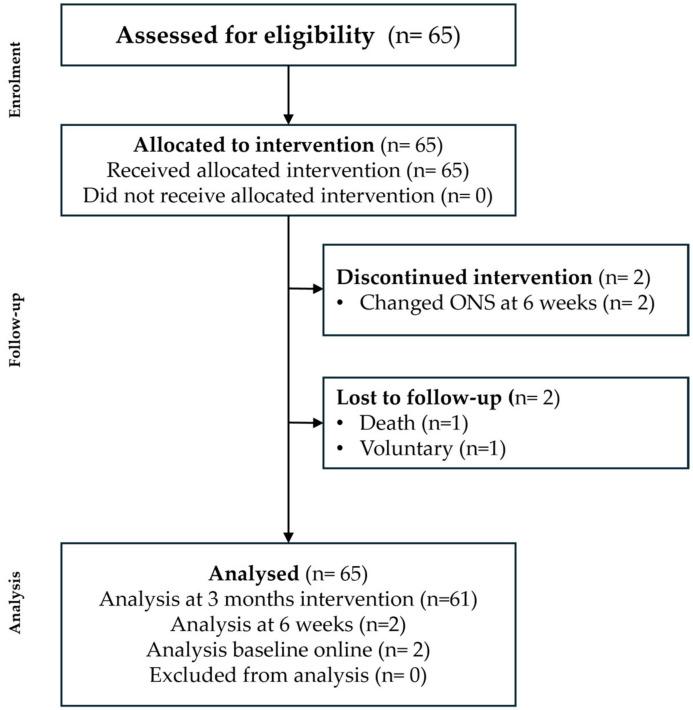
User-friendly tools for assessing nutrition status and interventions in malnourished patients are crucial. This study evaluated the effectiveness of a personalised nutrition intervention using a novel oral nutritional supplement and AI-supported morphofunctional assessment to monitor clinical outcomes in patients with disease-related malnutrition (DRM). This prospective observational study involved patients receiving concentrated high-protein, high-calorie ONS (cHPHC-ONS), per usual clinical practice. Comprehensive assessments were performed at baseline (B) and three months (M3) post-intervention. 65 patients participated in the study. Significant decreases were observed in the percentage weight loss from B (-6.75 ± 7.5%) to M3 (0.5 ± 3.48%) ( < 0.01), in the prevalence of malnutrition (B: 93.4%; M3: 78.9%; < 0.01), severe malnutrition (B: 60.7%; M3: 40.3%; < 0.01), and sarcopenia (B: 19.4%; M3: 15.5%; < 0.04). Muscle area increased ( = 0.03), and there were changes in the echogenicity of the rectus femoris muscle ( = 0.03) from B to M3. In patients aged ≥60, an increase in muscle thickness ( = 0.04), pennation angle ( = 0.02), and handgrip strength ( = 0.04) was observed. There was a significant reduction in the prevalence of malnutrition (B0: 93.4%; M3: 78.9%; < 0.01) and severe malnutrition (B0: 60.7%; M3: 40.3%; < 0.01). In patients with DRM, a personalised intervention with cHPHC-ONS significantly reduces the prevalence of malnutrition, severe malnutrition, and sarcopenia and improves muscle mass and function.
便于用户使用的工具对于评估营养不良患者的营养状况和干预措施至关重要。本研究评估了一种使用新型口服营养补充剂和人工智能支持的形态功能评估来监测与疾病相关的营养不良 (DRM) 患者临床结局的个性化营养干预措施的有效性。这是一项前瞻性观察性研究,涉及根据常规临床实践接受浓缩高蛋白、高热量口服营养补充剂 (cHPHC-ONS) 的患者。在干预前 (B) 和干预后三个月 (M3) 进行全面评估。共有 65 名患者参与了这项研究。从 B 到 M3,体重减轻百分比有显著下降(-6.75 ± 7.5%至 0.5 ± 3.48%)(< 0.01),营养不良的发生率(B:93.4%;M3:78.9%)(< 0.01)、严重营养不良(B:60.7%;M3:40.3%)(< 0.01)和肌肉减少症(B:19.4%;M3:15.5%)(< 0.04)也有显著下降。肌肉面积增加(= 0.03),股直肌的回声强度从 B 到 M3 也有变化(= 0.03)。在年龄≥60 岁的患者中,观察到肌肉厚度增加(= 0.04)、肌腹角度增加(= 0.02)和握力增加(= 0.04)。营养不良的发生率(B0:93.4%;M3:78.9%)和严重营养不良的发生率(B0:60.7%;M3:40.3%)有显著下降。在 DRM 患者中,cHPHC-ONS 的个性化干预可显著降低营养不良、严重营养不良和肌肉减少症的发生率,并改善肌肉质量和功能。




 Zotero 插件