Masresha Balcha G, Shibeshi Messeret E, de Wee Roselina, Shapumba Nicholas, Sayi Takudzwa, Reef Susan E, Goodson James L
African Regional Office, World Health Organization, Brazzaville P.O. Box 06, Congo.
Country Office, World Health Organization, Windhoek P.O. Box 3444, Namibia.
Vaccines (Basel). 2024 Aug 23;12(9):957. doi: 10.3390/vaccines12090957.
The WHO Measles and Rubella Strategic Framework 2021-2030 within the Immunization Agenda 2030 includes both measles and rubella elimination goals and provides guidance to countries for planning and implementing the measles and rubella elimination strategies. Namibia has been implementing measles elimination strategies since 1997.
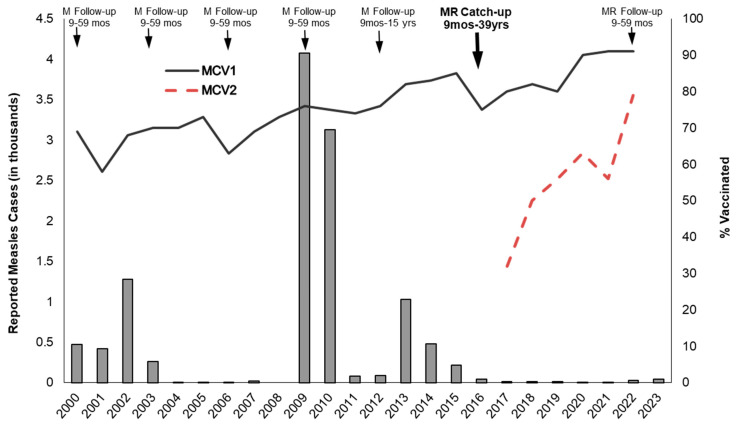
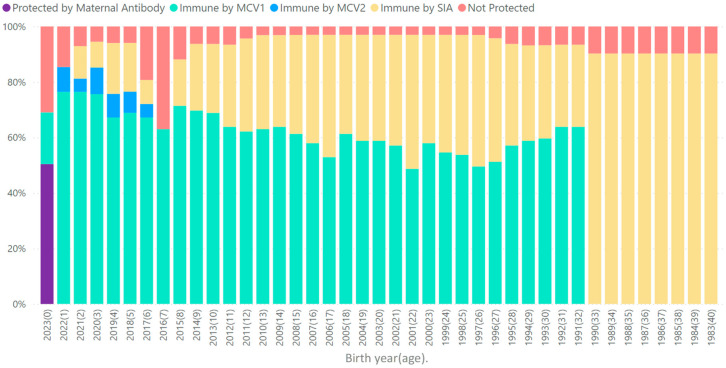
We reviewed and described the implementation of measles and rubella elimination strategies and the programmatic and epidemiological situation in Namibia during 2000-2023. Namibia introduced a rubella-containing vaccine (RCV) in 2016 as a combined measles-rubella (MR) vaccine using a MR catch-up campaign, targeting a wide age range based on detailed analysis and triangulation of multiple key data sources including MR vaccination coverage, MR case-based surveillance, detailed measles outbreak investigations, and serosurveys.
In 2020, estimated MCV1 coverage in Namibia reached 90% and has been sustained at 91% in 2021 and 2022. MCV2 was introduced in 2016, and the estimated MCV2 coverage has steadily increased to 79% in 2022. Following the MCV2 introduction and the implementation of the wide age range MR catch-up campaign in 2016, annual measles and rubella incidence decreased substantially. During 2017-2023, the period following the implementation of the catch-up MR vaccination SIA in 2016, average annual measles incidence per million population in Namibia decreased by 97% from the average during 2010-2016. Similarly, the average annual rubella incidence decreased by 95% from 2010-2016 to 2017-2023.
Successful implementation of the 2016 wide age range campaign and maintaining high routine immunization coverage likely led to the significant reduction in measles and rubella incidence in Namibia. To sustain the reduction in measles and rubella incidence and attain the elimination targets, Namibia needs to attain and maintain high routine immunization coverage with both doses of the MR vaccine and implement timely and high-quality periodic MR follow-up SIAs. High-quality elimination-standard measles and rubella surveillance will help guide strategies and serve as the basis for the eventual verification of measles and rubella elimination in Namibia according to the WHO-recommended framework.
《2030年免疫议程》中的世界卫生组织2021-2030年麻疹和风疹战略框架既包含麻疹和风疹消除目标,也为各国规划和实施麻疹和风疹消除战略提供指导。纳米比亚自1997年以来一直在实施麻疹消除战略。
我们回顾并描述了纳米比亚在2000 - 2023年期间麻疹和风疹消除战略的实施情况以及规划和流行病学状况。纳米比亚于2016年引入含风疹疫苗(RCV),作为麻疹 - 风疹联合疫苗(MR),通过开展麻疹 - 风疹查漏补种活动,基于对包括麻疹 - 风疹疫苗接种覆盖率、基于病例的麻疹监测、详细的麻疹疫情调查和血清学调查等多个关键数据源的详细分析和三角测量,针对广泛年龄范围人群。
2020年,纳米比亚估计的MCV1覆盖率达到90%,并在2021年和2022年维持在91%。MCV2于2016年引入,估计的MCV2覆盖率稳步上升,到2022年达到79%。在2016年引入MCV2并开展广泛年龄范围的麻疹 - 风疹查漏补种活动后,麻疹和风疹的年发病率大幅下降。在2017 - 2023年期间,即2016年实施查漏补种麻疹 - 风疹疫苗补充免疫活动之后,纳米比亚每百万人口的年均麻疹发病率较2010 - 2016年期间的平均水平下降了97%。同样,风疹的年均发病率从2010 - 2016年到2017 - 2023年下降了95%。
2016年广泛年龄范围活动的成功实施以及维持高常规免疫覆盖率可能导致纳米比亚麻疹和风疹发病率显著降低。为了维持麻疹和风疹发病率的下降并实现消除目标,纳米比亚需要实现并维持两剂麻疹 - 风疹疫苗的高常规免疫覆盖率,并及时开展高质量的定期麻疹 - 风疹后续补充免疫活动。高质量的消除标准麻疹和风疹监测将有助于指导战略,并作为根据世界卫生组织推荐框架最终核实纳米比亚麻疹和风疹消除情况的基础。