Department of Obstetrics and Gynecology, University of Ulsan College of Medicine, Asan Medical Center, Seoul, Korea.
Department of Obstetrics and Gynecology, Haeundae Paik Hospital, Inje University College of Medicine, Busan, Korea.
Sci Rep. 2024 Sep 28;14(1):22433. doi: 10.1038/s41598-024-74036-w.
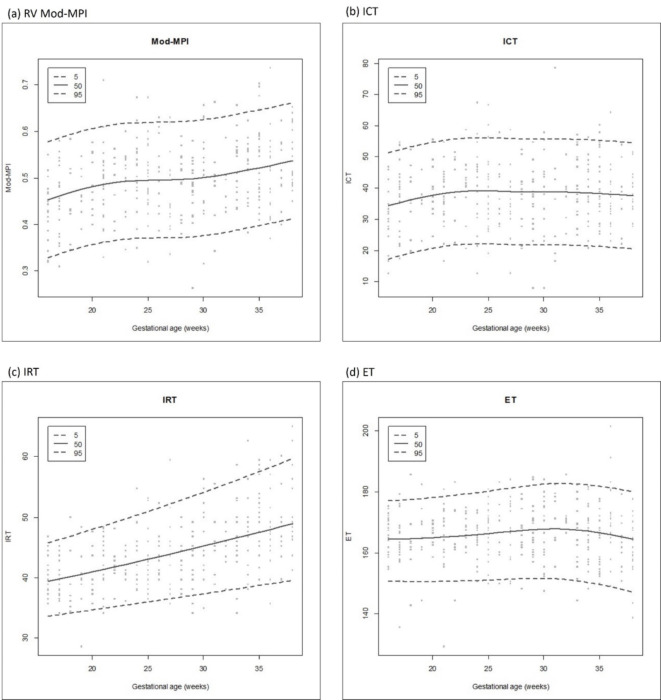
To establish normal reference ranges for fetal right ventricular modified myocardial performance index (RV Mod-MPI) using automatic synchronization of the RV inflow and outflow images (MPI). Additionally, we aimed to clinically apply RV Mod-MPI to investigate its changes in fetal right congenital diaphragmatic hernia (CDH) compared to normal fetuses. This prospective study included uncomplicated singleton pregnancies between 16 and 38 weeks of gestational age. Cases with any maternal or fetal complications that developed during the enrollment period were excluded. Two experienced operators measured the RV Mod-MPI using the automated and manual methods. The intraclass correlation coefficients (ICC) were calculated for intra- and inter-operator reproducibility. The mean differences between the manual and automated measurements were also compared. The RV Mod-MPI was then compared between the right CDH fetuses and normal fetuses. Seventy normal fetuses were analyzed for the feasibility of an automated system, and 364 examinations from 272 fetuses were analyzed for developing the normal references. The automated system showed significantly higher intra- and inter-operator reproducibility of Mod-MPI than those of manual measurements (ICC = 0.962 vs. 0.913 and 0.961 vs. 0.889, respectively). The mean difference in Mod-MPI between the manual and automated method was 0.0002 ± 0.0586 with a 95% confidence interval of -0.0095-0.0099. The Mod-MPI and isovolumetric relaxation time increased throughout the gestational weeks. The isovolumetric contraction time increased until 24 weeks of gestation and then slightly decreased afterwards, and the ejection time also increased until 31 weeks of gestation and then decreased. There was no significant difference in the Mod-MPI between right CDH and normal fetuses. The automated system showed high inter- and intra-operator reproducibility. Furthermore, the normal reference values of Mod-MPI for each gestational age were established. Our results suggest that the automated system might be clinically feasible for evaluating fetal cardiac function.
为了使用 RV 流入和流出图像(MPI)的自动同步建立胎儿右心室改良心肌运动指数(RV Mod-MPI)的正常参考范围。此外,我们旨在将 RV Mod-MPI 临床应用于研究其在胎儿右先天性膈疝(CDH)与正常胎儿中的变化。这项前瞻性研究包括 16 至 38 孕周的无并发症的单胎妊娠。排除在入组期间发生任何母亲或胎儿并发症的病例。两名经验丰富的操作人员使用自动和手动方法测量 RV Mod-MPI。计算了内和操作者之间的组内相关系数(ICC)的重现性。还比较了手动和自动测量之间的平均差异。然后比较了右 CDH 胎儿和正常胎儿之间的 RV Mod-MPI。分析了 70 个正常胎儿以确定自动系统的可行性,并对 272 个胎儿的 364 次检查进行了分析以建立正常参考值。自动系统显示 Mod-MPI 的内和操作者之间的重现性明显高于手动测量(ICC=0.962 与 0.913 和 0.961 与 0.889,分别)。手动和自动方法之间 Mod-MPI 的平均差异为 0.0002±0.0586,95%置信区间为-0.0095-0.0099。Mod-MPI 和等容舒张时间随妊娠周数而增加。等容收缩时间增加到 24 孕周,然后略有下降,然后射血时间也增加到 31 孕周,然后下降。右 CDH 和正常胎儿之间的 Mod-MPI 没有显著差异。自动系统显示出高的内和操作者之间的重现性。此外,建立了每个孕龄的 Mod-MPI 正常参考值。我们的结果表明,自动系统可能在评估胎儿心功能方面具有临床可行性。