The University of Sydney Northern Clinical School, St Leonards, New South Wales, Australia
HammondCare, Sydney, New South Wales, Australia.
BMJ Open. 2024 Sep 28;14(9):e086557. doi: 10.1136/bmjopen-2024-086557.
Paramedics have the potential to make a substantial contribution to community-based palliative care provision. However, they are hindered by a lack of policy and institutional support, as well as targeted education and training. This study aimed to elicit paramedics', palliative care doctors' and nurses', general practitioners', residential aged care nurses' and bereaved families and carers' attitudes and perspectives on how palliative paramedicine can be improved to better suit the needs of community-based patients, their families and carers, and the clinicians involved in delivering the care.
In this qualitative study underpinned by a social constructivist epistemology, semistructured interviews were conducted.
50 participants with palliative paramedicine experience, from all jurisdictions of Australia. Participants were interviewed between November 2021 and April 2022.
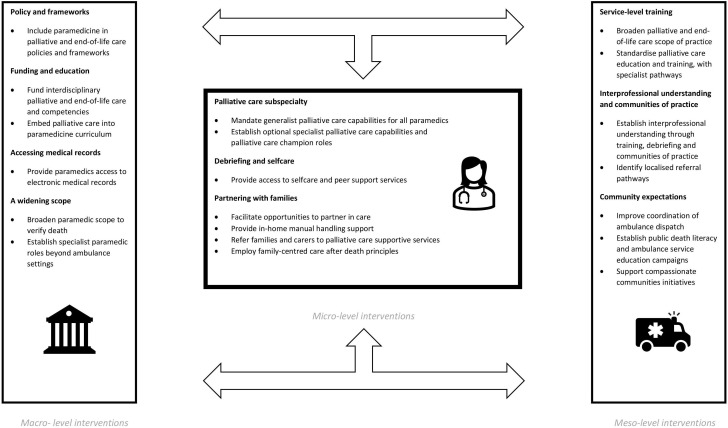
All participants suggested paramedics play an important adjunct role in the provision of palliative and end-of-life care in home-based settings. Three levels of opportunities for improvement were identified: macrolevel (policy and frameworks; funding and education; accessing medical records and a widening scope); mesolevel (service-level training; interprofessional understanding and communities of practice and community expectations) and microlevel (palliative care subspecialty; debriefing and self-care and partnering with families).
To enhance paramedic capacity to provide palliative care support, improvements targeting systems, services, communities and individuals should be made. This calls for stronger inclusion of paramedicine in interdisciplinary palliative care and greater investment in both the generalist and specialist palliative paramedicine workforce.
护理人员有潜力为社区为基础的姑息治疗提供实质性的贡献。然而,他们受到政策和机构支持的缺乏、以及有针对性的教育和培训的阻碍。本研究旨在了解护理人员、姑息治疗医生和护士、全科医生、养老院护士以及失去亲人的家庭和照顾者对姑息医疗的态度和看法,以及如何改进姑息医疗以更好地满足社区患者、他们的家庭和照顾者以及提供护理的临床医生的需求。
在社会建构主义认识论的基础上,本研究采用了定性研究方法,进行了半结构化访谈。
50 名具有姑息护理经验的参与者,来自澳大利亚的所有司法管辖区。参与者于 2021 年 11 月至 2022 年 4 月期间接受了访谈。
所有参与者都认为护理人员在家庭环境中提供姑息和临终关怀方面发挥着重要的辅助作用。确定了三个改进机会的层次:宏观层次(政策和框架;资金和教育;获取医疗记录和扩大范围)、中观层次(服务层面的培训;跨专业理解和实践社区以及社区期望)和微观层次(姑息护理专科;汇报和自我保健以及与家庭合作)。
为了提高护理人员提供姑息护理支持的能力,应该针对系统、服务、社区和个人进行改进。这需要更强的将护理人员纳入跨学科姑息护理,以及对姑息护理专业人员和普通护理人员的更大投资。