National University Heart Centre Singapore Singapore.
Yong Loo Lin School of Medicine National University of Singapore Singapore Singapore.
J Am Heart Assoc. 2024 Oct;13(19):e035486. doi: 10.1161/JAHA.124.035486. Epub 2024 Sep 30.
Echocardiographic indexes of aortic stenosis may not comprehensively reflect disease morbidity. Plasma proteomic profiling may add prognostic value in these patients.
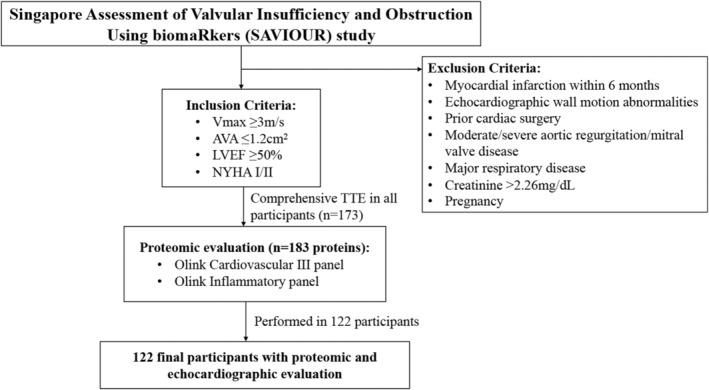
Proximity extension assays (Olink) of 183 circulating cardiovascular and inflammatory proteins were performed in a prospective follow-up study of 122 asymptomatic/minimally symptomatic patients (mean±SD age, 69.1±10.9 years; 61% men) with moderate to severe aortic stenosis and preserved left ventricular ejection fraction. Protein signatures of higher-risk echocardiographic subgroups were determined. Associations of proteins with the primary composite outcome (heart failure hospitalization, progression to New York Heart Association class III-IV, or all-cause mortality) were evaluated using competing risk analyses, with aortic valve replacement being the competing risk. Network analysis unveiled mutually exclusive communities of proteins and echocardiographic parameters, connected only through NT-proBNP (N-terminal pro-B-type natriuretic peptide). Members of the tumor necrosis factor receptor superfamily (TNFRSF1A, TNFRSF1B, and TNFRSF14), and trefoil factor-3 were major hub proteins among the circulating biomarkers. Left ventricular global longitudinal strain >-15% was associated with higher levels of proteins, primarily of inflammation and immune regulation, whereas aortic valve area <1 cm, E/e' >15, and left atrial reservoir strain <20% were associated with higher levels of NT-proBNP. Of 14 proteins associated with the primary end point, phospholipase-C, C-X-C motif chemokine-9, and interleukin-10 receptor subunit β demonstrated the highest hazard ratios after adjusting for clinical factors (<0.05).
Plasma proteins involved in inflammation and immune regulation were differentially expressed in patients with aortic stenosis with reduced left ventricular global longitudinal strain, and associated with adverse clinical outcomes. Their incorporation into aortic stenosis risk stratification warrants further assessment.
主动脉瓣狭窄的超声心动图指标可能无法全面反映疾病的发病率。血浆蛋白质组谱分析可能会为这些患者增加预后价值。
在一项对 122 例无症状/轻度症状(平均年龄 69.1±10.9 岁;61%为男性)的中度至重度主动脉瓣狭窄且左心室射血分数正常的患者前瞻性随访研究中,进行了 183 种循环心血管和炎症蛋白的接近延伸分析(Olink)。确定了高危超声心动图亚组的蛋白特征。使用竞争风险分析评估了蛋白质与主要复合终点(心力衰竭住院、进展为纽约心脏协会 III-IV 级或全因死亡率)的相关性,主动脉瓣置换是竞争风险。网络分析揭示了蛋白质和超声心动图参数之间相互排斥的社区,仅通过 N 端脑钠肽前体(NT-proBNP)连接。肿瘤坏死因子受体超家族(TNFRSF1A、TNFRSF1B 和 TNFRSF14)成员和三叶因子-3 是循环生物标志物中的主要枢纽蛋白。左心室整体纵向应变>-15%与炎症和免疫调节相关的蛋白水平升高相关,而主动脉瓣面积<1cm、E/e' >15 和左心房储备应变<20%与 NT-proBNP 水平升高相关。在与主要终点相关的 14 种蛋白中,磷脂酶-C、C-X-C 基序趋化因子-9 和白细胞介素-10 受体亚基β在调整临床因素后显示出最高的危险比(<0.05)。
在左心室整体纵向应变降低的主动脉瓣狭窄患者中,参与炎症和免疫调节的血浆蛋白表达不同,并与不良临床结局相关。将其纳入主动脉瓣狭窄风险分层值得进一步评估。