Kim Kwang-Soo, Zhang Junyi, Arrieta Víctor A, Dmello Crismita, Grabis Elena, Habashy Karl, Duffy Joseph, Zhao Junfei, Gould Andrew, Chen Li, Hu Jian, Balyasnikova Irina, Chand Dhan, Levey Dan, Canoll Peter, Zhao Wenting, Sims Peter A, Rabadan Raul, Pandey Surya, Zhang Bin, Lee-Chang Catalina, Heiland Dieter Henrik, Sonabend Adam M
Department of Neurological Surgery, Feinberg School of Medicine, Northwestern University, Chicago, IL, USA.
Northwestern Medicine Malnati Brain Tumor Institute of the Lurie Comprehensive Cancer Center, Feinberg School of Medicine, Northwestern University, Chicago, IL, USA.
bioRxiv. 2024 Sep 18:2024.09.11.612571. doi: 10.1101/2024.09.11.612571.
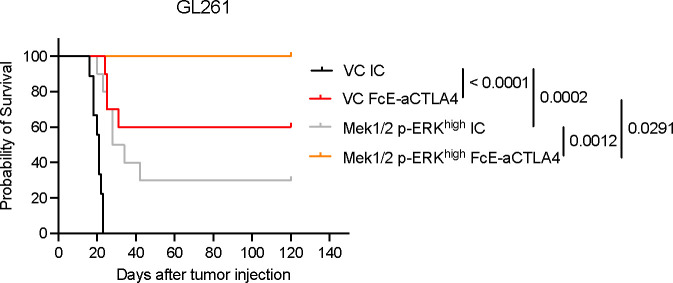
Glioblastoma (GB) remains a formidable challenge in neuro-oncology, with immune checkpoint blockade (ICB) showing limited efficacy in unselected patients. We previously recently established that MAPK/ERK signaling is associated with overall survival following anti-PD-1 and anti-CTLA-4 treatment in recurrent GB. However, the causal relationship between MAPK/ERK signaling and susceptibility to ICB, as well as the mechanisms underlying this association, remain poorly understood.
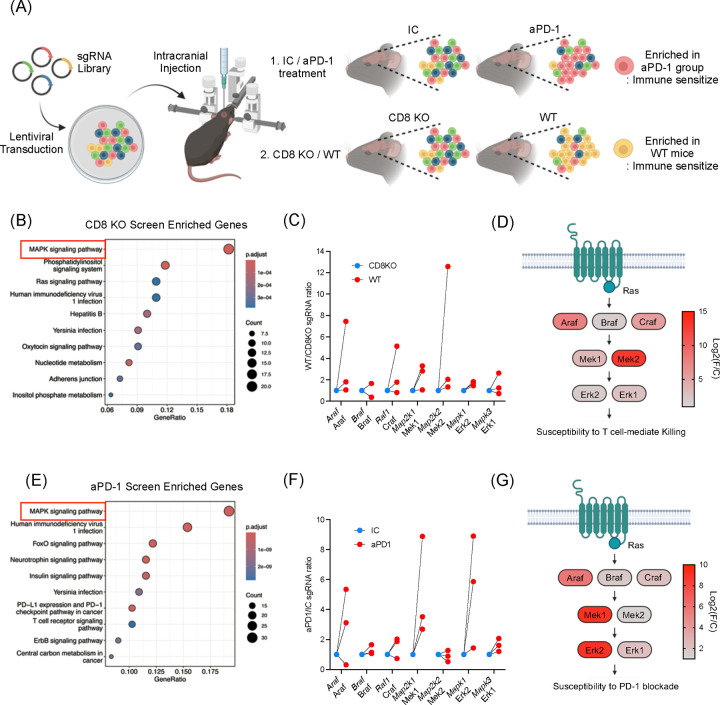
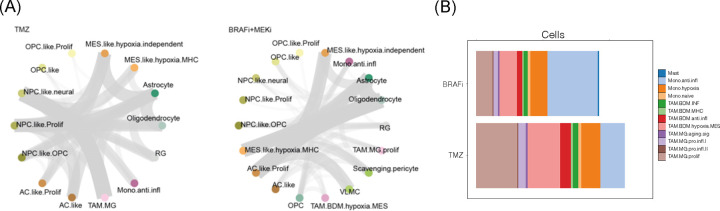
We conducted kinome-wide CRISPR/Cas9 screenings in murine gliomas to identify key regulators of susceptibility to anti-PD-1 and CD8 T cell responses and performed survival studies to validate the most relevant genes. Additionally, paired single cell RNA-sequencing (scRNA-seq) with p-ERK staining, spatial transcriptomics on GB samples, and slice culture of a BRAF mutant GB tumor treated with BRAFi/MEKi were used to determine the causal relationship between MAPK signaling, tumor cell immunogenicity, and modulation of microglia phenotype.
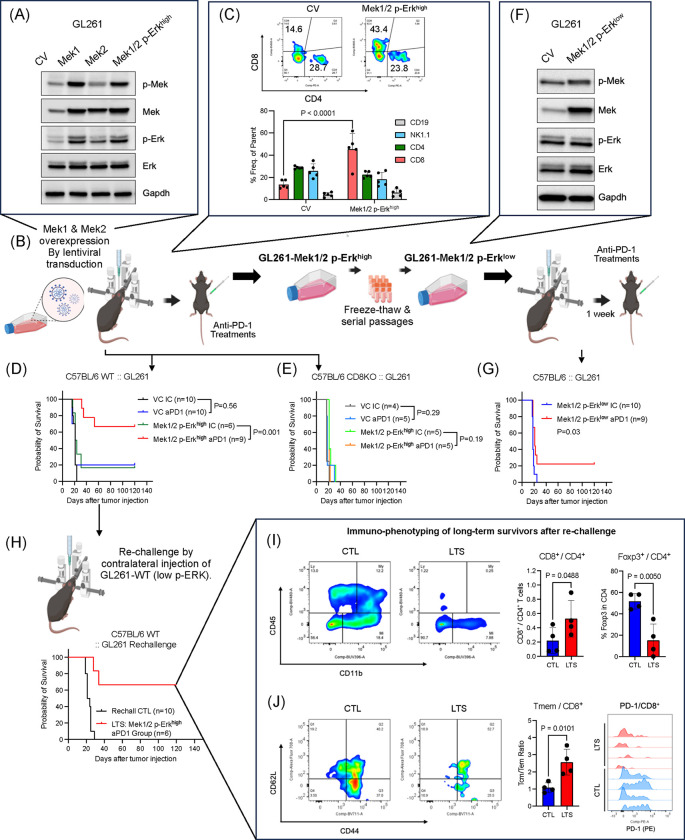
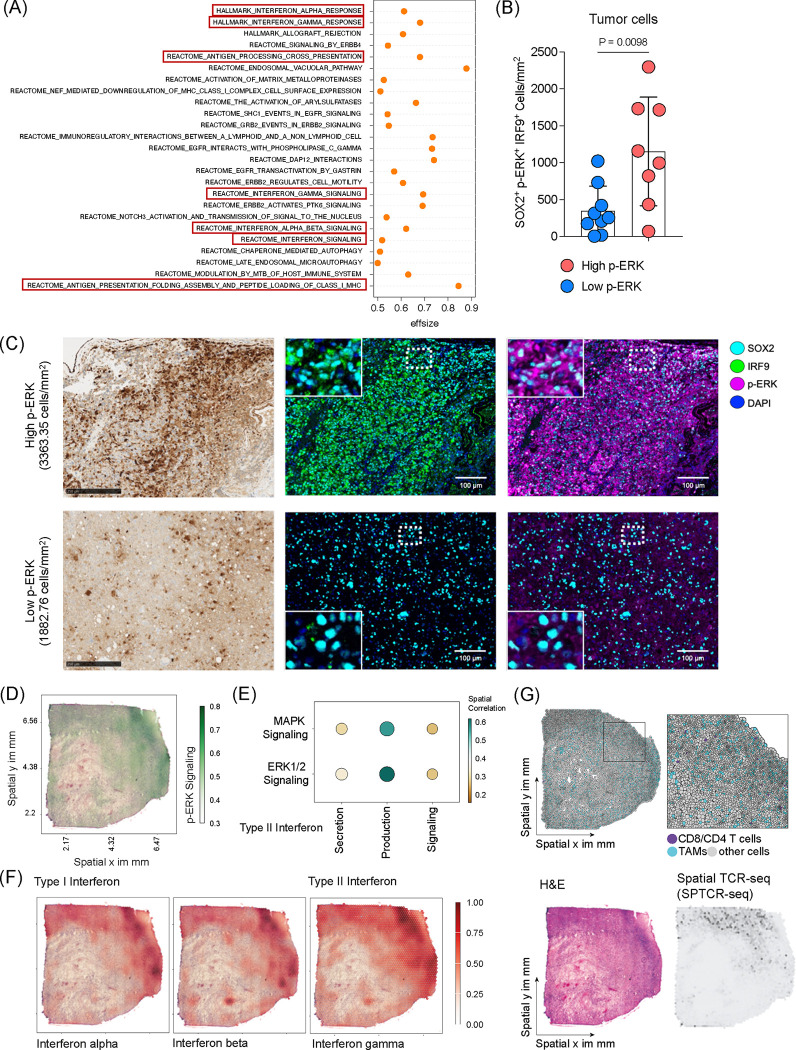
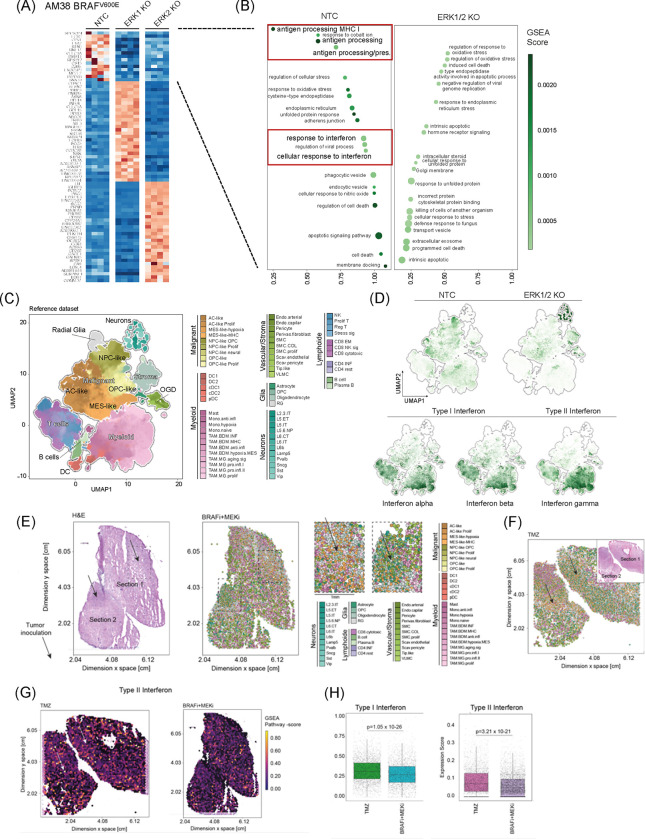
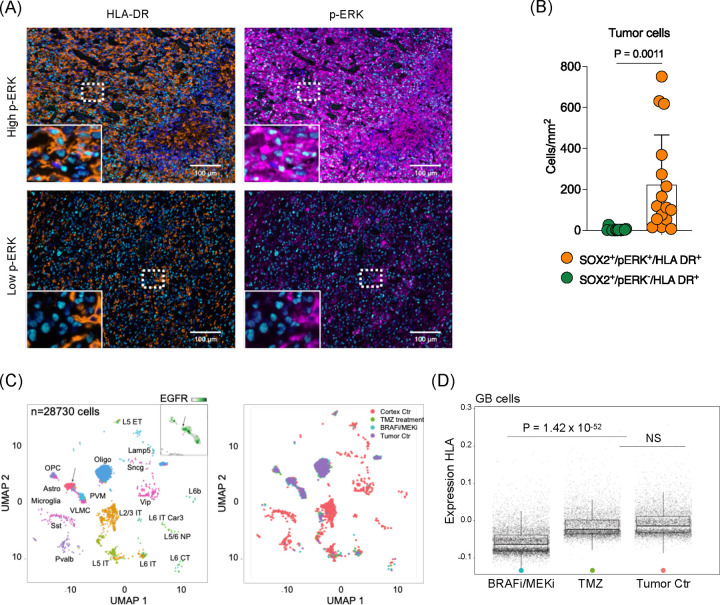
CRISPR/Cas9 screens identified the MAPK pathway, particularly the RAF-MEK-ERK pathway, as the most critical modulator of glioma susceptibility to CD8 T cells, and anti-PD-1 across all kinases. Experimentally-induced ERK phosphorylation in gliomas enhanced survival with ICB treatment, led to durable anti-tumoral immunity upon re-challenge and memory T cell infiltration in long-term survivors. Elevated p-ERK in glioma cells correlated with increased interferon responses, antigen presentation and T cell infiltration in GB. Moreover, spatial transcriptomics and scRNA-seq analysis revealed the modulation of interferon responses by the MAPK/ERK pathway in BRAF human GB cells with ERK1/2 knockout and in slice cultures of human BRAF GB tissue. Notably, BRAFi/MEKi treatment disrupted the interaction between tumor cells and tumor-associated macrophages/microglia in slice cultures from BRAF mutant GB.
Our data indicate that the MAPK/ERK pathway is a critical regulator of GB cell susceptibility to anti-tumoral immunity, modulating interferon responses, and antigen-presentation in glioma cells, as well as tumor cell interaction with microglia. These findings not only elucidate the mechanistic underpinnings of immunotherapy resistance in GB but also highlight the MAPK/ERK pathway as a promising target for enhancing immunotherapeutic efficacy in this challenging malignancy.
胶质母细胞瘤(GB)仍是神经肿瘤学中一项艰巨的挑战,免疫检查点阻断(ICB)在未经过挑选的患者中疗效有限。我们最近证实,在复发性GB中,MAPK/ERK信号通路与抗PD-1和抗CTLA-4治疗后的总生存期相关。然而,MAPK/ERK信号通路与ICB敏感性之间的因果关系以及这种关联背后的机制仍知之甚少。
我们在小鼠胶质瘤中进行了全激酶组CRISPR/Cas9筛选,以确定对抗PD-1敏感性和CD8 T细胞反应的关键调节因子,并进行生存研究以验证最相关的基因。此外,采用配对单细胞RNA测序(scRNA-seq)与p-ERK染色、GB样本的空间转录组学以及用BRAFi/MEKi治疗的BRAF突变GB肿瘤的切片培养,以确定MAPK信号通路、肿瘤细胞免疫原性和小胶质细胞表型调节之间的因果关系。
CRISPR/Cas9筛选确定MAPK通路,特别是RAF-MEK-ERK通路,是胶质瘤对CD8 T细胞和所有激酶的抗PD-1敏感性的最关键调节因子。实验诱导的胶质瘤中ERK磷酸化通过ICB治疗提高了生存率,在再次攻击时导致持久的抗肿瘤免疫,并在长期存活者中出现记忆T细胞浸润。胶质瘤细胞中升高的p-ERK与GB中干扰素反应增加、抗原呈递和T细胞浸润相关。此外,空间转录组学和scRNA-seq分析揭示了在BRAF人GB细胞中ERK1/2基因敲除以及人BRAF GB组织切片培养中,MAPK/ERK通路对干扰素反应的调节作用。值得注意的是,BRAFi/MEKi治疗破坏了BRAF突变GB切片培养中肿瘤细胞与肿瘤相关巨噬细胞/小胶质细胞之间的相互作用。
我们的数据表明,MAPK/ERK通路是GB细胞对抗肿瘤免疫敏感性的关键调节因子,调节胶质瘤细胞中的干扰素反应和抗原呈递,以及肿瘤细胞与小胶质细胞的相互作用。这些发现不仅阐明了GB中免疫治疗耐药性的机制基础,还突出了MAPK/ERK通路作为增强这种具有挑战性的恶性肿瘤免疫治疗疗效的一个有前景的靶点。