Hart Samuel F M, Garrett Fiona E S, Kerr Jesse S, Metzger Michael J
Pacific Northwest Research Institute, Seattle, WA, USA.
Molecular and Cellular Biology Program, University of Washington, Seattle, WA, USA.
bioRxiv. 2024 Sep 19:2024.09.13.612964. doi: 10.1101/2024.09.13.612964.
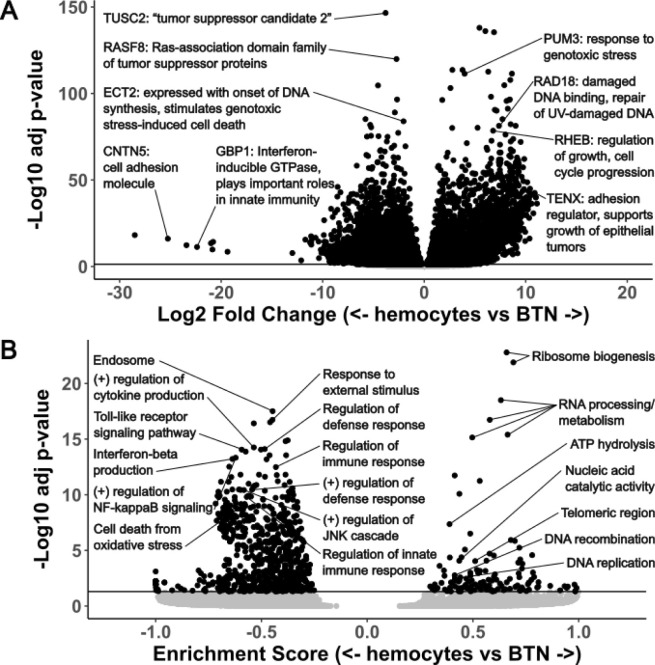
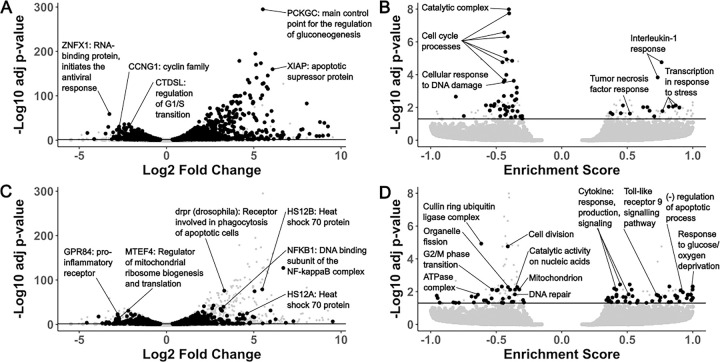
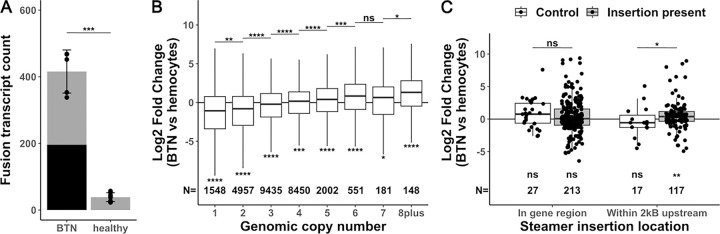
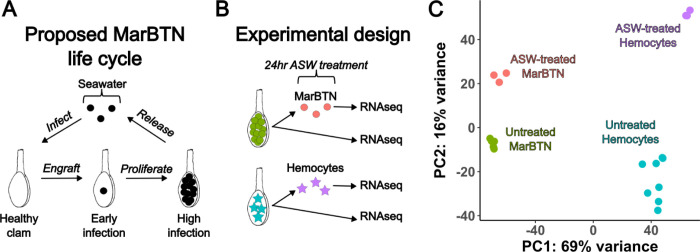
Transmissible cancers are unique instances in which cancer cells escape their original host and spread through a population as a clonal lineage, documented in Tasmanian Devils, dogs, and ten bivalve species. For a cancer to repeatedly transmit to new hosts, these lineages must evade strong barriers to transmission, notably the metastasis-like physical transfer to a new host body and rejection by that host's immune system. We quantified gene expression in a transmissible cancer lineage that has spread through the soft-shell clam () population to investigate potential drivers of its success as a transmissible cancer lineage, observing extensive differential expression of genes and gene pathways. We observed upregulation of genes involved with genotoxic stress response, ribosome biogenesis and RNA processing, and downregulation of genes involved in tumor suppression, cell adhesion, and immune response. We also observe evidence that widespread genome instability affects the cancer transcriptome via gene fusions, copy number variation, and transposable element insertions. Finally, we incubated cancer cells in seawater, the presumed host-to-host transmission vector, and observed conserved responses to halt metabolism, avoid apoptosis and survive the low-nutrient environment. Interestingly, many of these responses are also present in healthy clam cells, suggesting that bivalve hemocytes may have inherent seawater survival responses that may partially explain why transmissible cancers are so common in bivalves. Overall, this study reveals multiple mechanisms this lineage may have evolved to successfully spread through the soft-shell clam population as a contagious cancer, utilizing pathways known to be conserved in human cancers as well as pathways unique to long-lived transmissible cancers.
可传播癌症是一种独特的现象,即癌细胞逃离其原始宿主,并作为一个克隆谱系在种群中传播,袋獾、狗和十种双壳贝类物种中都有相关记录。对于一种癌症要反复传播到新宿主,这些谱系必须规避强大的传播障碍,特别是类似转移的物理转移到新宿主体内以及被该宿主免疫系统排斥。我们对一种已在软壳蛤种群中传播的可传播癌症谱系中的基因表达进行了定量分析,以研究其作为可传播癌症谱系成功传播的潜在驱动因素,观察到基因和基因通路存在广泛的差异表达。我们观察到与基因毒性应激反应、核糖体生物发生和RNA加工相关的基因上调,以及与肿瘤抑制、细胞黏附和免疫反应相关基因的下调。我们还观察到证据表明广泛的基因组不稳定性通过基因融合、拷贝数变异和转座元件插入影响癌症转录组。最后,我们将癌细胞置于假定的宿主间传播载体海水中培养,观察到它们对停止代谢、避免凋亡以及在低营养环境中存活的保守反应。有趣的是,许多这些反应在健康的蛤细胞中也存在,这表明双壳贝类血细胞可能具有固有的海水存活反应,这可能部分解释了为什么可传播癌症在双壳贝类中如此常见。总体而言,这项研究揭示了该谱系可能进化出的多种机制,使其能够作为一种传染性癌症成功地在软壳蛤种群中传播,利用了已知在人类癌症中保守的途径以及长寿可传播癌症特有的途径。