Ren Na, Ma Fengyan, Tian Mengbai, Zhang Guochao, Xing Qi, Zheng Xu, Wu Wei, Qi Yimin, Wang Mingyu, Zhao Liang
Department of Thoracic Surgery, National Cancer Center/National Clinical Research Center for Cancer/Cancer Hospital, Chinese Academy of Medical Sciences and Peking Union Medical College, Beijing, People's Republic of China.
Patient Prefer Adherence. 2024 Sep 24;18:1979-1989. doi: 10.2147/PPA.S464331. eCollection 2024.
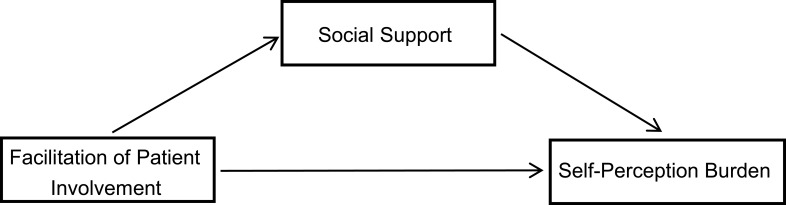
Patients with lung cancer often experience a high level of self-perceived burden, which significantly affects their quality of life and psychological health. Social support is closely related to the self-perceived burden, yet there is scant research on the relationship between social support, facilitation of patient involvement, and self-perceived burden. This study aims to understand the current situation of self-perceived burden in postoperative lung cancer patients and to explore the mediating role of social support between facilitation of patient involvement and self-perceived burden.
A cross-sectional design was used in this study. Using a convenience sampling method, a total of 331 lung cancer patients who were hospitalized for surgical treatment at a tertiary cancer hospital in Beijing, China, from August 2022 to May 2023, were selected to participate in this survey. The survey included a self-designed sociodemographic questionnaire, the Facilitation of Patient Involvement Scale (FPIS), the Perceived Social Support Scale (PSSS), and the Self-Perceived Burden Scale (SPBS). Data were analyzed using SPSS 24.0 for statistical description and Pearson correlation analysis, while AMOS 24.0 was utilized to construct a structural equation model to examine the mediation effect.
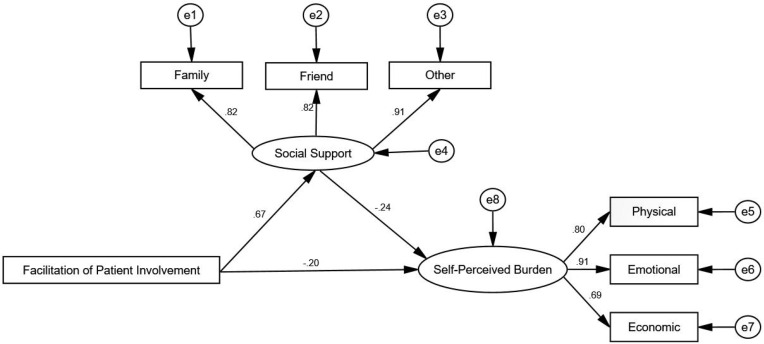
The score of self-perceived burden in lung cancer patients was 26.42 ±8.23 points. Bot facilitation of patient involvement and social support was negatively correlated with self-perceived burden (r = -0.313, r = -0.332, P < 0.001). Social support plays a partially mediated role in the relationship between facilitation of patient involvement and self-perceived burden, accounting for 44.3% of the total effect.
The self-perceived burden of patients after lung cancer surgery was at a moderate level, and social support partially mediates the relationship between facilitation of patient involvement and self-perceived burden. Medical staff should encourage patient participation in their own treatment decisions and alleviate the burden associated with lung cancer and surgical treatment by enhancing their social support.
肺癌患者常经历高水平的自我感知负担,这显著影响其生活质量和心理健康。社会支持与自我感知负担密切相关,但关于社会支持、促进患者参与和自我感知负担之间关系的研究却很少。本研究旨在了解肺癌术后患者自我感知负担的现状,并探讨社会支持在促进患者参与和自我感知负担之间的中介作用。
本研究采用横断面设计。采用便利抽样法,选取2022年8月至2023年5月在中国北京一家三级癌症医院住院接受手术治疗的331例肺癌患者参与本调查。该调查包括自行设计的社会人口学问卷、患者参与促进量表(FPIS)、感知社会支持量表(PSSS)和自我感知负担量表(SPBS)。使用SPSS 24.0进行数据分析以进行统计描述和Pearson相关分析,同时利用AMOS 24.0构建结构方程模型以检验中介效应。
肺癌患者自我感知负担得分为26.42±8.23分。促进患者参与和社会支持均与自我感知负担呈负相关(r = -0.313,r = -0.332,P < 0.001)。社会支持在促进患者参与和自我感知负担之间的关系中起部分中介作用,占总效应的44.3%。
肺癌手术后患者的自我感知负担处于中等水平,社会支持部分中介了促进患者参与和自我感知负担之间的关系。医务人员应鼓励患者参与自身治疗决策,并通过增强其社会支持来减轻与肺癌及手术治疗相关的负担。