Nicoletti Paola, Zafer Samreen, Matok Lital, Irron Inbar, Patrick Meidva, Haklai Rotem, Evangelista John Erol, Marino Giacomo B, Ma'ayan Avi, Sewda Anshuman, Holmes Greg, Britton Sierra R, Lee Won Jun, Wu Meng, Ru Ying, Arnaud Eric, Botto Lorenzo, Brody Lawrence C, Byren Jo C, Caggana Michele, Carmichael Suzan L, Cilliers Deirdre, Conway Kristin, Crawford Karen, Cuellar Araceli, Di Rocco Federico, Engel Michael, Fearon Jeffrey, Feldkamp Marcia L, Finnell Richard, Fisher Sarah, Freudlsperger Christian, Garcia-Fructuoso Gemma, Hagge Rhinda, Heuzé Yann, Harshbarger Raymond J, Hobbs Charlotte, Howley Meredith, Jenkins Mary M, Johnson David, Justice Cristina M, Kane Alex, Kay Denise, Gosain Arun Kumar, Langlois Peter, Legal-Mallet Laurence, Lin Angela E, Mills James L, Morton Jenny E V, Noons Peter, Olshan Andrew, Persing John, Phipps Julie M, Redett Richard, Reefhuis Jennita, Rizk Elias, Samson Thomas D, Shaw Gary M, Sicko Robert, Smith Nataliya, Staffenberg David, Stoler Joan, Sweeney Elizabeth, Taub Peter J, Timberlake Andrew T, Topczewska Jolanta, Wall Steven A, Wilson Alexander F, Wilson Louise C, Boyadjiev Simeon A, Wilkie Andrew O M, Richtsmeier Joan T, Jabs Ethylin Wang, Romitti Paul A, Karasik David, Birnbaum Ramon Y, Peter Inga
Department of Genetics and Genomic Sciences, Icahn School of Medicine at Mount Sinai, New York, NY.
Azrieli Faculty of Medicine, Bar Ilan University, Safed, Israel.
Genet Med Open. 2024;2. doi: 10.1016/j.gimo.2024.101851. Epub 2024 May 17.
The etiopathogenesis of coronal nonsyndromic craniosynostosis (cNCS), a congenital condition defined by premature fusion of 1 or both coronal sutures, remains largely unknown.
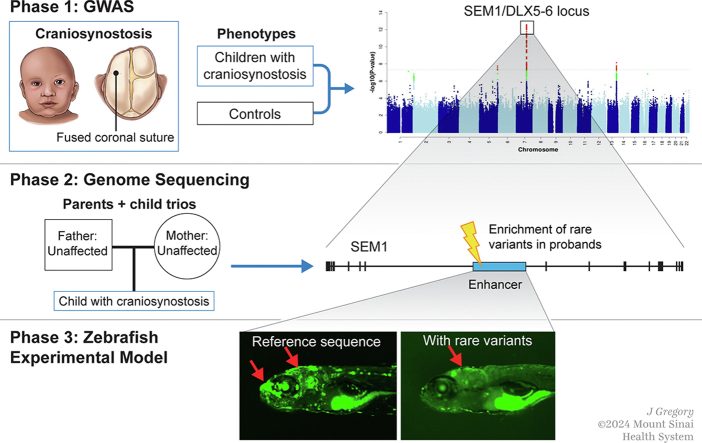
We conducted the largest genome-wide association study of cNCS followed by replication, fine mapping, and functional validation of the most significant region using zebrafish animal model.
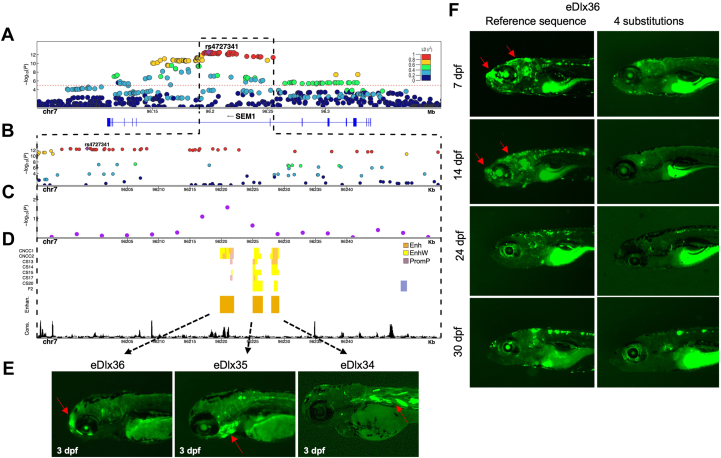
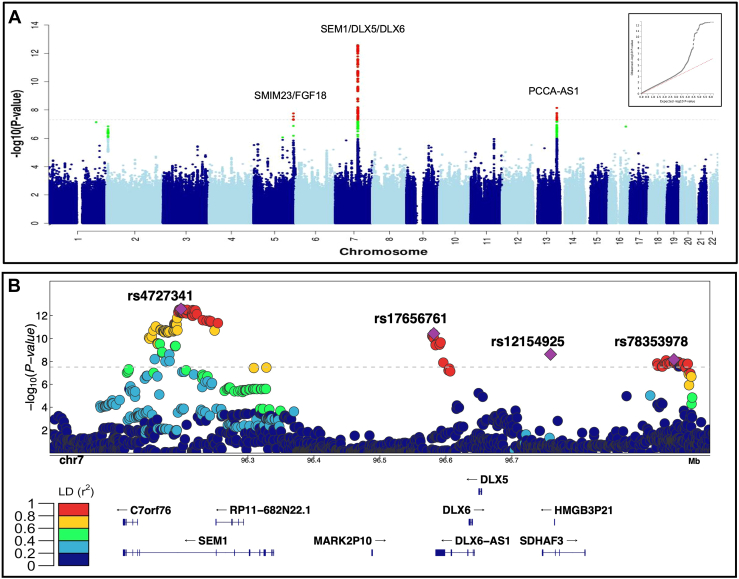
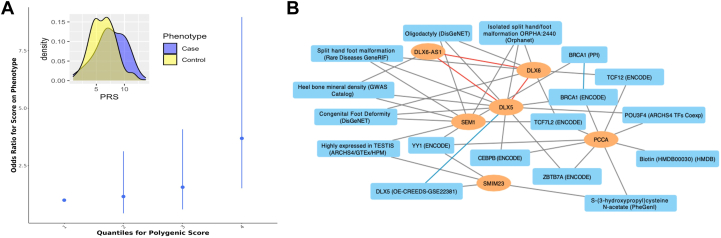
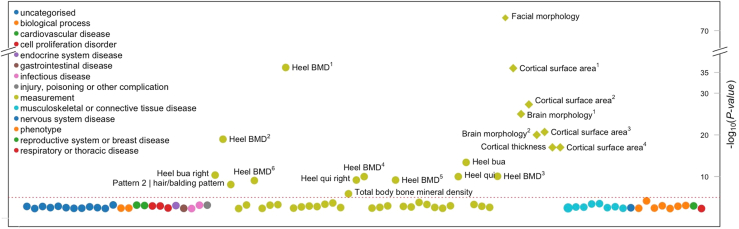
Genome-wide association study identified 6 independent genome-wide-significant risk alleles, 4 on chromosome 7q21.3 locus, and their combination conferred over 7-fold increased risk of cNCS. The top variants were replicated in an independent cohort and showed pleiotropic effects on brain and facial morphology and bone mineral density. Fine mapping of 7q21.3 identified a craniofacial transcriptional enhancer (eDlx36) within the linkage region of the top variant (rs4727341; odds ratio [95% confidence interval], 0.48[0.39-0.59]; = 1.2E-12) that was located in intron and enriched in 4 rare risk variants. In zebrafish, the activity of the transfected human eDlx36 enhancer was observed in the frontonasal prominence and calvaria during skull development and was reduced when the 4 rare risk variants were introduced into the sequence.
Our findings support a polygenic nature of cNCS risk and functional role of craniofacial enhancers in cNCS susceptibility with potential broader implications for bone health.
冠状非综合征性颅缝早闭(cNCS)是一种由一条或两条冠状缝过早融合所定义的先天性疾病,其发病机制在很大程度上仍不清楚。
我们开展了关于cNCS的最大规模全基因组关联研究,随后使用斑马鱼动物模型对最显著区域进行重复验证、精细定位和功能验证。
全基因组关联研究确定了6个独立的全基因组显著风险等位基因,其中4个位于7号染色体q21.3位点,它们的组合使cNCS的风险增加了7倍多。顶级变异在一个独立队列中得到重复验证,并对脑和面部形态以及骨密度显示出多效性作用。7q21.3的精细定位在顶级变异(rs4727341;优势比[95%置信区间],0.48[0.39 - 0.59];P = 1.2E - 12)的连锁区域内确定了一个颅面转录增强子(eDlx36),该增强子位于内含子中,且在4个罕见风险变异中富集。在斑马鱼中,在颅骨发育过程中,转染的人类eDlx36增强子的活性在额鼻突和颅盖骨中被观察到,当将4个罕见风险变异引入该序列时,其活性降低。
我们的研究结果支持cNCS风险的多基因性质以及颅面增强子在cNCS易感性中的功能作用,这可能对骨骼健康具有更广泛的意义。