Chang Liang, Luo Ying, Li Weirong, Liu Fangfei, Guo Jiaxin, Dai Bingyang, Tong Wenxue, Qin Ling, Wang Jiali, Xu Jiankun
Musculoskeletal Research Laboratory, Department of Orthopaedics & Traumatology, The Chinese University of Hong Kong, Hong Kong, 999077, China.
School of Biomedical Engineering, Sun Yat-Sen University, Guangzhou, Guangdong, 510000, China.
Regen Biomater. 2024 Sep 3;11:rbae095. doi: 10.1093/rb/rbae095. eCollection 2024.
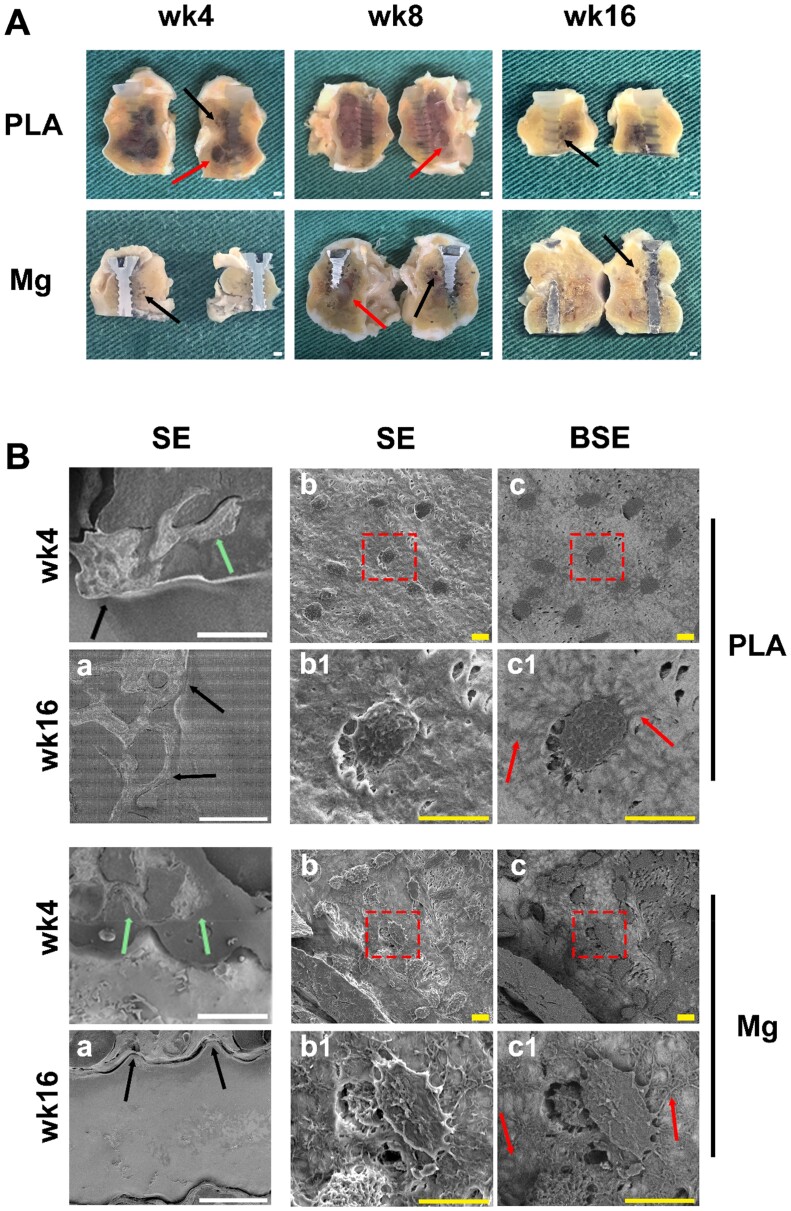
With mechanical strength close to cortical bone, biodegradable and osteopromotive properties, magnesium (Mg)-based implants are promising biomaterials for orthopedic applications. However, during the degradation of such implants, there are still concerns on the potential adverse effects such as formation of cavities, osteolytic phenomena and chronic inflammation. Therefore, to transform Mg-based implants into clinical practice, the present study evaluated the local effects of high-purity Mg screws (HP-Mg, 99.99 wt%) by comparing with clinically approved polylactic acid (PLA) screws in epiphyseal trabecular bone of rabbits. After implantation of screws at the rabbit distal femur, bone microstructural, histomorphometric and biomechanical properties were measured at various time points (weeks 4, 8 and 16) using micro-CT, histology and histomorphometry, micro-indentation and scanning electron microscope. HP-Mg screws promoted peri-implant bone ingrowth with higher bone mass (BV/TV at week 4: 0.189 ± 0.022 in PLA group versus 0.313 ± 0.053 in Mg group), higher biomechanical properties (hardness at week 4: 35.045 ± 1.000 HV in PLA group versus 51.975 ± 2.565 HV in Mg group), more mature osteocyte LCN architecture, accelerated bone remodeling process and alleviated immunoreactive score (IRS of Ram11 at week 4: 5.8 ± 0.712 in PLA group versus 3.75 ± 0.866 in Mg group) as compared to PLA screws. Furthermore, we conducted finite element analysis to validate the superiority of HP-Mg screws as orthopedic implants by demonstrating reduced stress concentration and uniform stress distribution around the bone tunnel, which led to lower risks of trabecular microfractures. In conclusion, HP-Mg screws demonstrated greater osteogenic bioactivity and limited inflammatory response compared to PLA screws in the epiphyseal trabecular bone of rabbits. Our findings have paved a promising way for the clinical application of Mg-based implants.
镁(Mg)基植入物具有接近皮质骨的机械强度、可生物降解性和骨诱导特性,是骨科应用中有前景的生物材料。然而,在这类植入物的降解过程中,人们仍担心其潜在的不良影响,如形成空洞、骨溶解现象和慢性炎症。因此,为了将镁基植入物转化为临床应用,本研究通过与临床认可的聚乳酸(PLA)螺钉对比,评估了高纯度镁螺钉(HP-Mg,99.99 wt%)在兔骨骺松质骨中的局部效应。在兔股骨远端植入螺钉后,于不同时间点(第4、8和16周)使用微型计算机断层扫描(micro-CT)、组织学和组织形态计量学、微压痕和扫描电子显微镜测量骨微观结构、组织形态计量学和生物力学性能。与PLA螺钉相比,HP-Mg螺钉促进了植入物周围骨向内生长,具有更高的骨量(第4周时,PLA组的骨体积分数[BV/TV]为0.189±0.022,而Mg组为0.313±0.053)、更高的生物力学性能(第4周时,PLA组的硬度为35.045±1.000 HV,而Mg组为51.975±2.565 HV)、更成熟的骨细胞LCN结构、加速的骨重塑过程以及减轻的免疫反应评分(第4周时,PLA组Ram11的免疫反应评分[IRS]为5.8±0.712,而Mg组为3.75±0.866)。此外,我们进行了有限元分析,通过证明骨隧道周围应力集中降低和应力分布均匀,验证了HP-Mg螺钉作为骨科植入物的优越性,这降低了小梁微骨折的风险。总之,在兔骨骺松质骨中,与PLA螺钉相比,HP-Mg螺钉表现出更大的成骨生物活性和有限的炎症反应。我们的研究结果为镁基植入物的临床应用铺平了一条有前景的道路。