
类风湿关节炎与牙髓根尖周病之间的因果关系、共享基因:来自 GWAS 和转录组数据的证据。
Causal relationship, shared genes between rheumatoid arthritis and pulp and periapical disease: evidence from GWAS and transcriptome data.
机构信息
Department of Endodontics, Changzhou Stomatological Hospital, Changzhou, China.
Department of General Surgery, Changzhou Hospital of Traditional Chinese Medicine, Changzhou, China.
出版信息
Front Immunol. 2024 Sep 13;15:1440753. doi: 10.3389/fimmu.2024.1440753. eCollection 2024.
OBJECTIVE
Patients with rheumatoid arthritis (RA) have an increased risk of developing pulp and periapical disease (PAP), but the causal relationship and shared genetic factors between these conditions have not been explored. This study aimed to investigate the bidirectional causal relationship between RA and PAP and to analyze shared genes and pathogenic pathways.
METHODS
We utilized GWAS data from the IEU Open GWAS Project and employed five Mendelian randomization methods (MR Egger, weighted median, inverse variance weighted, simple mode, and weighted mode) to investigate the bidirectional causal relationship between RA and PAP. Transcriptome data for RA and irreversible pulpitis (IRP) were obtained from the GEO database. Hub genes were identified through differential analysis, CytoHubba, machine learning (ML), and other methods. The immune infiltration of both diseases was analyzed using the ssGSEA method. Finally, we constructed a regulatory network for miRNAs, transcription factors, chemicals, diseases, and RNA-binding proteins based on the identified hub genes.
RESULTS
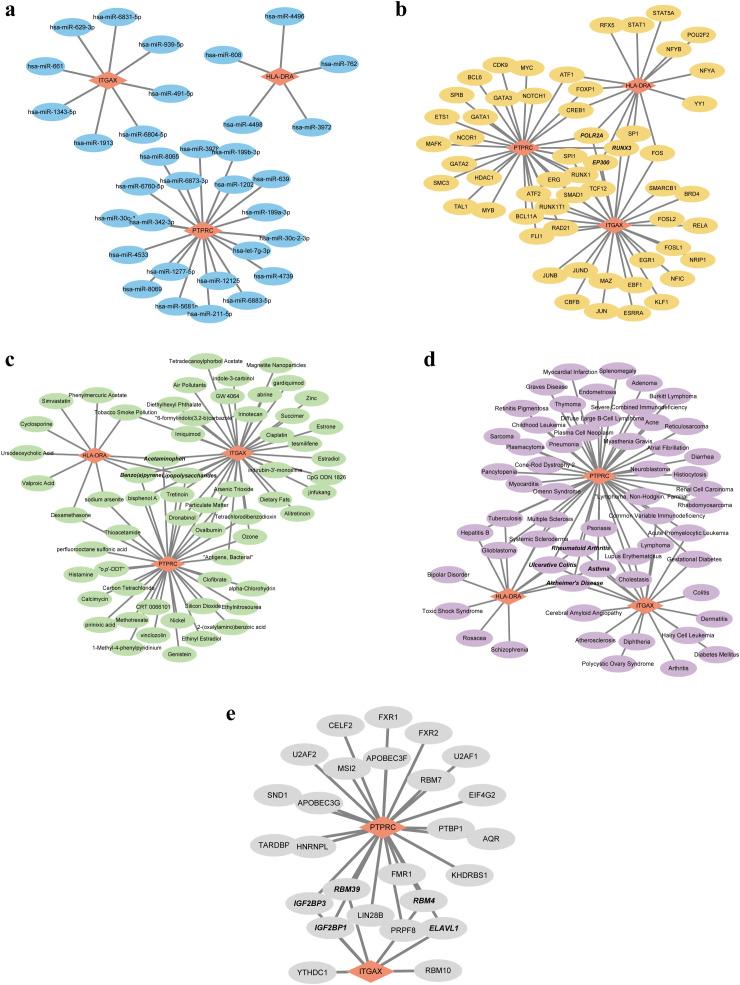
RA was significantly associated with an increased risk of PAP (OR = 1.1284, 95% CI 1.0674-1.1929, p < 0.001). However, there was insufficient evidence to support the hypothesis that PAP increased the risk of RA. Integrating datasets and differential analysis identified 84 shared genes primarily involved in immune and inflammatory pathways, including the IL-17 signaling pathway, Th17 cell differentiation, and TNF signaling pathway. Using CytoHubba and three ML methods, we identified three hub genes (HLA-DRA, ITGAX, and PTPRC) that are significantly correlated and valuable for diagnosing RA and IRP. We then constructed a comprehensive regulatory network using the miRDB, miRWalk, ChipBase, hTFtarget, CTD, MalaCards, DisGeNET, and ENCORI databases.
CONCLUSION
RA may increase the risk of PAP. The three key genes, HLA-DRA, ITGAX, and PTPRC, have significant diagnostic value for both RA and IRP.
目的
类风湿关节炎(RA)患者发生牙髓和根尖周病(PAP)的风险增加,但尚未探讨这些疾病之间的因果关系和共同遗传因素。本研究旨在探讨 RA 和 PAP 之间的双向因果关系,并分析共同基因和致病途径。
方法
我们利用 IEU Open GWAS 项目的 GWAS 数据,采用五种孟德尔随机化方法(MR Egger、加权中位数、逆方差加权、简单模式和加权模式)来研究 RA 和 PAP 之间的双向因果关系。RA 和不可逆性牙髓炎(IRP)的转录组数据来自 GEO 数据库。通过差异分析、CytoHubba、机器学习(ML)和其他方法确定枢纽基因。使用 ssGSEA 方法分析两种疾病的免疫浸润情况。最后,我们根据鉴定出的枢纽基因构建了一个 miRNA、转录因子、化学品、疾病和 RNA 结合蛋白的调控网络。
结果
RA 与 PAP 风险增加显著相关(OR=1.1284,95%CI1.0674-1.1929,p<0.001)。然而,没有足够的证据支持 PAP 增加 RA 风险的假设。整合数据集和差异分析确定了 84 个主要参与免疫和炎症途径的共享基因,包括 IL-17 信号通路、Th17 细胞分化和 TNF 信号通路。使用 CytoHubba 和三种 ML 方法,我们鉴定出三个显著相关且对诊断 RA 和 IRP 有价值的枢纽基因(HLA-DRA、ITGAX 和 PTPRC)。然后,我们使用 miRDB、miRWalk、ChipBase、hTFtarget、CTD、MalaCards、DisGeNET 和 ENCORI 数据库构建了一个全面的调控网络。
结论
RA 可能会增加 PAP 的风险。HLA-DRA、ITGAX 和 PTPRC 这三个关键基因对 RA 和 IRP 均具有显著的诊断价值。


 Zotero 插件