Trott M, Suetani S, Arnautovska U, Kisely S, Kar Ray M, Theodoros T, Le V, Leske S, Lu M, Soole R, Warren N, Siskind D
UQ Medical School, Faculty of Medicine, The University of Queensland, Brisbane, Queensland, Australia.
Physical and Mental Health Research Stream, Queensland Centre for Mental Health Research, Brisbane, Queensland, Australia.
Acta Psychiatr Scand. 2025 Apr;151(4):467-484. doi: 10.1111/acps.13759. Epub 2024 Oct 1.
People with severe mental illness (SMI) have a higher risk of suicide compared with the general population. However, variations in suicide methods between people with different SMIs have not been examined. The aim of this pre-registered (PROSPERO CRD42022351748) systematic review was to pool the odds of people with SMI who die by suicide versus those with no SMI, stratified by suicide method.
Searches were conducted on December 11, 2023 across PubMed, PsycInfo, CINAHL, and Embase. Eligible studies were those that reported suicide deaths stratified by SMI and suicide methods. Studies were pooled in a random-effects meta-analysis, and risk of bias was measured by the Joanna Briggs Institute checklist.
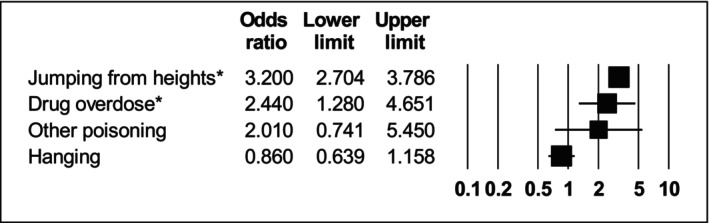
After screening, 12 studies were eligible (n = 380,523). Compared with those with no SMI, people with schizophrenia had 3.38× higher odds of jumping from heights (95% CI: 2.08-5.50), 1.93× higher odds of drowning (95% CI: 1.50-2.48). People with bipolar disorder also had 3.2× higher odds of jumping from heights (95% CI: 2.70-3.78). Finally, people with major depression had 3.11× higher odds of drug overdose (95% CI: 1.53-6.31), 2.11× higher odds of jumping from heights (95% CI: 1.93-2.31), and 2.33× lower odds of dying by firearms (OR = 0.43, 95% CI: 0.33-0.56). No studies were classified as high risk of bias, and no outcomes had high levels of imprecision or indirectness.
These findings could inform lethal means counselling practices in this population. Additionally individual, clinical, community and public health interventions for people with SMI should prioritise, where feasible, means restriction including access to heights or drugs to overdose.
与普通人群相比,患有严重精神疾病(SMI)的人自杀风险更高。然而,不同严重精神疾病患者的自杀方式差异尚未得到研究。这项预先注册(PROSPERO CRD42022351748)的系统评价旨在汇总按自杀方式分层的严重精神疾病患者与无严重精神疾病患者自杀死亡的比值比。
于2023年12月11日在PubMed、PsycInfo、CINAHL和Embase数据库进行检索。纳入的合格研究是那些报告了按严重精神疾病和自杀方式分层的自杀死亡情况的研究。研究采用随机效应荟萃分析进行汇总,并通过乔安娜·布里格斯研究所清单评估偏倚风险。
筛选后,12项研究符合要求(n = 380,523)。与无严重精神疾病的人相比,精神分裂症患者从高处跳下的比值比高3.38倍(95%可信区间:2.08 - 5.50),溺水的比值比高1.93倍(95%可信区间:1.50 - 2.48)。双相情感障碍患者从高处跳下的比值比也高3.2倍(95%可信区间:2.70 - 3.78)。最后,重度抑郁症患者药物过量的比值比高3.11倍(95%可信区间:1.53 - 6.31),从高处跳下的比值比高2.11倍(95%可信区间:1.93 - 2.31),死于枪击的比值比低2.33倍(比值比 = 0.43,95%可信区间:0.33 - 0.56)。没有研究被归类为高偏倚风险,也没有结果存在高度不精确或间接性。
这些发现可为该人群的致命手段咨询实践提供参考。此外,针对严重精神疾病患者的个体、临床、社区和公共卫生干预措施应在可行的情况下优先考虑限制手段,包括限制接触高处或可用于过量用药的药物。