Betz Milan W, De Brandt Jana, Aussieker Thorben, Monsegue Alejandra P, Houtvast Dion C J, Gehlert Sebastian, Verdijk Lex B, van Loon Luc J C, Gosker Harry R, Langen Ramon J C, Derave Wim, Burtin Chris, Spruit Martijn A, Snijders Tim
NUTRIM Research Institute of Nutrition and Translational Research in Metabolism, Maastricht University Medical Centre+, Department of Human Biology, Maastricht, The Netherlands.
Faculty of Rehabilitation Sciences, REVAL - Rehabilitation Research Center, BIOMED - Biomedical Research Institute, Hasselt University, Diepenbeek, Belgium.
ERJ Open Res. 2024 Sep 30;10(5). doi: 10.1183/23120541.00203-2024. eCollection 2024 Sep.
COPD is a disease characterised by skeletal muscle dysfunction. A spatial relationship exists between satellite cells and muscle fibre capillaries, which has been suggested to be of major importance for satellite cell function. In the present study we compared the spatial relationship between satellite cells and capillaries in patients with COPD and age-matched healthy older adults.
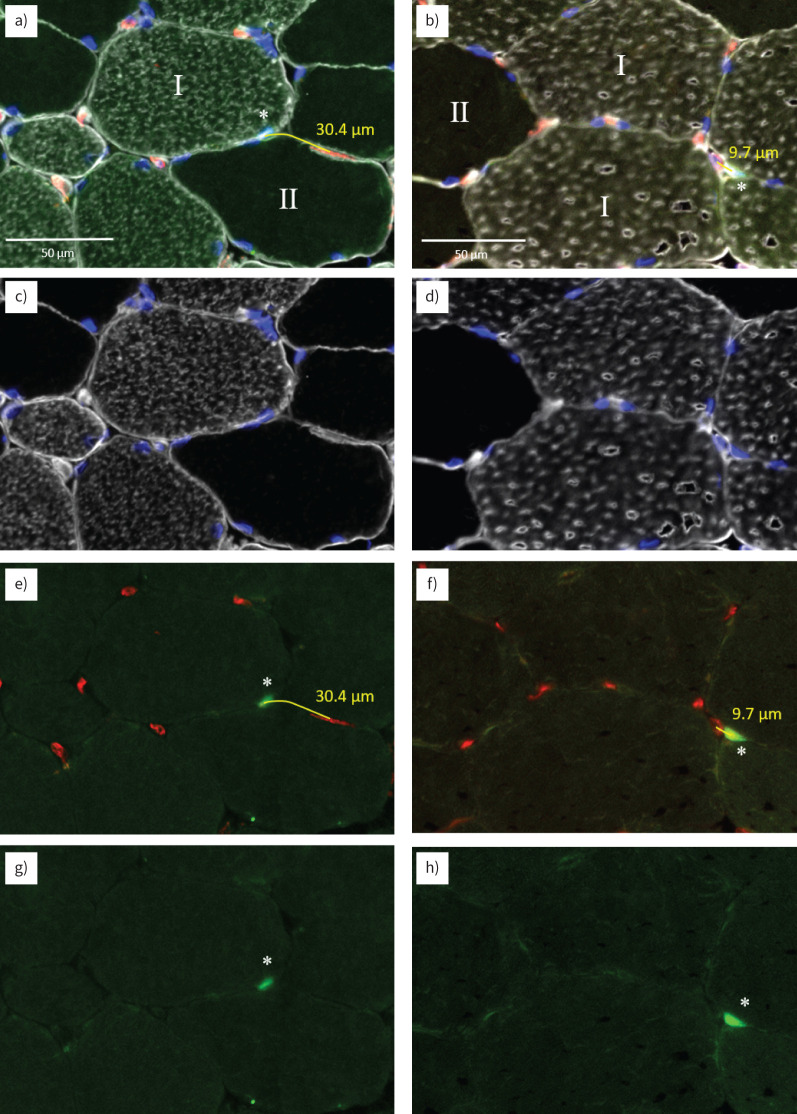
Muscle biopsies were obtained from the of n=18 patients with COPD (8 female, 10 male; age 66±5 years, mild-to-severe airflow obstruction) and n=18 age-, sex- and body mass index-matched healthy control adults (8 female, 10 male; age 68±5 years). Immunohistochemistry was used to assess type I/II muscle fibre size, distribution, myonuclear content, satellite cell number and fibre capillarisation. In addition, type I/II muscle fibre satellite cell distance to its nearest capillary was assessed.
The percentage of type II muscle fibres was significantly greater in patients with COPD (62±10%) compared with controls (50±12%, p<0.05). Muscle fibre capillarisation was significantly lower in patients with COPD compared with controls (p<0.05). While satellite cell content was not different between groups, type I and type II satellite cell distance to its nearest capillary was significantly greater in patients with COPD (type I: 21.3±4.8 µm; type II: 26.7±9.3 µm) compared with controls (type I: 16.1±3.5 µm; type II: 22.7±5.8 µm; p<0.05).
Satellite cells are located at a greater distance from their nearest capillary in patients with COPD compared with age-matched controls. This increased distance could play a role in impaired satellite cell function in patients with COPD.
慢性阻塞性肺疾病(COPD)是一种以骨骼肌功能障碍为特征的疾病。卫星细胞与肌纤维毛细血管之间存在空间关系,这被认为对卫星细胞功能至关重要。在本研究中,我们比较了COPD患者与年龄匹配的健康老年人中卫星细胞与毛细血管之间的空间关系。
从n = 18例COPD患者(8例女性,10例男性;年龄66±5岁,轻度至重度气流阻塞)和n = 18例年龄、性别和体重指数匹配的健康对照成年人(8例女性,10例男性;年龄68±5岁)获取肌肉活检样本。采用免疫组织化学方法评估I/II型肌纤维大小、分布、肌核含量、卫星细胞数量和纤维毛细血管化。此外,评估I/II型肌纤维卫星细胞到其最近毛细血管的距离。
与对照组(50±12%)相比,COPD患者中II型肌纤维的百分比显著更高(62±10%,p<0.05)。与对照组相比,COPD患者的肌纤维毛细血管化显著更低(p<0.05)。虽然两组之间卫星细胞含量没有差异,但与对照组相比,COPD患者中I型和II型卫星细胞到其最近毛细血管的距离显著更大(I型:21.3±4.8 µm;II型:26.7±9.3 µm)(对照组:I型:16.1±3.5 µm;II型:22.7±5.8 µm;p<0.05)。
与年龄匹配的对照组相比,COPD患者的卫星细胞距离其最近的毛细血管更远。这种距离增加可能在COPD患者卫星细胞功能受损中起作用。